
What Are Revenue Codes in Medical Billing?
Revenue codes are special three digit numbers. These numbers tell insurance companies what service your practice provided to the patient. Every service in hospital or practice has its own revenue code. When you send a claim to insurance, you must include the correct revenue code. Without a revenue code, insurance will not pay you.
Think of revenue codes like product codes in a store. When you buy something, the cashier scans the product code. The software knows the price immediately. Revenue codes work the same way in medical billing. The insurance company sees the revenue code and knows exactly what service you provided.
Revenue codes appear on UB-04 claim forms. UB-04 is the standard claim form for hospitals and practices. The revenue code goes in Box 42 of the UB-04 form. You must put the correct code in this box. If you put in the wrong code, the insurance company will reject your claim or delay your payment.
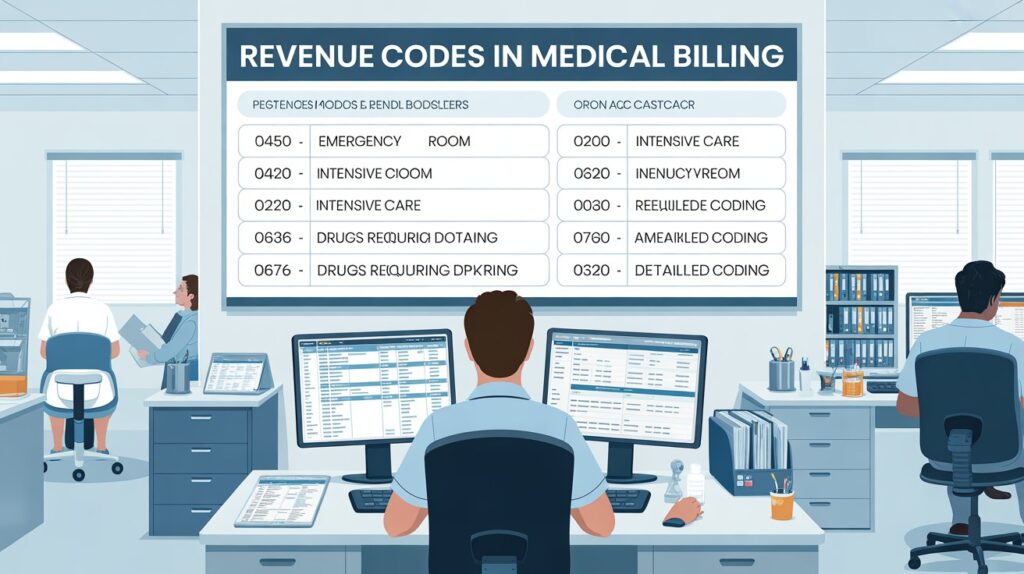
Why Revenue Codes Are Different from CPT Codes
Many people confuse revenue codes with CPT codes. But they are very different. CPT codes describe the specific medical procedure. CPT codes are five digits with numbers and letters. Revenue codes describe the department or service area. Revenue codes are only three digits with only numbers.
For example, CPT code 99213 means office visit for established patients. But revenue code 0510 means general practice. You use both codes together on the same claim. The revenue code tells WHERE the service happened. The CPT code tells WHAT service happened.
Who Uses Revenue Codes?
Not everyone uses revenue codes. Only institutional providers use revenue codes. Institutional providers include hospitals, skilled nursing facilities, home health agencies, and hospice centers. Individual doctors in small offices do not use revenue codes. They use CMS-1500 form instead of UB-04 form.
But if you work in medical billing for any practice that admits patients overnight, you will use revenue codes every day. If your practice has an emergency department, surgery department, or radiology department, you will use revenue codes. Learning revenue codes is necessary for your career success.
The History and Purpose of Revenue Codes
Revenue codes started in the 1980s. Before revenue codes, billing was very confusing. Every hospital used different codes. Insurance companies could not understand the bills. Processing claims took many months. Hospitals lost millions of dollars waiting for payments.
The government created revenue codes to solve this problem. They wanted one standard system for all hospitals and practices. They created the UB-04 form with revenue code boxes. Now every hospital and practice uses the same codes. Insurance companies can process claims much faster. Everyone benefits from this standardized system.
The Centers for Medicare and Medicaid Services (CMS) manages revenue codes today. CMS updates the codes every year. They add new codes for new services. They delete old codes that are no longer used. As a medical biller, you must stay updated with these changes. Using outdated revenue codes will cause claim rejections.
How Revenue Codes Are Structured
Revenue codes follow a simple structure. Every revenue code has exactly three digits. The first digit shows the major category. The second and third digits show the specific service within that category.
Let me explain with examples. All revenue codes starting with 0 are accommodation codes. Code 0100 to 0219 are room and board charges. Code 0300 to 0329 are laboratory services. Code 0400 to 0449 are radiology services. When you see the revenue code starting with 0, you know it is a standard hospital service.
The second and third digits give more specific information. For example, code 0110 means room and board private room. Code 0111 means room and board private room for medical/surgical care. Code 0112 means room and board private room for obstetric care. The structure helps you understand the code even if you have never seen it before.
Understanding Revenue Code Categories
Revenue codes are divided into major categories. Understanding these categories makes learning codes much easier. Here are the main categories you will use most often:
0100-0219: Room and board services 0300-0329: Laboratory services
0400-0449: Radiology services 0500-0599: Medical/surgical supplies and devices 0600-0729:
Therapy services 0800-0899: Inpatient renal dialysis
Each category has many specific codes inside it. You do not need to memorize every code. But you must know which category to look in when you need a code. Keep a revenue code reference guide at your desk. Check it whenever you are unsure about a code.
Most Common Revenue Codes Used in Medical Billing
Some revenue codes appear on almost every claim. Other codes are very rare. Smart medical billers memorize the most common codes. This saves time and reduces errors. Here are the revenue codes you will use most frequently in your daily work.
| Revenue Code | Description | When to Use |
| 0100 | All-inclusive room and board | Patient stays overnight in hospital |
| 0110 | Room and board – private room | Patient in private single room |
| 0120 | Room and board – semi-private | Patient in room with 2 beds |
| 0150 | Room and board – intensive care | Patient in ICU or critical care |
| 0200 | Intensive care unit | ICU services and monitoring |
These five codes handle most room and board situations. Every medical biller must know these codes perfectly. Practice using them until they become automatic.
Emergency and Outpatient Revenue Codes
Emergency departments and outpatient services use different revenue codes. These are also very common in medical billing. You will use these codes many times every week.
| Revenue Code | Description | When to Use |
| 0450 | Emergency room – general | Standard emergency room visit |
| 0451 | Emergency room – urgent care | Less serious emergency cases |
| 0456 | Emergency room – urgent care | Alternative code for urgent care |
| 0510 | Practice – general | General practice services |
| 0636 | Drugs requiring specific coding | Special medications |
Emergency room codes are critical. Using the wrong emergency code can reduce your payment significantly. Always verify the level of emergency service before selecting the code. Check the medical documentation carefully.
Revenue Codes for Diagnostic and Therapeutic Services
Diagnostic services help doctors find what is wrong with patients. Therapeutic services help treat the patient. Both types of services have their own revenue codes. Understanding the difference is very important for correct billing.
Laboratory Revenue Codes
Laboratory tests are very common in medical billing. Blood tests, urine tests, culture tests all need laboratory revenue codes. Here are the main laboratory codes:
0300: Laboratory – general classification 0301: Laboratory – chemistry 0302: Laboratory – immunology 0303: Laboratory – renal patient (home) 0304: Laboratory – non-routine dialysis 0305: Laboratory – hematology 0306: Laboratory – bacteriology and microbiology
Most laboratory services use code 0300 or 0301. Use more specific codes when the laboratory test falls into a special category. Always check with your laboratory department if you are unsure which code to use. Wrong laboratory codes cause many claim rejections.
Radiology and Imaging Revenue Codes
Radiology services include X-rays, CT scans, MRI scans, and ultrasounds. These services are expensive. Using correct revenue codes confirms you get paid the right amount.
0400: Radiology – diagnostic 0401: Radiology – diagnostic – general 0402: Radiology – diagnostic – angiocardiography 0403: Radiology – diagnostic – arthrography 0404: Radiology – diagnostic – chest X-ray 0320: Radiology – diagnostic – mammography 0610: MRI – magnetic resonance imaging 0611: MRI – brain and brainstem 0612: MRI – spinal cord and spine
Radiology codes can be confusing because many different codes exist. The key is to match the specific type of imaging performed. Read the radiology report carefully. The type of imaging is usually stated clearly in the first line of the report.
Revenue Codes for Pharmacy and Medical Supplies
Pharmacy and medical supplies represent huge costs for hospitals and practices. Correct revenue codes help practices get reimbursed for these expensive items. Missing or wrong supply codes lose thousands of dollars every month.
Pharmacy Revenue Codes
Pharmacy codes cover all medications given to patients during their stay. Different codes exist for different types of medications.
| Revenue Code | Description | Usage Examples |
| 0250 | Pharmacy – general | Standard medications |
| 0251 | Pharmacy – generic drugs | Non-brand name medications |
| 0252 | Pharmacy – non-generic drugs | Brand name medications |
| 0254 | Pharmacy – drugs incident to other services | Drugs given during procedure |
| 0255 | Pharmacy – drugs incident to radiology | Contrast dye and imaging drugs |
Always document the specific medication name and dosage in the medical record. Insurance companies audit pharmacy charges frequently. They want to verify that expensive medications were really given to the patient. Good documentation protects your practice from audits.
Medical and Surgical Supply Codes
Medical supplies include bandages, syringes, catheters, and surgical equipment. These items add up quickly. Proper coding confirms reimbursement.
0270: Medical/surgical supplies – general 0271: Medical/surgical supplies – non-sterile 0272: Medical/surgical supplies – sterile 0275: Medical/surgical supplies – pacemaker 0276: Medical/surgical supplies – intraocular lens 0278: Medical/surgical supplies – other implants
The most important rule for supply codes: document everything. Write down every supply item used. Include the quantity and cost. Insurance companies will not pay for supplies without proper documentation. Train your practice staff to document supplies in real-time during patient care.
Revenue Codes for Therapy Services
Therapy services help patients recover and rehabilitate. Physical therapy, occupational therapy, and speech therapy all have specific revenue codes. These services are very common in rehabilitation practices and skilled nursing facilities.
Physical Therapy Revenue Codes
Physical therapy helps patients regain movement and strength. Physical therapists work with patients after surgery, injury, or illness.
0420: Physical therapy – general 0421: Physical therapy – visit charge 0422: Physical therapy – hourly charge 0423: Physical therapy – group rate 0424: Physical therapy – evaluation or re-evaluation
Code 0420 is the most common physical therapy code. Use it for most physical therapy services. Use code 0424 when the physical therapist performs an initial evaluation of a new patient. Some insurance companies pay differently for evaluation visits versus treatment visits.
Occupational and Speech Therapy Revenue Codes
Occupational therapy helps patients perform daily activities. Speech therapy helps patients with speaking, swallowing, and communication.
0430: Occupational therapy – general 0431: Occupational therapy – visit charge 0432: Occupational therapy – hourly charge 0433: Occupational therapy – group rate 0434: Occupational therapy – evaluation or re-evaluation
0440: Speech therapy – general 0441: Speech therapy – visit charge 0442: Speech therapy – hourly charge 0443: Speech therapy – group rate 0444: Speech therapy – evaluation or re-evaluation
Notice the pattern in therapy codes. The structure is the same for all three therapy types. Code ending in 0 is general. Code ending in 1 is visit charge. Code ending in 2 is an hourly charge. Learning this pattern makes remembering codes much easier.
Revenue Codes for Operating Room and Surgery
Operating room services are among the most expensive hospital services. Correct revenue codes confirm maximum reimbursement for surgical procedures. One mistake in operating room billing can cost your practice thousands of dollars on a single claim.
Operating Room Revenue Codes
| Revenue Code | Description | When to Use |
| 0360 | Operating room services – general | Standard surgical procedures |
| 0361 | Operating room – minor surgery | Simple outpatient procedures |
| 0362 | Operating room – organ transplant | Transplant surgeries |
| 0367 | Operating room – kidney transplant | Kidney transplant specifically |
| 0369 | Operating room – other | Other surgical services |
Operating room billing is complicated. You must use operating room revenue code along with CPT procedure codes. You must also bill for anesthesia, surgical supplies, and recovery room separately. Each item needs its own line on the UB-04 form with correct revenue code.
Recovery Room and Post-Surgery Revenue Codes
After surgery, patients go to the recovery room. The recovery room has its own revenue codes separate from the operating room.
0370: Anesthesia – general 0371: Anesthesia – incident to radiology 0372: Anesthesia – incident to other services 0710: Recovery room – general 0719: Recovery room – other
Always bill the recovery room separately from the operating room. Insurance companies expect to see both charges on surgical claims. Missing a recovery room charge is a red flag that may trigger audit of your entire claim.
Revenue Codes for Cardiac and Respiratory Services
Heart and lung services require specialized equipment and staff. These services have their own revenue code categories. Practices with cardiac care units or respiratory therapy departments must master these codes.
Cardiac Services Revenue Codes
Cardiac services include heart monitoring, stress tests, echocardiograms, and cardiac catheterization.
0480: Cardiology – general 0481: Cardiology – cardiac catheterization lab 0482: Cardiology – stress test 0483: Cardiology – echocardiography 0489: Cardiology – other
Cardiac procedures are often very expensive. Insurance companies scrutinize cardiac claims carefully. Make sure your medical documentation supports the revenue code you use. The cardiologist’s report should clearly describe the procedure performed. Match your revenue code to the documented procedure.
Respiratory Services Revenue Codes
Respiratory services help patients breathe better. These services include oxygen therapy, breathing treatments, and ventilator support.
0410: Respiratory services – general 0412: Respiratory services – inhalation services 0413: Respiratory services – hyperbaric oxygen therapy 0414: Respiratory services – ventilator support 0419: Respiratory services – other
Ventilator support (code 0414) is especially important for critical care billing. Patients on ventilators need intensive monitoring. This service justifies higher room and board charges. Always use code 0414 when a patient requires mechanical ventilation.
Revenue Codes for Behavioral Health and Substance Abuse
Mental health and substance abuse services have special revenue codes. These services are growing rapidly. More practices offer behavioral health services every year. Understanding these codes opens new billing opportunities.
Psychiatric and Psychological Revenue Codes
0900: Psychiatric services – general 0901: Psychiatric services – electroshock treatment 0902: Psychiatric services – milieu therapy 0903: Psychiatric services – play therapy 0904: Psychiatric services – activity therapy 0911: Psychiatric services – rehabilitation 0912: Psychiatric services – partial hospitalization 0913: Psychiatric services – psychological services 0914: Psychiatric services – psychological testing
Code 0912 for partial hospitalization is very important. Partial hospitalization programs (PHP) provide intensive treatment while patients live at home. This is the middle ground between inpatient and outpatient care. Many insurance companies cover PHP services. Using the correct revenue code confirms payment.
Substance Abuse Treatment Revenue Codes
Substance abuse treatment helps patients overcome addiction to drugs or alcohol. These services are covered by most insurance plans under mental health benefits.
1000: Substance abuse – general 1001: Substance abuse – alcohol abuse 1002: Substance abuse – drug abuse 1003: Substance abuse – detoxification 1004: Substance abuse – rehabilitation 1005: Substance abuse – partial hospitalization
Detoxification (code 1003) requires medical supervision. Patients withdraw from addictive substances under doctor care. This is different from rehabilitation (code 1004) which focuses on therapy and counseling. Use the correct code based on the type of service provided.
Revenue Codes for Observation and Outpatient Services
Observation status is a special category between inpatient and outpatient. The patient stays in the hospital bed but is not officially admitted. Observation billing uses specific revenue codes. Many practices struggle with observation billing because the rules are complicated.
Observation Revenue Codes
| Revenue Code | Description | When to Use |
| 0760 | Treatment or observation room – general | Observation services |
| 0761 | Treatment or observation room – treatment room | Outpatient treatment area |
| 0762 | Treatment or observation room – observation room | Specific observation unit |
| 0769 | Treatment or observation room – other | Other treatment areas |
Observation billing rules are strict. Patients must meet medical necessity criteria for observation. The doctor must document the reason for observation in the medical record. Observation typically lasts less than 48 hours. If a patient stays longer, they should be converted to inpatient admission with different revenue codes.
Same-Day Surgery Revenue Codes
Same-day surgery means the patient has surgery and goes home the same day. No overnight stay. These procedures use different revenue codes than inpatient surgery.
0490: Ambulatory surgical care – general 0499: Ambulatory surgical care – other 0750:
Gastrointestinal services – general 0790: Lithotripsy services
Many surgeries are now same-day procedures. Gallbladder removal, hernia repair, and colonoscopy procedures often happen same-day. Using correct revenue codes for same-day surgery confirms proper payment. Do not use inpatient room and board codes for same-day patients.
How to Choose the Correct Revenue Code
Choosing the correct revenue code requires careful review of medical documentation. Follow these steps every time you code a claim. These steps will prevent most coding errors.
Step 1: Read the entire medical record. Do not rush. Understand what happened to the patient. What services did they receive? Where did the services happen? What departments were involved?
Step 2: Identify the main service or department. Is this a laboratory service? Radiology service? Pharmacy charge? Surgery? The main service determines which revenue code category to use.
Step 3: Look up the revenue code category. Use your revenue code reference guide. Find the correct three-digit code category. For example, if the service is radiology, look at the 0400 series.
Step 4: Choose the most specific code available. Do not use general code if more specific code exists. For example, use 0404 for chest X-ray instead of 0400 general radiology.
Step 5: Verify the code matches the CPT code. The revenue code and CPT code must make sense together. They should describe the same type of service. If they conflict, check your codes again.
Step 6: Check insurance-specific requirements. Some insurance companies have special rules about revenue codes. Medicare has different rules than private insurance. Know your payer requirements.
Common Revenue Code Selection Mistakes
Even experienced billers make revenue code mistakes. Here are the most common errors and how to avoid them.
Mistake 1: Using 0001 general code for everything. Code 0001 is too general. Insurance companies may reject claims with only general codes. Always use the most specific code available.
Mistake 2: Mixing inpatient and outpatient codes. Inpatient stays use accommodation codes (0100-0219). Outpatient visits use different codes. Never mix these on the same claim.
Mistake 3: Forgetting to code ancillary services. The main procedure needs revenue code. But so do laboratory tests, X-rays, medications, and supplies used during procedure. Each item needs a separate line with the correct revenue code.
Mistake 4: Using outdated revenue codes. CMS updates revenue codes every year. Old codes become invalid. Using invalid code causes automatic claim rejection. Update your coding manuals annually.
Mistake 5: Not matching revenue code to place of service. Revenue codes tell WHERE service happened. Make sure your revenue code matches the actual location. Do not use emergency room code for services provided in the radiology department.
Revenue Code Updates and Changes
Revenue codes change every year. CMS announces changes in late summer or fall. Changes take effect on January 1st of the following year. As a medical biller, you must stay current with these changes. Using outdated codes after January 1st will cause all your claims to be rejected.
How to Stay Updated with Revenue Code Changes
Subscribe to CMS updates. CMS sends email notifications about coding changes. Sign up for these emails on the CMS website. Read every notification carefully.
Attend annual coding training. Most hospitals and practices provide coding updates training in December. Attend these sessions. Take notes. Ask questions about anything you do not understand.
Update your coding software. If your practice uses billing software, the vendor should provide annual updates. Install updates before January 1st. Test the new codes to make sure they work correctly.
Replace printed reference materials. If you use printed code books, buy new editions every year. Do not try to save money by using old books. Outdated reference materials cost more in rejected claims than new books cost.
Join professional associations. Organizations like AAPC (American Academy of Professional Coders) and AHIMA (American Health Information Management Association) provide coding education. Members receive regular updates about coding changes.
Recent Revenue Code Changes
In the past few years, several important revenue code changes have occurred. New codes were added for telehealth services. Codes were updated for new medical technologies. Some old codes were deleted because those services are no longer provided.
For example, revenue code 0780 was added for extracorporeal shock wave therapy. Code 0771 was added for non-OR procedure room services. These codes did not exist five years ago. New medical treatments require new billing codes.
Also, CMS clarified guidance on observation billing. The rules for using observation revenue codes became more specific. Practices that did not follow the new rules had many claims rejected. This shows why staying updated is so important.
Revenue Codes and Insurance Claim Denials
Wrong revenue codes cause thousands of claim denials every day. Understanding common denial reasons helps you prevent denials before they happen. Every denied claim delays your payment and creates extra work.
Top Revenue Code Denial Reasons
Invalid revenue code: You used code that does not exist or is outdated. Solution: Verify all codes in current year coding manual before submitting claim.
Revenue code does not match procedure code: Your CPT code and revenue code describe different types of services. Solution: Review both codes together to confirm they make sense as a pair.
Revenue code not covered for this patient type: Some revenue codes only apply to inpatients or only to outpatients. Solution: Verify patient status before selecting revenue code.
Revenue code requires additional documentation: Insurance wants to see medical records before paying. Solution: Submit medical records with initial claim for high-risk revenue codes.
Revenue code bundled into another service: Insurance says the service is included in another charge and will not pay separately. Solution: Check payer bundling policies before billing separately.
How to Appeal Revenue Code Denials
When insurance denies a claim due to a revenue code issue, you can appeal. Appeals often succeed if you provide correct information. Follow these appeal steps:
Step 1: Read the denial letter carefully. Understand exactly why insurance denied the claim. What was wrong with the revenue code?
Step 2: Review the medical documentation. Was the service really provided? Is it documented clearly in medical records?
Step 3: Verify the revenue code is correct. Look up the code again in your reference materials. Is it the right code for the service provided?
Step 4: Write an appeal letter explaining the situation. Be polite and professional. Provide facts. Reference the medical record. Explain why the revenue code is correct.
Step 5: Include supporting documentation. Attach copies of medical records, coding guidelines, and any other evidence that supports your case.
Step 6: Submit appeal within deadline. Most insurance companies require appeals within 60-90 days of denial. Missing a deadline means you cannot appeal.
Step 7: Follow up on appeal status. Call the insurance company after two weeks to check on the appeal. Ask for a reference number and expected decision date.
Revenue Codes and Medicare Guidelines
Medicare has special rules about revenue codes. These rules are very strict. Medicare is the largest payer for most hospitals and practices. Understanding Medicare revenue code requirements is necessary for successful billing.
Medicare-Specific Revenue Code Requirements
Medicare publishes detailed instructions in the Medicare Claims Processing Manual. Chapter 25 covers revenue codes specifically. Every medical biller should read this chapter at least once.
Here are key Medicare revenue code rules:
Rule 1: Required revenue codes. Medicare requires revenue codes on all UB-04 claims. You cannot submit UB-04 claims to Medicare without revenue codes. Missing revenue codes cause automatic rejection.
Rule 2: Revenue code 0001 restrictions. Medicare generally does not allow revenue code 0001 (total charges) except in specific situations. Use specific revenue codes instead of 0001 whenever possible.
Rule 3: HCPCS code requirements. Medicare requires HCPCS codes with certain revenue codes. For example, revenue code 0636 (drugs) must have HCPCS code showing specific drugs given to patients.
Rule 4: Revenue code date requirements. Medicare looks at revenue code and date of service together. Some revenue codes cannot be used on the same day as other codes. Check Medicare guidelines for date restrictions.
Rule 5: Observation billing rules. Medicare has very specific rules for observation revenue codes. Patients must meet medical necessity criteria. Services must be reasonable and necessary. Doctors must document why observation was needed instead of inpatient admission or outpatient visit.
Medicare Revenue Code Edits
Medicare uses automated computer edits to check revenue codes. These edits reject claims instantly if codes do not meet Medicare requirements. Common Medicare edits include:
OCE (Outpatient Code Editor): Checks outpatient claims for coding errors. OCE reviews revenue codes, CPT codes, and HCPCS codes together. OCE will reject claims if codes are inconsistent.
MUE (Medically Unlikely Edit): Limits how many times you can bill certain revenue codes on the same day. For example, MUE might limit emergency room revenue code to one unit per day per patient.
NCCI (National Correct Coding Initiative): Bundles certain services together. If two services are bundled, you cannot bill both with separate revenue codes on the same day.
Understanding these edits helps you avoid Medicare rejections. Before submitting a claim to Medicare, think about whether your revenue codes will pass automated edits. If you are unsure, check Medicare guidelines or ask your supervisor.
Best Practices for Revenue Code Management
Successful medical billing practices follow strict standards for revenue code management. These best practices reduce errors, speed up payments, and maximize revenue. Implement these practices in your practice starting today.
Create Standard Operating Procedures
Write down exactly how your practice selects revenue codes. Create step-by-step instructions. Include examples. Train all billing staff using the same procedures. When everyone follows the same process, you get consistent results.
Your revenue code procedures should cover:
- Where to find revenue codes in medical documentation
- How to handle unclear or incomplete documentation
- What to do when multiple revenue codes could apply
- How to verify revenue codes before claim submission
- Who to contact with revenue code questions
Implement Regular Coding Audits
Audit your revenue code usage regularly. Random sample of claims each month. Check if revenue codes are correct. Calculate your accuracy rate. Set a goal of 95% or higher accuracy. If accuracy drops below 95%, provide additional training to staff.
During audits, track these metrics:
- How many claims have incorrect revenue codes
- Which revenue codes have most errors
- Which staff members need additional training
- What types of services cause most coding confusion
- How much money is lost due to revenue code errors
Maintain Updated Reference Materials
Keep current revenue code manuals at every billing workstation. Replace manuals every January with new editions. Also maintain online access to CMS revenue code information. Train staff to check references whenever unsure about code.
Your reference material library should include:
- Current year UB-04 manual with revenue code definitions
- CMS Medicare Claims Processing Manual Chapter 25
- Your state Medicaid revenue code guidelines
- Major commercial payer revenue code policies
- Internal practice revenue code policies and procedures
Technology and Revenue Code Automation
Modern billing software helps automate revenue code selection. Softwares can suggest appropriate revenue codes based on CPT codes and medical documentation. However, automation is not perfect. Human review is still necessary.
Benefits of Revenue Code Software
Speed: Software selects codes much faster than manual lookup. You can process more claims per hour.
Consistency: Software applies the same logic to every claim. No variation between different billing staff.
Updates: Software vendors provide automatic updates when revenue codes change. No need to manually update code tables.
Edit checking: Software checks for common errors before claim submission. Catches mistakes that humans might miss.
Reporting: Software tracks which revenue codes are used most often. Helps identify training needs and audit priorities.
Limitations of Revenue Code Software
Software is a helpful tool but not a replacement for human expertise. Softwares make mistakes. Software cannot read medical documentation like humans can. Software does not understand complicated clinical situations.
Common software problems include:
- Suggesting outdated revenue codes not yet removed from database
- Missing new revenue codes recently added by CMS
- Incorrectly bundling services that should be billed separately
- Not accounting for insurance-specific revenue code requirements
- Selecting general codes when specific codes are more appropriate
Always review software suggestions before submitting a claim. Verifying the suggested revenue code makes sense for the documented service. Use your professional judgment. If a software suggestion seems wrong, look up the correct code manually.
Future of Revenue Codes in Healthcare
Healthcare billing continues to evolve. Revenue codes will remain an important part of billing for many years. However, the way we use revenue codes is changing. New technologies and payment models affect revenue code usage.
Impact of Value-Based Care on Revenue Codes
Healthcare is shifting from fee-for-service to value-based care. In value-based care, providers are paid for patient outcomes rather than individual services. This changes how revenue codes are used.
Under value-based contracts, you might bill one bundled payment for the entire episode of care. Traditional revenue codes still apply, but they function differently. Revenue codes track services provided but do not determine payment amount. Payment is based on overall care quality and patient satisfaction.
Practice must still code accurately under value-based care. Insurance companies use revenue code data to analyze cost patterns and utilization. Incorrect coding affects quality metrics and risk adjustment calculations.
Artificial Intelligence and Revenue Code Selection
Artificial intelligence (AI) is beginning to assist with medical coding. AI programs read medical documentation and suggest appropriate revenue codes. These programs learn from past coding decisions and improve over time.
AI shows promise for improving coding accuracy and speed. However, AI cannot fully replace human coders yet. Medical documentation is complicated. Clinical judgment is required. Human review of AI suggestions will be necessary for the future.
As AI technology improves, it will handle more routine revenue code selection. This frees human coders to focus on complicated cases requiring expertise. The most successful billers will learn to work alongside AI tools rather than being replaced by them.
Electronic Health Records Integration
Electronic health records (EHR) are improving revenue code automation. Modern EHR systems capture clinical information and automatically suggest billing codes. When a doctor documents patient care in EHR, the system recommends appropriate revenue codes based on documentation.
This integration reduces errors from manual code lookup. It speeds up the billing process. Charges are captured in real-time as services are provided. Nothing is forgotten or missed.
However, EHR integration requires careful setup. Revenue code crosswalks must be built correctly. Clinical staff must document services accurately. Billing staff must review
EHR-generated codes before claim submission. Technology helps but cannot replace human oversight.
Revenue codes control your Revenue Cycle
This is the simple truth. Good codes bring money fast. Bad codes lose money. Every claim you send has revenue codes in it. Each code is a chance to win or lose. Rich practices and poor practices are different because of one thing: how good their revenue codes are. Money must come in or practice dies.
Insurance companies are strict. Very strict. They use softwares to check claims in a few seconds. They do not care why you made a mistake. They only want correct codes on correct forms. One mistake in the revenue code causes rejection right away. Many mistakes cause big audits. Audits mean you must return money. Returning money creates a crisis. All this happens because of small coding mistakes that you could avoid.
Good news also exists. Practices that know revenue codes very well always win. Their claims never have problems. Money comes to them on time. They always have enough cash. Workers are happy because rejections are rare. Insurance companies like working with them. They grow and become successful while others fail. Success is not about luck. Not about where practice is located. Not about how many patients come. Success is about perfect revenue codes every day.
All insurance companies demand perfect codes. They change rules many times every year. New codes are added. Old codes are deleted. Billing rules change. Payment rules change. If your practice does not learn these changes, you lose money fast. Staying updated is not optional. It is required. Your practice must keep learning to survive.