
Medical billing is the process that makes sure doctors, clinics, and hospitals get paid for the services they provide. It starts when a patient visits a medical practice and ends when the insurance company or patient pays the bill. Have you ever wondered why a clinic asks for your insurance card and personal information every time you visit? That is the first step in medical billing. There is a lot happening behind the scenes even though it looks simple.
When a patient comes to a clinic, several things happen quickly. First, the patient registers at the front desk. The office collects personal details, contact information, and insurance information. Then the doctor examines the patient, performs tests, prescribes medicines, or recommends procedures. After the visit, every service is recorded in the patient’s medical record. The next step is medical coding. Services are turned into codes using ICD-10, CPT, and HCPCS . Why do codes matter so much? These codes tell the insurance company exactly what service was done, when, and why. Correct codes help the clinic get paid and reduce claim problems.
Medical billing connects the patient, the medical practice, and the insurance company. Without it, payments could be slow or lost. When a claim is sent to insurance, they review it carefully. Sometimes they approve it fast, sometimes they ask for more information, and sometimes they deny it. Denials can happen for missing information, wrong codes, or insurance rules. What happens if a claim is denied? The billing team checks the claim, fixes errors, and sends it again.
People working in medical billing do many important tasks. They check if a patient’s insurance is active, verify benefits, code services, submit claims, post payments, handle rejections, and prepare statements for patients. They make sure the clinic gets paid so doctors and staff can focus on patients. Have you ever thought about what happens after you pay your copay? That money goes through the billing system and matches with insurance payments.
Medical billing also follows strict rules. HIPAA protects patient privacy and medical information. Mistakes can cause audits, fines, or payment delays. That is why clinics train staff and use software to make billing correct and fast. Isn’t it surprising how much work happens before you even see a bill?
Technology is important in medical billing. Most claims are sent electronically using billing software. The software checks for missing information and proper codes. This step, called claim scrubbing, reduces mistakes. Many clinics use automatic systems to track unpaid claims, patient balances, and denials. Advanced systems can predict which claims might be denied. Wouldn’t it be easier if all bills were paid on time? Technology helps make that happen.
Billing also helps clinics track their money. By watching claim submission speed, denial rates, and accounts receivable, a clinic knows how well it is doing. Key performance indicators (KPIs) like days in accounts receivable and clean claim rate help staff improve processes, train employees, and send correct patient statements. Why is tracking money so important in a medical practice? Without good billing, even the best doctors cannot keep the clinic running.
Medical billing makes sure doctors, nurses, and staff are paid, patients are billed correctly, and insurance payments come on time. Even small mistakes, like a wrong date of birth or insurance number, can slow payments and cause confusion. Accuracy, patience, and attention to detail are very important. Have you ever thought that billing is as important as the care you get at the clinic? It keeps the clinic running smoothly so medical staff can focus on helping patients.
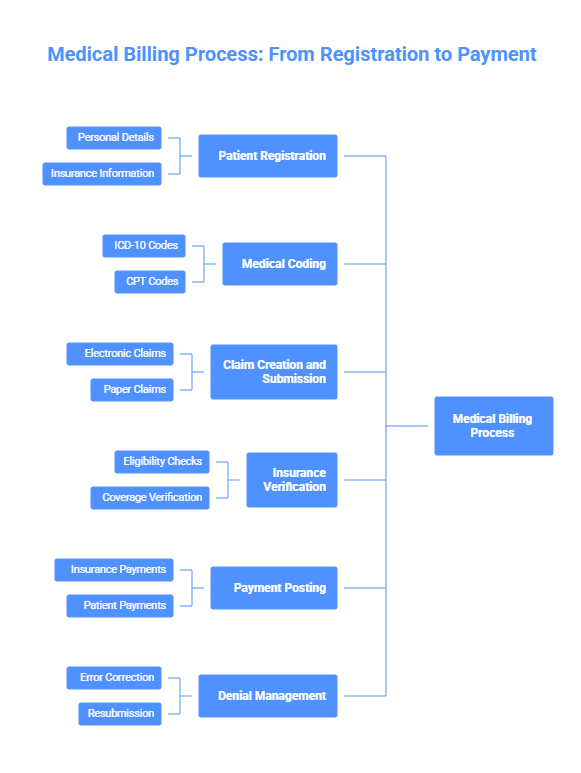
The Patient Registration Process
The patient registration process is the first step in medical billing. This step happens when a patient comes to a medical practice for the first time or for a new visit. It may seem simple, but it is very important. The registration process collects all the information the clinic needs to make sure the patient can get care and the practice can get paid. Have you ever filled out a long form at the doctor’s office and wondered why they need so much information? Every detail matters for billing, insurance, and patient safety.
When a patient registers, the staff collects personal details like name, address, phone number, and date of birth. They also ask for insurance information, including the insurance company, policy number, and group number. This information is checked carefully. If a mistake is made, the clinic may not get paid or the insurance may deny the claim. Why is a small detail like the date of birth so important? Because even a tiny mistake can delay payments or cause confusion.
Next, the staff verifies the patient’s insurance. Verification confirms that the patient’s insurance is active and covers the services they need. It also checks for copays, deductibles, and any limits on coverage. How does the clinic know if the insurance will pay? Verification is the answer. Staff can call the insurance company, check online portals, or use software tools. If insurance coverage is not active, the clinic may ask the patient to pay upfront or schedule services differently.
During registration, clinics also collect consent forms and signatures. Patients may need to sign forms to allow the clinic to bill their insurance and to get treatment. They may also sign forms agreeing to privacy rules under HIPAA . Why do patients have to sign so many forms? These forms protect both the patient and the clinic and make sure all rules are followed.
Medical practices often use electronic systems for registration. Electronic registration is faster and reduces errors. Data entered is stored securely and used later for billing and coding. Some clinics allow online pre-registration, which saves time at the front desk.
Wouldn’t it be easier to fill out forms at home before your visit? Online pre-registration is becoming common because it helps both patients and clinics.
Insurance eligibility checks are another key part of registration. Staff verify that the insurance plan covers the patient for the visit, treatment, or procedure. They also check for any special requirements, like referrals or prior authorizations. Have you ever been surprised that your insurance did not cover a test? This is why eligibility checks are done before the patient sees the doctor. It prevents delays and helps the clinic get paid.
Registration also includes demographic and medical information that helps coding and billing later. For example, the staff may ask about chronic conditions, previous procedures, or medications. This information helps use the correct codes for billing. Accurate coding depends on complete and correct registration information. Isn’t it interesting how early details affect billing later?
A smooth registration process saves time and prevents problems later. If a patient’s insurance is verified, and all forms are complete, the billing process moves faster. If registration is incomplete, the practice may face rejected or delayed claims. Many clinics train staff carefully to make registration accurate and fast. Why is a fast and correct registration so important? Because it keeps the clinic running smoothly and patients happy.
In some practices, registration staff also educate patients about their financial responsibilities. They explain copays, coinsurance, and what might not be covered by insurance. Have you ever been confused about what you have to pay at the clinic? Clear communication during registration helps patients understand their bills and reduces complaints later.
Medical practices use registration as the foundation for the entire billing cycle. Every step after registration, coding, claim submission, payment posting, depends on accurate registration information. Mistakes at this stage can slow the whole process. That is why registration staff are trained to double-check names, insurance IDs, dates of birth, and other critical details.
Good registration is like setting a strong foundation for a house. If the foundation is solid, everything else stands well. If the foundation is weak, the building may face problems. In the same way, a correct and complete registration process helps the medical practice get paid, allows claims to be approved, and keeps patients informed about their responsibilities. Wouldn’t you prefer that your first step at the clinic is done right so there are no headaches later?
Understanding Health Insurance in Medical Billing
Health insurance is one of the most important parts of medical billing. Without insurance, patients may have to pay the full cost of their medical care. Have you ever wondered why your bill is sometimes higher than expected? Understanding how insurance works helps both patients and medical practices.
Health insurance is a contract between a patient and an insurance company. The patient pays premiums, and in return, the insurance company helps pay for medical services. There are many types of insurance, and each works differently.
Types of Health Insurance
Medical billing depends on the type of insurance a patient has. Common types include:
- Private Insurance: Purchased by individuals or provided by employers.
- Medicare: Government insurance for people over 65 or with certain disabilities.
- Medicaid: Government insurance for people with low income.
- HMO (Health Maintenance Organization): Patients must use doctors and hospitals in the plan’s network.
- PPO (Preferred Provider Organization): Patients can see doctors outside the network but may pay more.
Why do different plans matter for billing? Each plan has its own rules about what it covers, how much it pays, and how claims are processed. Understanding the insurance type is the first step in medical billing.
How Insurance Affects Billing
Insurance affects billing in many ways. When a patient visits a medical practice, the billing staff must know:
- Whether the insurance covers the services.
- What portion the insurance will pay.
- What portion the patient must pay, like copays or deductibles.
Have you ever been asked to pay a copay even after insurance? That is common, and billing staff must calculate it correctly. Incorrect billing can lead to delays, complaints, or denied claims.
Insurance coverage also determines how claims are coded and submitted. Some insurance plans require pre-authorization for certain procedures. Others may need specific documentation before paying a claim. Wouldn’t it be easier if all insurance rules were the same? Unfortunately, every plan has different rules, and medical billing must follow them closely.
Key Terms in Health Insurance
Understanding insurance means knowing some key terms:
- Copay: A fixed amount the patient pays at the time of visit.
- Coinsurance: A percentage of the cost the patient pays after insurance.
- Deductible: The amount a patient must pay before insurance starts covering costs.
- Out-of-Pocket Maximum: The maximum amount a patient pays in a year.
- Pre-Authorization: Approval from the insurance company before certain services.
- Network: The group of doctors and hospitals that the insurance plan covers.
Why is it important to know these terms? Because mistakes in calculating these amounts can cause billing errors and delays in payment.
The Role of Insurance Verification
Before a patient sees a doctor, the billing staff verifies insurance eligibility. This is a critical step. Verification confirms:
- The insurance is active.
- The plan covers the needed service.
- Any pre-authorizations or referrals are completed.
- Copay and deductible amounts.
Bullet points help simplify:
- Verify patient demographics (name, date of birth, address).
- Check insurance plan type and coverage.
- Confirm pre-authorizations if needed.
- Record copay, coinsurance, and deductible amounts.
- Note any restrictions or limits on the service.
Have you ever been told your insurance does not cover a test? Proper verification prevents this problem and helps the medical practice get paid.
How Billing Staff Use Insurance Information
Billing staff use insurance information in several ways:
- Coding Claims Correctly: Insurance rules may affect which CPT or ICD-10 codes are used.
- Submitting Claims: Electronic or paper claims are sent to the insurance company.
- Calculating Patient Responsibility: Copay, deductible, or coinsurance amounts are added to the patient bill.
- Handling Denials: If a claim is denied, the staff review insurance rules and resubmit the claim.
Isn’t it interesting how insurance details affect every step in billing? Even small errors, like an incorrect group number, can delay payment.
Common Problems with Insurance in Medical Billing
Medical billing often faces challenges related to insurance. Some common problems include:
- Incorrect Information: Wrong insurance ID, date of birth, or policy number.
- Expired Coverage: Patient’s insurance is no longer active.
- Lack of Pre-Authorization: Insurance requires approval that was not obtained.
- Out-of-Network Claims: Services provided by a doctor not covered by the plan.
- Complex Rules: Some insurance plans have complicated rules for specific procedures.
What happens when a claim is denied? The billing team must carefully review the claim, contact the insurance company, and fix errors before resubmitting. This takes time and attention to detail.
Patient Education and Communication
Billing staff also educate patients about their insurance. They explain:
- What services are covered.
- Copays, coinsurance, and deductibles.
- Steps for pre-authorization.
- Any potential out-of-pocket costs.
Have you ever left the clinic confused about your bill? Clear communication during registration and billing helps patients understand their responsibilities and reduces complaints later.
Insurance affects almost every step in medical billing. From registration to coding, claim submission, and payment posting, insurance rules guide the process. Understanding insurance is critical for smooth operations, accurate billing, and timely payments.
Medical Coding: The Backbone of Billing
Medical coding is one of the most important steps in medical billing. It turns everything a doctor does during a patient visit into standardized codes. These codes are then used to submit claims to insurance companies. Have you ever wondered why every medical service has a number or code? That number is what tells the insurance company exactly what was done and how much the practice should be paid. Without accurate coding, the billing process can run into serious problems.
Coding is not random. There are strict rules and systems that must be followed. The most common coding systems are:
- ICD-10: International Classification of Diseases. These codes explain the patient’s diagnosis.
- CPT: Current Procedural Terminology. These codes describe the procedures or services provided.
- HCPCS: Healthcare Common Procedure Coding System. These codes cover supplies, equipment, and some additional services.
Why do these codes matter so much? Insurance companies use them to determine coverage and payment. If a code is wrong, the claim can be delayed, partially paid, or denied completely.
How Coding Works in Practice
After a patient visit, the medical provider documents everything in the medical record. This documentation includes:
- Symptoms reported by the patient.
- Examination findings.
- Tests ordered and results.
- Procedures performed.
- Medications prescribed.
Medical coders review this documentation and select the appropriate codes. They make sure every service is represented correctly, and that the codes match insurance rules. Have
you ever thought that a small missing detail in a note can cost a practice hundreds of dollars? That is why coders must pay close attention.
Common Challenges in Medical Coding
Medical coding can be tricky. Some common challenges include:
- Incomplete Documentation: If the doctor’s notes are unclear, coders may not know which code to use.
- Incorrect Codes: Using the wrong code can lead to denied claims.
- Updates and Changes: Coding systems are updated regularly, and coders must stay current.
- Multiple Codes for One Visit: A patient may have several diagnoses or procedures, each needing a separate code.
Isn’t it surprising how much detail goes into each code? Accurate coding requires training, experience, and attention to every word in the medical record.
The Role of Coders in the Billing Cycle
Medical coders are critical to the entire billing process. Their work helps make sure that:
- Claims are accurate.
- Insurance companies understand what services were provided.
- The practice gets paid correctly and on time.
Bullet points help summarize the coder’s responsibilities:
- Review the patient’s medical record.
- Identify diagnoses and procedures.
- Assign correct ICD-10, CPT, or HCPCS codes.
- Check for compliance with payer rules.
- Submit coding for claim creation.
Have you ever wondered who decides how much a medical procedure is worth? Coders play a major part because their codes determine the payment from insurance companies.
Coding Compliance and Regulations
Medical coding must follow strict rules. HIPAA and other federal regulations require that codes are accurate and documentation is complete. Practices can face audits, fines, or reduced payments if coding is not compliant. Coders also need to follow payer-specific rules, as different insurance companies may require slightly different coding practices.
Why is compliance so important? Because even small errors can delay payment and cause serious legal issues. Coders often attend ongoing training to stay updated on coding rules and insurance requirements.
Tools and Technology in Coding
Many medical practices use software to assist coders. Coding software can:
- Suggest appropriate codes based on documentation.
- Check for errors before submitting claims.
- Update automatically with new coding rules.
- Help track claims and denials for review.
Wouldn’t it be easier if the computer could do all the coding? Technology helps, but coders still need to make judgment calls based on the patient’s medical record. Software reduces errors, but human review is essential.
Best Practices for Accurate Coding
Accurate coding reduces denied claims, speeds up payment, and keeps the medical practice running smoothly. Best practices include:
- Double-check documentation before coding.
- Stay current with coding updates.
- Use software to catch potential mistakes.
- Review denied claims to learn what went wrong.
- Communicate with providers if documentation is unclear.
Isn’t it amazing how one small code can make such a big difference in billing? Coding may seem like a small step, but it affects the entire revenue cycle. A mistake at this stage can cause delays, extra work, and patient confusion.
The Impact of Coding on Revenue
Accurate coding directly affects the financial health of a medical practice. Proper codes help achieve:
- Faster insurance payment.
- Reduced claim denials.
- Accurate patient billing.
- Clear reporting and compliance records.
Every payment, every statement, and every claim depends on accurate coding. It is a small step with a huge impact.
Charge Capture: Recording Services Provided
Charge capture is the process of recording all services a doctor, nurse, or medical staff provides to a patient. It is a very important step in medical billing because what is captured becomes the basis for billing insurance and patients. Have you ever wondered how a clinic knows exactly what to charge for your visit? That is the role of charge capture. Without accurate charge capture, the medical practice may lose money or submit claims that get denied.
When a patient receives care, everything done must be recorded. This includes office visits, lab tests, imaging studies, procedures, and medications administered. Charge capture helps make sure that nothing is missed. Every service has a code that corresponds to insurance billing. Why is it important to record every service? Because even a small missed item, like a blood test, can result in lost revenue.
How Charge Capture Works
Charge capture can be done in several ways. Medical practices may use:
- Paper-based charge sheets: Staff write down each service during the visit.
- Electronic health records (EHRs): Services are documented in software and automatically transferred to billing.
- Mobile devices or tablets: Doctors or nurses enter services directly during or after the patient visit.
The main goal is to make sure every service is captured accurately and quickly. Have you ever noticed your doctor typing on a computer during your visit?That typing often helps charge capture to be done immediately and correctly.
Common Services Captured
Examples of services captured include:
- Office visits and consultations
- Laboratory tests, like blood work or urinalysis
- Imaging studies, such as X-rays, MRIs, or CT scans
- Procedures, including surgeries or minor treatments
- Immunizations and injections
- Medications administered in the clinic
Each service is linked to a CPT code or HCPCS code for billing purposes. This coding is critical for insurance claims. Wouldn’t it be frustrating if a simple injection was not recorded and never paid for? Accurate capture prevents that frustration.
Importance of Accuracy in Charge Capture
Accurate charge capture affects the entire billing cycle. Mistakes can lead to:
- Lost revenue: Missing services are never billed.
- Delayed payments: Claims may be rejected due to incomplete data.
- Patient confusion: Incorrect statements may be sent.
- Compliance issues: Billing for services not provided can lead to legal problems.
Isn’t it amazing how careful record-keeping keeps the practice running smoothly? Staff must pay close attention and double-check everything they record.
Technology and Charge Capture
Modern medical practices use technology to improve charge capture. EHR systems can automatically transfer data to billing software, reducing errors. Some systems also provide:
- Alerts for missing services
- Coding suggestions based on documentation
- Integration with labs, imaging centers, and pharmacies
Wouldn’t it be great if every charge was automatically correct? Technology helps, but human review is still necessary to catch errors or exceptions.
Best Practices for Charge Capture
Good charge capture requires consistency, accuracy, and communication. Best practices include:
- Record all services immediately after the visit.
- Use standardized codes and documentation.
- Review charts to confirm that no services are missed.
- Communicate between clinical and billing staff to resolve unclear entries.
- Train staff regularly on proper procedures.
Why do some clinics lose money even with many patients? Often it is because charge capture is not done correctly. Missing a few services per day can add up to a large financial loss over time.
Role in the Revenue Cycle
Charge capture is the link between patient care and billing. Once services are captured accurately, the next steps,coding, claim creation, and submission,can happen smoothly. Poor charge capture causes delays and errors downstream. It is like building a house: if the foundation is weak, everything else suffers. Would you trust a house built on shaky ground? The same applies to billing without accurate charge capture.
Challenges in Charge Capture
Some common challenges include:
- Forgetting to record minor services or supplies
- Miscommunication between doctors, nurses, and billing staff
- Complex procedures with multiple steps or codes
- Manual entry errors in paper-based systems
Bullet points summarize solutions:
- Use EHR or electronic systems to reduce manual errors
- Train staff to capture every service
- Perform daily or weekly audits to check for missing charges
- Maintain good communication between clinical and billing teams
Accurate charge capture helps the medical practice receive full payment for all services. It protects the clinic’s revenue and keeps patients’ bills accurate.
Claim Creation and Submission
Claim creation and submission is the step where all the patient’s visit details, services, and codes are turned into a document that is sent to the insurance company. This step is critical because it connects the medical practice to the payer. If claims are created incorrectly or submitted late, the medical practice may face delays or denials, which can affect revenue. What happens when a single number is wrong on a claim? That small error can stop payment in its tracks.
What a Medical Claim Includes
A medical claim is a structured document that provides all the details an insurance company needs to process payment. Key information includes:
- Patient demographic information (name, date of birth, address)
- Insurance details (policy number, group number, payer ID)
- Diagnosis codes (ICD-10)
- Procedure codes (CPT or HCPCS)
- Dates of service
- Provider information
- Charges for each service
Bullet points help visualize the process:
- Collect all patient data from registration
- Confirm codes from medical coding
- Assign charges for each service
- Verify insurance coverage and eligibility
- Create the claim in the billing system
Can a single missing detail cause a claim to bounce back? Yes. Insurance companies are strict, and even minor mistakes can cause a claim to be rejected or denied.
Types of Claims
There are two main types of claims used in medical billing:
- CMS-1500 Claim Form: Used mainly for outpatient services, doctor visits, and individual providers.
- UB-04 Claim Form: Used for hospital or facility services, including inpatient care.
Electronic claims are preferred today because they are faster and reduce errors. Many insurance companies now require claims to be submitted electronically.
Electronic vs Paper Claims
- Electronic Claims (EDI): Faster processing, automatic error checking, and easy tracking.
- Paper Claims: Slower, higher chance of errors, may be required for certain insurance plans.
Electronic submission is like sending a package with a tracking number,it is faster, and the sender can see where it is. Paper submission is slower and risks getting lost or delayed.
Claim Scrubbing
Before submission, claims are “scrubbed.” This means they are reviewed for errors, missing codes, or inconsistencies. Claim scrubbing software automatically checks for common problems.
Common checks include:
- Missing or incorrect patient information
- Wrong or incompatible codes
- Duplicate claims
- Incorrect dates of service
- Invalid insurance ID
What if a claim has multiple errors? It may be rejected by the insurance company, causing delays and extra work for the billing staff.
The Submission Process
Once a claim passes all checks, it is submitted to the insurance company. Steps include:
- Upload the claim to an electronic clearinghouse or submit directly to the payer.
- The clearinghouse reviews and forwards the claim to the correct insurance company.
- The insurance company reviews the claim for accuracy and coverage.
- The claim is either approved, partially paid, or denied.
Bullet points summarize submission tips:
- Submit claims promptly to avoid delays
- Double-check codes and patient info
- Use electronic submission whenever possible
- Keep copies or electronic records of all claims
Tracking Claims
After submission, the billing team tracks claims to make sure they are processed. Many practices use software dashboards to monitor claim status:
- Pending: Waiting for insurance review
- Approved: Payment will be sent
- Denied: Errors or coverage issues must be corrected
- Rejected: Immediate correction required
How does tracking help the practice? It allows staff to identify problems early and resubmit claims quickly. Timely tracking keeps revenue flowing smoothly.
Common Challenges in Claim Submission
Some challenges include:
- Incorrect coding or missing documentation
- Insurance verification errors
- System errors in electronic submission
- Confusing payer rules
- Duplicate submissions
Solutions include:
- Regular staff training
- Use of claim scrubbing software
- Daily monitoring of claim status
- Open communication between coding, billing, and clinical staff
Best Practices for Efficient Claim Submission
- Create claims immediately after services are coded
- Make sure all patient and insurance details are complete.
- Review claims with claim scrubbing tools before submission
- Submit electronically whenever possible
- Track claims continuously and follow up on denied claims
What separates a high-performing billing department from an average one? It’s the ability to create and submit claims correctly, quickly, and consistently, with minimal errors.
Claim creation and submission is the bridge between patient care and payment. When done correctly, it keeps the medical practice financially stable and helps bill patients accurately. Mistakes at this stage can cause delays, confusion, and lost revenue. Accurate claim creation is like laying the foundation of a building: if it is strong, everything else stands firm.
Claim Scrubbing and Pre-Submission Checks
Claim scrubbing and pre-submission checks are critical steps in medical billing. Before a claim reaches the insurance company, it must be reviewed to catch errors, missing information, and inconsistencies. This helps claims get approved faster and reduces denials. Could one small error really stop a payment? Absolutely. Even a minor mistake, like a wrong code or missing date, can delay the whole payment process.
What is Claim Scrubbing?
Claim scrubbing is the process of reviewing claims using software or manual checks to find errors before submission. It’s like proofreading an important document before sending it out.
The goal is to make sure the claim is complete, accurate, and meets insurance requirements.
Common things checked during claim scrubbing include:
- Patient details (name, date of birth, insurance ID)
- Accurate coding (ICD-10, CPT, HCPCS)
- Correct dates of service
- Valid provider information
- Duplicate charges
- Authorization or referral requirements
Bullet points summarize common scrubbing tasks:
- Verify patient demographics and insurance information
- Match diagnoses to procedures
- Check for missing or incorrect codes
- Confirm pre-authorizations or referrals
- Prevent duplicate claims.
What happens if a claim is not scrubbed? The insurance company may reject it, which delays payment and increases workload for the billing team.
Software for Claim Scrubbing
Many medical practices use specialized software to automate claim scrubbing. Features often include:
- Automatic error detection
- Alerts for missing or incorrect codes
- Cross-checking with insurance rules
- Suggestions for correcting errors
- Tracking for resubmissions
Wouldn’t it save a lot of time if most errors were caught automatically? That is exactly what modern claim scrubbing software does, though human review is still needed for complicated cases.
Pre-Submission Checks
Pre-submission checks are done to confirm everything is ready before sending the claim. These checks reduce denials and improve cash flow. Steps include:
- Verify that all codes match the services provided.
- Check insurance coverage and eligibility.
- Confirm pre-authorizations or referrals are in place.
- Review patient responsibility, such as copays or deductibles.
- Double-check provider details and billing address.
Why take extra time before submission? Because prevention is better than correction. A rejected claim means more work and delayed revenue.
Common Errors Caught in Claim Scrubbing
Even small mistakes can cause big problems. Common errors include:
- Typographical mistakes in patient or provider information
- Incorrect coding or mismatched diagnosis and procedure codes
- Missing modifiers required for certain procedures
- Duplicate claims or services
- Claims submitted to the wrong insurance payer
Bullet points show solutions to avoid these errors:
- Regular training for coders and billing staff
- Use automated scrubbing software
- Implement a checklist for pre-submission reviews
- Audit denied claims to identify patterns
Could one small error cost hundreds of dollars? Yes, because insurance may reject or pay less for claims with mistakes.
The Role of the Billing Team
The billing team plays a crucial role in claim scrubbing and pre-submission checks. Their responsibilities include:
- Reviewing claims flagged by software
- Correcting mistakes before submission
- Communicating with coding and clinical staff if documentation is unclear
- Tracking resubmitted claims and following up with insurance companies
Who keeps the money flowing smoothly in a medical practice? The billing team, because accurate claims mean faster payments and fewer delays.
Benefits of Effective Claim Scrubbing
Effective claim scrubbing and pre-submission checks bring many benefits:
- Faster payments: Insurance companies approve clean claims more quickly.
- Fewer denials: Accurate claims reduce the need for resubmission.
- Improved revenue: The medical practice collects more money correctly.
- Patient satisfaction: Patients receive correct bills with fewer surprises.
- Compliance: Accurate claims follow HIPAA and insurance rules.
Isn’t it smart to catch mistakes before they cause problems? That’s the main goal of claim scrubbing: preventing delays and protecting revenue.
Best Practices for Claim Scrubbing
- Use software to identify errors automatically
- Review flagged claims manually before submission
- Keep a checklist of common errors to review each claim
- Provide ongoing training for coding and billing staff
- Track trends in denials to prevent recurring mistakes
Claim scrubbing and pre-submission checks are like quality control in a factory. Every claim must pass inspection before it leaves the practice. If done correctly, it speeds up payment, reduces frustration, and helps the medical practice operate efficiently.
Handling Claim Denials and Rejections
Claim denials and rejections are common challenges in medical billing. They happen when an insurance company refuses to pay a claim, either partially or fully. Understanding why claims are denied and knowing how to handle them is crucial to keep the medical practice financially healthy. What happens when the clinic expects payment, but the claim comes back as denied? This is where careful review and follow-up make all the difference.
Difference Between Denials and Rejections
- Claim Rejections: These occur when a claim has technical errors, missing information, or incorrect formatting. Rejected claims never enter the payment process. They are returned immediately for correction.
- Claim Denials: Denials happen when the insurance company reviews the claim but decides it is not payable. This can be due to coverage issues, missing authorizations, or incorrect coding.
Why is it important to know the difference? Because rejected claims can usually be fixed and resubmitted quickly, while denied claims may require more investigation and documentation.
Common Reasons for Denials
Some of the most frequent reasons for claim denials include:
- Incorrect or missing patient information – a wrong date of birth or insurance ID
- Coding errors – mismatched diagnosis or procedure codes
- Lack of pre-authorization – certain procedures require prior approval
- Out-of-network services – the provider is not covered by the patient’s plan
- Duplicate claims – submitting the same service more than once
- Timely filing issues – claim submitted after the insurance deadline
Bullet points summarize steps to prevent common denials:
- Verify insurance information during registration
- Use correct ICD-10, CPT, and HCPCS codes
- Confirm pre-authorizations before the service
- Track in-network vs out-of-network coverage
- Submit claims within the payer’s deadlines
- Audit claims before submission to avoid duplicates
Could one small oversight cost hundreds or even thousands of dollars? Yes, and that is why prevention and accuracy are key.
Steps to Handle a Denied Claim
When a claim is denied, the billing team follows a structured process:
- Review the denial reason: Insurance companies provide a code or explanation for each denial.
- Check the patient’s records:Make sure documentation supports the claim.
- Correct errors if possible: Update codes, add missing information, or attach required documents.
- Appeal the denial if needed: Submit a formal appeal with supporting evidence.
- Resubmit the claim:Include all corrections to prevent another denial.
Isn’t it frustrating when all that work is delayed by a small error? A well-trained billing team can turn denials into approvals with proper follow-up.
Role of Documentation in Denial Management
Proper documentation is the backbone of handling denials. Medical records, coding notes, and authorization letters help prove that services were necessary and correctly coded.
Without strong documentation, appeals are often unsuccessful.
- Keep all patient notes and lab results
- Attach referral or pre-authorization letters if required
- Include explanations for unusual services or procedures
How does strong documentation affect revenue? It increases the likelihood that denied claims are overturned and payment is collected.
Tracking Denials
Medical practices track denials to identify patterns and prevent future issues. Key metrics include:
- Denial rate: Percentage of claims denied
- Common denial reasons: Identifies recurring problems
- Time to resolution: How long it takes to correct and resubmit claims
- Recovery rate: Percentage of denied claims successfully collected
Bullet points for best tracking practices:
- Maintain a denial log with dates, reasons, and corrective actions
- Review trends monthly to identify process improvements
- Train staff on preventing recurring denials
- Share denial trends with providers for better documentation
Could tracking trends save time and money? Absolutely. It helps the practice fix problems before they grow and supports smoother revenue flow.
Preventing Future Denials
Prevention is always better than correction. Steps to reduce denials include:
- Accurate patient registration and insurance verification
- Proper coding and documentation
- Timely submission of claims
- Clear communication with patients about coverage and responsibilities
- Ongoing staff training and education
Why fight the same battle twice when it can be avoided? Preventing denials saves time, money, and frustration.
Importance of Communication
Handling denials requires strong communication between:
- Billing staff and providers
- Medical practice and insurance companies
- Practice staff and patients
Clear communication helps:
- Documentation is complete
- Corrections are made quickly
- Patients understand their financial responsibility
Could a quick phone call or email make a denied claim payable? Often, yes. Prompt communication can resolve issues before they become bigger problems.
Tools and Technology for Denial Management
Many practices use software to help manage denials. Features may include:
- Automated alerts for denied claims
- Tracking status of appeals and resubmissions
- Reporting tools to analyze denial trends
- Integration with coding and billing systems
Using technology helps staff work smarter, not harder. It reduces manual errors and speeds up the process.
Handling claim denials and rejections is a critical skill in medical billing. With proper documentation, careful tracking, and effective communication, most denied claims can be corrected and paid. A proactive approach helps the medical practice stay financially healthy and avoid revenue loss. Isn’t it better to solve the problem before it snowballs into a bigger issue? That is the essence of effective denial management.
Payment Posting and Reconciliation
Payment posting and reconciliation are essential steps in medical billing. After insurance companies or patients pay for services, the payments must be accurately recorded in the medical practice’s system. This step helps track revenue correctly and resolve any differences between expected and received payments. What if the clinic
receives less than expected? That is where reconciliation comes in, catching discrepancies before they become problems.
What is Payment Posting?
Payment posting is the process of recording all incoming payments into the practice management system. Payments can come from:
- Insurance companies
- Patients (copays, coinsurance, or balances)
- Third-party payers
Every payment must be linked to the correct claim and service. Accurate posting helps keep patient accounts up-to-date and lets the practice know which claims are fully paid and which are pending.
Why is precise posting critical? Even a small error, like posting a payment to the wrong patient or claim, can cause confusion, duplicate billing, or delays in revenue.
Steps in Payment Posting
Payment posting usually follows these steps:
- Receive payment details, such as electronic remittance advice (ERA) or paper Explanation of Benefits (EOB).
- Compare the payment to the original claim amount.
- Post the payment to the corresponding patient account and claim line items.
- Note any differences, such as underpayment or denial adjustments.
- Communicate discrepancies to the billing team for further action.
Bullet points summarize best practices:
- Verify the payer and patient information
- Post payments to the correct claim line item
- Record adjustments, write-offs, or contractual obligations
- Keep detailed notes for future reference
- Check totals to confirm accuracy
Could a single misplaced payment affect the entire month’s revenue? Yes, which is why careful attention is vital.
What is Reconciliation?
Reconciliation is the process of comparing the payments received to the amounts billed. The goal is to identify any differences and resolve them. Differences may include:
- Partial payments from insurance
- Denied charges
- Patient underpayments or overpayments
- Refunds or adjustments
Reconciling payments helps the practice’s financial records match reality. It is like balancing a checkbook, everything must add up.
Common Issues During Reconciliation
Some common issues include:
- Payments applied to wrong patient accounts
- Missing or delayed payments from insurance companies
- Errors in coding or charge capture affecting payment amounts
- Differences due to contractual adjustments or payer rules
Bullet points for resolving issues:
- Identify the source of the discrepancy
- Contact the payer or patient if clarification is needed
- Adjust the account with proper documentation
- Update financial records and track changes for audit purposes
Isn’t it better to catch errors early rather than wait for the month-end report? Proactive reconciliation keeps accounts accurate and reduces end-of-month stress.
Electronic Payment Posting
Many medical practices use electronic systems for payment posting. Benefits include:
- Faster recording of payments
- Automatic posting from electronic remittance advice
- Integration with patient accounts and billing software
- Reduced manual entry errors
Wouldn’t it save a lot of time if payments were posted automatically? Electronic posting streamlines the process, but staff still review the records to catch unusual payments or discrepancies.
Adjustments and Write-Offs
Sometimes the amount paid by the insurance or patient is less than expected. Reasons may include:
- Contractual adjustments: Payers have agreements that reduce payment amounts
- Denied services: Certain charges are not covered by insurance
- Patient balances: Copays or coinsurance amounts not paid
Bullet points for handling adjustments:
- Document the reason for each adjustment
- Post adjustments accurately in the system
- Communicate with the billing team for follow-up if needed
- Keep records for audit and reporting
Could ignoring adjustments create bigger problems later? Absolutely. Unresolved adjustments can distort revenue reports and confuse patients.
Benefits of Accurate Payment Posting and Reconciliation
Accurate payment posting and reconciliation helps maintain:
- Correct financial records for the practice
- Clear patient statements and fewer disputes
- Faster identification of denials or underpayments
- Compliance with accounting and insurance regulations
- Smooth workflow for billing staff
Why stress over missing payments when a system can keep everything organized? Accurate posting and reconciliation are like keeping the engine of a car well-oiled—it keeps the revenue cycle running smoothly.
Best Practices for Payment Posting and Reconciliation
- Post payments daily to avoid backlog
- Review ERA and EOB carefully
- Track and resolve discrepancies promptly
- Maintain detailed records for audit purposes
- Train staff regularly on posting and reconciliation procedures
Payment posting and reconciliation is a crucial part of the medical billing cycle. It helps the medical practice receive the money it is owed and keeps patient accounts accurate. When done correctly, it reduces errors, saves time, and keeps the practice financially healthy. Wouldn’t a well-organized system make everyone’s job easier? That is exactly the advantage of effective payment posting and reconciliation
Patient Billing and Statements
Patient billing and statements are key steps in medical billing. Once insurance payments are applied, the patient may still owe money for copays, coinsurance, or services not covered by insurance. Clear and accurate patient billing helps the medical practice get paid on time and keeps patients informed. What if a patient doesn’t understand their bill? Confusion can delay payment and create frustration for both the practice and the patient.
What is Patient Billing?
Patient billing is the process of generating invoices for the portion of medical costs that the patient is responsible for. This includes:
- Copays
- Coinsurance
- Deductibles
- Non-covered services
- Balances from previous visits
The goal is to provide clear, accurate, and timely bills so patients know exactly what they owe.
Why does clarity matter so much? Because unclear bills lead to calls, complaints, and delayed payments. A well-organized bill improves patient satisfaction and reduces administrative work.
Components of a Patient Statement
A patient statement usually includes:
- Patient information (name, address, account number)
- Dates of service
- Description of services provided
- Charges for each service
- Payments made by insurance
- Remaining balance owed by the patient
- Due date for payment
Bullet points help simplify the key components:
- Clear identification of patient and account
- Itemized list of services and charges
- Payments and adjustments applied
- Outstanding balance clearly stated
- Contact information for questions
Could a simple statement layout improve payment speed? Absolutely. Patients are more likely to pay promptly when they can easily understand the charges.
Methods of Patient Billing
Medical practices use different methods to send bills:
- Paper Statements: Traditional mailed bills, often used for patients without electronic access.
- Electronic Statements: Sent via email or patient portal, faster and environmentally friendly.
- In-Person Billing: Collected at the time of service or during follow-up visits.
Bullet points for best practices:
- Use patient-preferred communication methods
- Send statements promptly after insurance processing
- Include easy-to-understand instructions for payment
- Provide multiple payment options (online, check, in-person)
Wouldn’t multiple payment options make life easier for patients and staff? It reduces delays and increases the likelihood of full payment.
Importance of Patient Communication
Effective patient communication is essential for timely payment. Practices should:
- Explain balances clearly during visits
- Send reminders before due dates
- Answer patient questions quickly and politely
- Provide detailed information on payment plans if needed
Could a friendly call prevent a payment problem? Often, yes. Proactive communication keeps patients satisfied and improves revenue.
Handling Patient Questions and Disputes
Sometimes patients question their bills. Common issues include:
- Confusion about copays or coinsurance
- Charges for services not performed
- Discrepancies between insurance payments and billed amounts
- Previous balance disputes
Steps to handle disputes effectively:
- Review the account and payments thoroughly
- Explain each line item clearly
- Correct errors promptly if found
- Document all communication for future reference
Bullet points summarize best practices:
- Respond to inquiries quickly
- Keep communication polite and professional
- Provide written explanations when needed
- Escalate complex issues to supervisors or billing managers
Isn’t it better to resolve issues quickly rather than letting frustration build? Fast and clear resolution maintains trust and supports timely payment.
Payment Plans and Collections
Not all patients can pay their bills at once. Practices often offer:
- Payment Plans: Allow patients to pay over time in manageable installments
- Collections: For overdue accounts, practices may send accounts to a collection agency as a last resort
Bullet points for managing payment plans:
- Assess patient ability to pay
- Set clear terms and schedules
- Track payments consistently
- Communicate changes or missed payments promptly
Could flexible options increase the likelihood of payment? Yes. Patients are more willing to pay when they see manageable solutions.
Benefits of Effective Patient Billing
Accurate and clear patient billing helps:
- Faster collection of outstanding balances
- Improved patient satisfaction and trust
- Reduced administrative workload from disputes
- Clear financial records for the practice
- Compliance with insurance and accounting standards
What makes patient billing successful? It is a combination of accuracy, clarity, and communication. Well-prepared statements help the medical practice stay financially healthy while keeping patients informed.
Best Practices for Patient Billing
- Send statements promptly after insurance payments
- Use clear and simple language in bills
- Offer multiple payment options
- Respond quickly to questions and disputes
- Keep detailed records for audits and reporting
Patient billing and statements are not just about collecting money, they are about building trust and maintaining clear communication with patients. When done correctly, it strengthens the relationship between the medical practice and the patient while ensuring revenue flows smoothly. Could a clear, well-structured bill be as powerful as a handshake? In a way, yes, iit shows professionalism, transparency, and care.
Reporting and Analytics in Medical Billing
Reporting and analytics are key tools in medical billing. They help a medical practice track performance, identify issues, and make informed decisions. With accurate data, practices can understand revenue trends, monitor claim statuses, and improve overall efficiency. How can numbers tell the story of a medical practice? Analytics reveal the strengths, weaknesses, and opportunities in billing operations.
What is Reporting in Medical Billing?
Reporting is the process of gathering information about billing and financial performance and presenting it in an understandable format. Reports can include:
- Daily, weekly, or monthly revenue
- Claims submitted, approved, denied, or pending
- Payment trends from insurance and patients
- Denial and rejection rates
- Outstanding balances and collections
Why is reporting critical? Because it gives the medical practice a clear picture of how billing is performing and where improvements are needed.
Types of Reports
There are several types of reports used in medical billing:
- Financial Reports: Show revenue, payments received, and outstanding balances.
- Claims Reports: Track submitted, approved, denied, or rejected claims.
- Denial Reports: Identify reasons for denials and track patterns.
- Patient Accounts Reports: Show patient balances, overdue payments, and payment plans.
- Productivity Reports: Measure efficiency of billing and coding staff.
Bullet points for benefits of each report type:
- Financial reports: Know exact revenue and cash flow
- Claims reports: Monitor claims lifecycle and identify delays
- Denial reports: Reduce recurring errors and improve collections
- Patient accounts reports: Track outstanding balances and payments
- Productivity reports: Optimize staff workflow and reduce errors
Could a single report prevent months of financial confusion? Absolutely. Regular reporting keeps the practice on top of revenue flow and billing efficiency.
Role of Analytics in Medical Billing
Analytics goes beyond reporting. It involves examining data to find patterns, trends, and opportunities for improvement. Analytics can answer questions such as:
- Which types of claims are most frequently denied?
- Which services generate the most revenue?
- How long does it take on average for claims to be paid?
- Are there recurring issues with certain payers or codes?
How can data uncover hidden problems? Analytics turns raw numbers into actionable insights, helping practices make strategic decisions.
Common Metrics Tracked
Important metrics in medical billing analytics include:
- Clean Claim Rate: Percentage of claims submitted without errors
- Denial Rate: Percentage of claims denied by insurance
- Days in Accounts Receivable (A/R): Average time to collect payment
- Net Collection Rate: Percentage of total expected revenue collected
- Patient Collection Rate: Percentage of patient balances collected
Could improving one metric double the practice’s revenue? It may not double, but even small improvements in claim processing or collections can significantly impact overall cash flow.
Tools and Software for Reporting
Medical billing software often includes reporting and analytics features. These tools can:
- Generate automated reports
- Track real-time claim statuses
- Identify trends and problem areas
- Provide dashboards for staff and management
Wouldn’t it be helpful to see all billing activity in one place? Dashboards allow managers to quickly spot bottlenecks, errors, or delayed payments.
Benefits of Reporting and Analytics
- Faster identification of billing issues
- Improved claim approval rates
- Better financial planning and forecasting
- Increased revenue and reduced write-offs
- Enhanced compliance with insurance and legal requirements
Isn’t it amazing how numbers can guide smarter decisions? Reporting and analytics transform billing data into insights that help practices work more efficiently and profitably.
Best Practices for Reporting and Analytics
- Run reports regularly (daily, weekly, monthly)
- Track key metrics to monitor performance
- Use dashboards for real-time insights
- Review trends and patterns to prevent recurring issues
- Share insights with staff to improve processes
Reports and analytics are not just about numbers—they are about improving efficiency, revenue, and patient satisfaction. When done properly, they allow the medical practice to see the bigger picture, make informed decisions, and optimize every step of the billing process. Could ignoring analytics lead to missed opportunities? Absolutely. Data-driven practices stay ahead while others struggle with preventable mistakes.
Compliance and Regulatory Requirements
Compliance and regulatory requirements are crucial in medical billing. Medical practices must follow federal and state laws, insurance rules, and coding standards. Failure to comply can lead to denied claims, fines, or legal trouble. What if the practice ignores rules just to speed up billing? That small shortcut can create huge problems down the line.
Understanding Compliance
Compliance means following all laws, regulations, and internal policies. In medical billing, this includes:
- HIPAA (Health Insurance Portability and Accountability Act) for patient privacy
- Accurate coding according to ICD-10, CPT, and HCPCS standards
- Proper documentation of services
- Following payer rules and requirements
Why is compliance non-negotiable?Because it protects patients, prevents fraud, and helps the medical practice receive payment legally and correctly.
HIPAA Requirements
HIPAA protects patient health information. Billing staff must make sure that:
- Patient records are secure
- Only authorized staff access sensitive information
- Electronic transmissions of claims are encrypted
- Patient data is not shared without permission
Bullet points summarize HIPAA best practices:
- Train staff regularly on privacy rules
- Use secure systems for EHR and billing
- Monitor access logs for unauthorized activity
- Encrypt emails or files sent to payers
Could a single data breach damage a practice’s reputation? Absolutely. HIPAA compliance is essential to maintain trust and avoid penalties.
Coding and Documentation Standards
Accurate coding is critical for compliance. ICD-10 codes are used for diagnoses, while CPT and HCPCS codes describe procedures and services. Documentation must support all codes. Common compliance tips include:
- Make sure every code matches the service provided.
- Avoid upcoding or unbundling procedures incorrectly
- Keep detailed notes for audits and insurance reviews
Is it risky to guess codes without documentation? Very risky. Mistakes can trigger denials, fines, or investigations.
Insurance and Payer Rules
Every insurance company has its own requirements for claim submission and payment. Compliance includes:
- Following specific claim formats
- Meeting deadlines for submission
- Ensuring pre-authorizations are obtained
- Checking patient eligibility before services
Bullet points for payer compliance:
- Maintain updated insurance rules and guides
- Train staff on payer-specific requirements
- Double-check pre-authorizations and referrals
- Use software alerts for missing or incorrect information
Could ignoring payer rules slow down payments? Yes. Even minor errors can result in rejected or denied claims.
Fraud Prevention
Compliance also helps prevent fraud. Billing fraud can occur when claims are submitted for services not provided, coded incorrectly, or exaggerated. Preventive measures include:
- Internal audits of claims
- Random checks on documentation
- Staff training on ethical billing practices
- Whistleblower policies for reporting issues
Is it better to prevent fraud than fix it after it happens? Absolutely. Prevention saves money, reputation, and legal trouble.
State and Federal Regulations
Medical practices must follow both federal and state regulations. Examples include:
- Medicare and Medicaid rules
- State licensing requirements
- Local insurance mandates
- Billing and collection laws
Bullet points for staying compliant:
- Keep updated on federal and state regulations
- Train staff regularly on changes
- Review internal policies annually
- Implement systems to maintain compliance.
Could missing one regulation create big fines? Yes. Compliance is a continuous process, not a one-time task.
Audits and Monitoring
Audits are essential to maintain compliance. Regular audits can detect mistakes, prevent fraud, and improve revenue. Practices should:
- Audit claims before submission
- Review paid claims for accuracy
- Monitor denied or rejected claims for patterns
- Conduct random internal audits
Could regular audits prevent problems before they escalate? Yes, proactive monitoring is far better than reactive fixes.
Best Practices for Compliance
- Train staff regularly on HIPAA, coding, and payer rules
- Use secure systems for patient data and billing
- Implement audits and monitoring processes
- Keep documentation accurate and thorough
- Stay updated on federal, state, and payer regulations
Compliance and regulatory requirements are the backbone of medical billing. They protect the practice, help secure legal payment, and maintain patient trust. Following rules carefully reduces errors, avoids penalties, and improves efficiency. Wouldn’t it be wise to follow the rules rather than face fines and delays? Absolutely, it’s the foundation of a stable and trustworthy medical practice.
| Step No. | Process Step | Description | Key Activities / Notes |
| 1 | Patient Registration | Collect patient personal and insurance details before visit | Verify demographics, insurance eligibility, assign patient ID |
| 2 | Insurance Verification & Eligibility | Confirm coverage, benefits, and co-pays | Check active coverage, plan limits, pre-authorization requirements |
| 3 | Charge Capture / Documentation | Record all services and procedures provided during the visit | Provide complete clinical notes and accurate coding (ICD-10, CPT, HCPCS). |
| 4 | Claim Creation | Generate claims based on charges and coding | Include patient, provider, payer info, dates of service, and proper codes |
| 5 | Claim Scrubbing & Pre-Submission Checks | Review claims for errors and missing info before submission | Automated software or manual checks, catch duplicate claims, coding errors |
| 6 | Claim Submission | Send claims to insurance electronically or by mail | Use the correct payer, format, and provide required documentation. |
| 7 | Payment Posting & Reconciliation | Record incoming payments from insurance and patients | Compare payment to expected amount, note adjustments or write-offs |
| 8 | Denial & Rejection Management | Handle claims that are denied or rejected by insurance | Review reason, correct errors, appeal or resubmit claims |
| 9 | Patient Billing & Statements | Generate invoices for patient responsibility after insurance payment | Include copays, coinsurance, deductibles, balances, due date |
| 10 | Reporting & Analytics | Track revenue, claim status, denials, and staff performance | Analyze metrics like clean claim rate, denial rate, A/R days, net collection rate |
| 11 | Compliance & Regulatory Checks | Make sure all claims and processes meet HIPAA, coding, and payer regulations. | Internal audits, staff training, documentation reviews |
| 12 | Continuous Training & Education | Train staff on coding, software, and regulations | Keeps the team updated on rules, technology, and best practices |
Outsourcing vs In-House Billing
Medical practices face a crucial decision when managing billing: should they handle it in-house or outsource it to a professional billing company? Both options have advantages and challenges. Making the right choice can affect revenue, efficiency, and patient satisfaction. What if the practice chooses the wrong path? Mistakes can lead to delayed payments, increased errors, and added stress for staff.
What is In-House Billing?
In-house billing means the medical practice manages all billing processes internally. The staff handles:
- Patient registration
- Coding and claim creation
- Claim submission and follow-up
- Payment posting and reconciliation
- Denials management
- Patient billing and statements
Advantages of in-house billing:
- Full control over the billing process
- Immediate access to patient accounts and records
- Direct communication between billing and clinical staff
Challenges of in-house billing:
- High staffing costs
- Need for continuous training on coding, compliance, and payer rules
- Risk of errors due to limited expertise
- Additional workload for existing staff
Could hiring more staff always solve billing problems? Not always. Even with more people, lack of training or outdated systems can still cause errors and delays.
What is Outsourced Billing?
Outsourced billing involves hiring a third-party company that specializes in medical billing to manage the entire revenue cycle. Services typically include:
- Patient registration and eligibility verification
- Coding and claim creation
- Claim submission and denial management
- Payment posting and reconciliation
- Reporting and analytics
Advantages of outsourcing:
- Access to experienced billing professionals
- Reduced errors and faster claim processing
- Lower administrative burden on staff
- Advanced technology without extra investment
Challenges of outsourcing:
- Less direct control over processes
- Need to trust an external company with sensitive patient data
- Possible communication delays
Could outsourcing save money in the long run? Often, yes. Professional billing companies can process claims more efficiently, reducing denials and accelerating payments.
Cost Comparison
In-house billing requires salaries, benefits, software, and training. Outsourced billing typically charges a percentage of collected revenue or a flat fee per claim.
Bullet points for comparison:
- In-House: Fixed salaries, ongoing software and training costs, office space
- Outsourced: Variable cost, scalable based on volume, access to experts and software
Is it better to pay a fixed salary or a performance-based fee? It depends on the practice’s size, claim volume, and cash flow priorities.
Impact on Revenue
Revenue is influenced by:
- Accuracy of coding and claims
- Timeliness of submission and follow-up
- Denial and rejection rates
- Efficiency of payment posting and patient billing
Outsourcing can improve revenue by reducing errors, minimizing denials, and speeding up collections. In-house billing can also succeed if the staff is well-trained, motivated, and supported by strong technology.
Could outsourcing help a busy practice focus more on patient care? Absolutely. When billing experts handle the revenue cycle, clinicians and staff can focus on patients instead of paperwork.
Quality Control and Monitoring
Both in-house and outsourced billing require quality control:
- Regular audits to identify errors
- Monitoring metrics like denial rates, clean claim rates, and days in A/R
- Ensuring compliance with regulations and payer rules
- Tracking patient satisfaction with billing communications
Bullet points for quality control:
- Set clear performance goals
- Review reports and analytics regularly
- Conduct periodic staff training
- Communicate openly with the billing team or company
Does having metrics really make a difference? Yes. Tracking performance helps revenue flow smoothly and catches problems early.
Decision-Making Considerations
Factors to consider when choosing between in-house and outsourcing:
- Size of the practice and patient volume
- Complexity of billing and payer mix
- Available staff and expertise
- Budget and financial flexibility
- Need for advanced technology and analytics
Could evaluating all these factors prevent headaches later? Absolutely. A thorough assessment helps the practice make the best long-term choice.
Best Practices for Either Option
- Train staff regularly on coding, compliance, and payer rules
- Implement reliable software for claims and payments
- Monitor metrics and performance consistently
- Maintain clear communication with billing staff or company
- Stay updated on regulations and industry changes
Outsourcing vs in-house billing is not just a financial decision; it’s a strategic choice that impacts efficiency, revenue, and patient satisfaction. Could the right choice make the revenue cycle almost effortless? When aligned with the practice’s needs, billing, whether in-house or outsourced, can run smoothly and keep the practice financially healthy.
| Feature / Aspect | In-House Billing | Outsourced Billing |
| Definition | Billing managed internally by practice staff | Billing managed by an external professional company |
| Services Included | Registration, coding, claim submission, denial management, payment posting, patient billing | Same services but handled externally |
| Advantages | Full control, direct access to patient accounts, immediate communication | Experienced staff, reduced errors, faster claims, lower administrative burden |
| Challenges | High staffing costs, need for training, risk of errors | Less direct control, reliance on external company, possible communication delays |
| Cost Structure | Fixed salaries, software, training, office space | Percentage of revenue or flat fee per claim, scalable cost |
| Impact on Revenue | Depends on staff expertise and technology | Can improve revenue through faster, accurate processing |
| Quality Control | Internal audits, performance tracking | Audits by company, metrics monitoring, reporting |
| Best Use | Smaller practices with manageable volume, strong internal staff | Busy practices, complex billing needs, desire to focus on patient care |
Takeaway: Understanding Medical Billing and Why It Matters
Medical billing is a very important process for every medical practice. It is how doctors, clinics, and other healthcare providers get paid for the services they provide. Have you ever thought about how a simple doctor visit turns into a payment? Medical billing makes this possible. From the first patient registration to the final payment posting, each step matters. Understanding the process helps practices run smoothly, keeps patient accounts clear, and helps money come in on time.
The medical billing process includes many steps: patient registration, insurance verification, charge capture, coding, claim submission, claim scrubbing, denial management, payment posting, patient billing, reporting, compliance, and staff education. Each step is important and must be done carefully. Errors in any step can delay payment, cause patient confusion, or even lead to legal issues. Could one small error stop a claim from being paid? Yes, even a tiny mistake in coding or insurance details can create problems.
Tips for Small Practices
Even small medical practices can benefit from following best practices:
- Keep detailed patient records
- Use checklists for claim scrubbing
- Track denied claims and analyze patterns
- Offer clear billing and payment options to patients
- Consider outsourcing complex billing tasks if needed
Could a small clinic run efficiently with these tips? Absolutely. Even with fewer staff, clear processes prevent revenue loss and improve patient satisfaction.
Tips for Large Practices
Larger medical practices have more patients, claims, and staff. Best practices include:
- Use advanced software for claims, posting, and reporting
- Train staff regularly on coding and regulations
- Monitor performance with dashboards and analytics
- Track denial trends and improve processes
- Keep patient communication clear and consistent
Without proper medical billing, practices can lose money, face denials, and have messy patient accounts. A smooth billing process keeps everything organized and makes sure patients and staff are happy.