
What Is an Explanation of Benefits (EOB)?
An Explanation of Benefits, called an EOB, is a document sent by the insurance company after they review a medical claim. It is not a bill. It is a record that explains how the insurance company processed the claim and made its payment decision. Both the medical office and the patient use the EOB to understand what happened with the claim.
When a doctor sends a claim to insurance, the insurance company reviews the patient’s plan, the billed service codes, and the provider’s details. After this review, the insurance company decides how much to allow and pay. The EOB is created after this step and shows the result of that decision.
An EOB includes the patient name, provider name, and date of service. It lists the services that were billed, the amount charged, the allowed amount, and the amount paid by insurance. If any portion of the claim was not paid, the EOB explains why.
The EOB also shows any patient responsibility, such as copayments, deductibles, or coinsurance. This helps the medical office know what amount, if any, should be billed to the patient.
Each service line on the EOB includes adjustment codes and notes. These are called Claim Adjustment Reason Codes (CARCs) and Remittance Advice Remark Codes (RARCs). These codes explain why a service was paid, reduced, or denied. For example, a code may indicate that a service is not covered, a billing limit was reached, or required information was missing. These codes are critical for billing teams when deciding next steps.
EOBs help billing staff identify errors. Insurance companies can make mistakes, and services that should be paid may be denied incorrectly. By reviewing the EOB, the billing team can spot these issues and respond by submitting a corrected claim or filing an appeal.
EOBs are also used to track payments. Billing teams compare the EOB to the payment received. If payment is missing or lower than expected, the EOB shows where the issue occurred. Without this review, unpaid or underpaid claims can go unnoticed, causing revenue loss.
The EOB does not guarantee final payment. Insurance companies may later take back payments through audits or recoupments if they find errors after payment.
Some insurance companies issue one EOB to the patient and a more detailed version to the provider. Provider EOBs usually contain additional adjustment codes and billing notes used for claim follow-up.
Many insurance companies now send EOBs electronically instead of on paper, but their purpose remains the same: to explain how the claim was processed, what was paid, and what was not.
For medical practices, reviewing EOBs is a routine task. It helps keep billing accurate, payments correct, and patient balances up to date.
What Is an Electronic Remittance Advice (ERA)?
An Electronic Remittance Advice, called an ERA, is a digital file sent by the insurance company after a claim is processed. It explains how the insurance handled the claim and is used by medical billing systems rather than patients.
An ERA is also known as an ANSI X12 835 transaction, which is the standard electronic format used by Medicare, Medicaid, and commercial insurance companies.
ERAs are designed for billing software and billing teams. They are imported directly into practice management or billing systems. Because they are electronic, ERAs allow payments to be posted faster and with fewer manual errors than paper explanations.
An ERA includes the claim number, patient name, provider name, billed CPT codes, allowed amounts, paid amounts, and unpaid or adjusted amounts. If a service is denied or reduced, the ERA includes standardized adjustment and remark codes explaining why.
These reason codes are essential for billing follow-up. They may indicate that a service is not covered, a deductible was not met, a modifier is missing, or documentation is required. Billing teams use these codes to determine whether to bill the patient, correct the claim, or submit an appeal.
ERAs help speed up payment posting. Instead of staff manually entering each payment line, the ERA automatically applies payments to claims within the billing system. Even with automation, billing teams still review denials, adjustments, and underpayments to confirm accuracy.
ERAs are commonly paired with Electronic Funds Transfer (EFT) payments. The EFT sends the money, and the ERA explains exactly how that money was applied to individual claims. This pairing helps practices match payments to claims and keep financial records accurate.
If an ERA contains incorrect information, billing teams can identify the issue quickly by comparing it to the original claim. This allows faster submission of corrected claims or appeals.
For medical practices, ERAs are a key tool for maintaining clean accounts, accurate payment posting, and timely revenue collection.
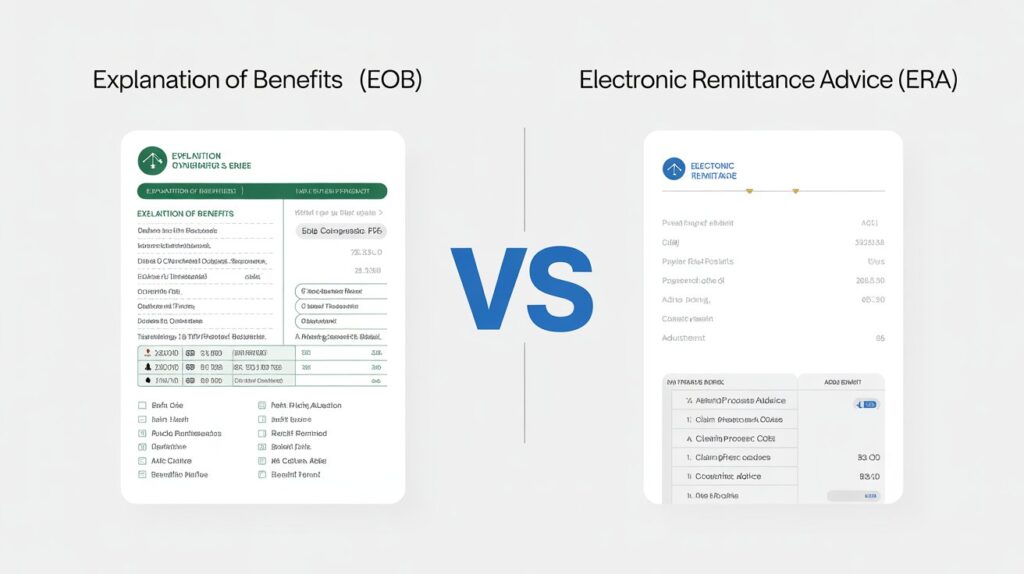
Why Insurance Companies Send EOB and ERA?
Insurance companies send EOB and ERA for two main reasons. Both show how a claim was handled, but they are for different users and purposes.
The EOB is mainly for the patient and the medical office. It explains what the insurance paid, what they did not pay, and why. It shows patient responsibility, like copays or deductibles.
Patients can understand their part of the bill from the EOB. Medical offices can use it to check if the insurance paid correctly.
The ERA is mainly for the medical office and the billing system. It is a digital version of the payment information. It shows every detail in a format that software can read. This helps the office post payments quickly and correctly without typing everything manually.
Both EOB and ERA include codes and notes from the insurance company. These codes explain why a payment was made, adjusted, or denied. Staff use these codes to fix errors, send appeals, or update patient balances.
Insurance sends these documents to make the billing process transparent and accurate. EOB communicates with patients, while ERA communicates with billing systems. Using both together helps practices save time, reduce errors, and get paid faster.
Checking every EOB and ERA confirms no claim is missed or misposted. Staff can quickly see if any payment is missing and take action immediately. This protects the practice revenue and keeps patient accounts accurate.
These documents also reduce confusion. Patients see their responsibility clearly, and the office sees the insurance responsibility. Both sides can track payments and avoid disputes.
Insurance companies send EOB and ERA to make claims easy to understand, to reduce errors, and to help both patients and offices know exactly what happened with each claim.
How EOB and ERA Are Used in Medical Billing
Using EOB and ERA correctly is very important for medical billing. They help staff post payments, track claims, and fix errors. Here is a clear breakdown of how each step works.
Posting Payments
The ERA shows exactly how much the insurance paid for each claim. Staff use this information to post payments in the billing system. This saves time because the payment details go directly from the ERA into the system.
Checking Patient Responsibility
The EOB shows what the patient owes. This can include copay, coinsurance, or deductible amounts. Staff use this to send accurate statements to patients and collect the right amount.
Identifying Denials
Both EOB and ERA include reason codes for denials. Staff read these codes to understand why a claim was denied. This helps decide whether to appeal or correct the claim.
Reconciling Payments
Sometimes the insurance payment does not match the expected amount. Using EOB and ERA, billing staff can reconcile the differences and make sure everything is correct in the patient account.
Updating Patient Accounts
When payments and adjustments are posted, the patient account must be updated. EOB and ERA help staff make sure patient balances are accurate and reflect insurance payments correctly.
Correcting Errors
If a claim has an error, the EOB or ERA shows it. Staff can use this information to correct codes, resubmit claims, or appeal denials quickly.
Reporting and Analytics
Billing teams use EOB and ERA data to create reports. These reports show trends in denials, payment delays, and patient balances. Practices can use this data to improve billing efficiency.
Improving Cash Flow
When claims are processed correctly using EOB and ERA, payments come faster. Accurate posting and follow-up reduce delays and increase revenue. This keeps the practice financially stable and allows staff to focus on patient care.
Explanation of Benefits (EOB) vs. Electronic Remittance Advice (ERA)
Medical practices get two main documents from insurance companies after submitting claims: EOB and ERA . Both show how a claim was handled, but they are very different in purpose, format, and use. Understanding the difference is important for staff to post payments correctly, track denials, and manage patient balances.
The EOB is mainly for the patient and the office. It explains what the insurance paid, what they did not pay, and why. It shows patient responsibility, like copay, coinsurance, or deductible. It also explains denials and adjustments. Staff use EOBs to check payments, verify patient amounts, and send accurate statements.
The ERA is mainly for the medical office and the billing system. It is an electronic file that can be uploaded directly to the practice management system. The ERA shows the exact payment amounts, claim adjustments, and reason codes. Staff use it to post payments quickly and automatically, reducing manual entry and errors.
Both documents include reason codes or adjustment codes . These codes explain why a payment was partially paid, denied, or adjusted. Billing staff use these codes to decide whether to correct a claim, appeal a denial, or collect the patient responsibility.
Using both EOB and ERA together keeps the billing process accurate. EOB confirms patient communication is clear, while ERA confirms payments are posted efficiently. Together, they reduce errors, improve cash flow, and make sure practices do not lose revenue.
| Feature | Explanation of Benefits (EOB) | Electronic Remittance Advice (ERA) |
| Purpose | Explains claim result to patient and office | Shows claim result to office and billing system |
| Main Users | Patient and office staff | Office staff and billing software |
| Format | Paper, PDF, or online portal | Electronic file (EDI format) |
| Payment Info | Shows allowed amount, paid amount, and patient responsibility | Shows exact payment amounts, adjustments, and claim totals |
| Denial Info | Lists reason codes for patient understanding | Lists detailed adjustment codes for automated processing |
| Posting Method | Usually entered manually by staff | Can be posted automatically into billing system |
| Patient Responsibility | Copay, coinsurance, deductible amounts are shown | Focus on total claim adjustments, not for patient view |
| Speed | Slower if paper; depends on mail or portal | Faster because digital and automated |
| Adjustment Codes | Explains partial payments or denials in simple terms | Detailed codes for system processing |
| Claim Tracking | Staff can track what patient owes and insurance paid | Staff can track payments, adjustments, and denials automatically |
| Error Identification | Helps staff find mistakes in claim or patient responsibility | Helps staff identify posting or payment errors |
| Record Keeping | Paper or portal copy for audit and patient questions | Electronic file saved in system for audit, reconciliation, and reporting |
| Cash Flow Impact | Helps collect patient balances on time | Helps post insurance payments quickly and accurately |
| Denial Management | Staff use EOB to appeal denied amounts or correct claims | Staff use ERA codes to correct and resubmit claims automatically |
| Reconciliation | Compare EOB to payments received to verify | Compare ERA to EFT or check to verify payment matches claim |
| Training Benefit | Easy to explain to patients about payments | Helps staff understand system automation and adjustments |
| Reporting | Manual tracking of trends, denials, and balances | Automated reporting on claims, payments, adjustments, and denials |
| Patient Communication | Clear explanation for patient to understand charges | Not used for patient; office-only document |
| Compliance | confirms transparency for patient | confirms accuracy in billing system |
| Integration | Can be scanned or uploaded | Directly integrates with billing software |
EOB and ERA together give full visibility of claims . The EOB helps staff understand patient responsibility and communicate clearly. The ERA allows staff to post payments accurately and automatically. Practices that use both carefully can reduce denied claims, fix errors quickly, and improve cash flow.
Using EOB and ERA helps practices save staff time. Manual entry is reduced because the ERA posts payments automatically. Denials are easier to manage because reason codes explain what went wrong. Patient statements are correct because the EOB shows exactly what the patient owes.
Practices that ignore these documents risk mistakes. Wrong posting can happen, money can be missed, and patient statements can be wrong. By reading both carefully, checking codes, and posting correctly, staff can keep billing accurate. This protects revenue and keeps the office organized.
EOB and ERA are tools for accuracy, speed, and transparency . EOB communicates with patients, ERA communicates with the system. Both together make sure claims are handled properly, payments are posted fast, and patients understand their responsibility. Using them well is key for a healthy billing process and strong practice revenue.
How Doctors and Clinics Read an EOB
Doctors and clinics use the EOB to understand how insurance handled a claim. It is very important for billing and keeping patient accounts correct. Reading an EOB carefully helps prevent lost revenue and reduces mistakes.
The first thing staff look at is the patient information . This includes the patient name, date of birth, and ID number. It confirms the claim belongs to the correct person. If this is wrong, the payment could go to the wrong patient account.
Next, staff check the provider information . This is the doctor or clinic name, address, and provider ID. If this does not match the claim, the insurance may deny payment. Correct provider information confirms the practice gets paid correctly.
Then they check the services billed . Each service has a CPT or HCPCS code. The EOB shows the amount charged, the amount allowed by insurance, and the amount paid. If the paid amount is less than expected, the reason is usually listed.
Reason codes are very important. They explain why the insurance paid less or denied a service. Common reasons include non-covered service, missing information, or exceeded limits. Staff use these codes to decide if they need to appeal or correct the claim.
The patient responsibility section shows how much the patient owes. This could be copay, coinsurance, or deductible. Clinics use this to send statements and collect the correct amount from the patient.
Staff also check the total payment . They compare the payment received with the EOB to confirm everything matches. If there is a difference, it may need to be investigated and fixed.
Finally, doctors and clinics often file EOBs for records . Keeping a copy helps in case of audits, disputes, or future billing questions. It also helps track which claims were paid, partially paid, or denied.
Reading the EOB carefully makes sure claims are accurate, payments are correct, and patient balances are clear . It is a key step in keeping the practice financially healthy.
How Billing Staff Read an ERA
Billing staff use the ERA to see how insurance processed claims and to post payments accurately in the system. Unlike the EOB, the ERA is made for the office, not the patient. It comes as an electronic file that can be uploaded directly into billing software.
The first thing staff check is the claim details . This includes the patient name, provider, and date of service. It confirms the payment matches the correct claim. If this is wrong, the payment could be posted to the wrong patient account.
Next, staff look at the payment amounts . The ERA shows how much the insurance paid and any adjustments. Adjustments can include denied amounts, contractual reductions, or patient responsibility. Staff use this to make sure the correct amount posts to each claim.
Adjustment reason codes are very important. They explain why a payment was less than expected. Common codes include service not covered, duplicate claim, or missing information. Staff read these codes to know if a correction or appeal is needed.
The ERA also helps with automated posting . When uploaded to the billing system, payments and adjustments can post automatically. This saves hours of work compared to manual posting and reduces errors.
Billing staff also check patient responsibility . The ERA shows the portion of the claim the patient must pay. This helps prepare statements for patients with accurate balances.
Staff then reconcile payments . They compare the ERA to the expected payment and any deposits received. If there is a mismatch, it is flagged for review. This confirms that all money is accounted for.
Finally, ERA files are saved for records . This helps in audits, reporting, and future follow-up. Staff can track which claims were paid, partially paid, or denied.
Reading the ERA carefully makes sure payments are accurate, claims are updated correctly, and staff can work efficiently . It is a key step in keeping the billing process smooth and the practice financially stable.
Why EOB and ERA Help Reduce Claim Denials
Using EOB and ERA correctly can help medical practices reduce claim denials. They show exactly what insurance paid, adjusted, or denied. Billing staff can use them to find mistakes and fix claims quickly. Here is a clear breakdown using 8 points.
Checking Patient Information
EOB and ERA show patient details. Staff make sure the patient name, ID, and date of birth match the claim. Wrong patient info is a common reason for denials.
Verifying Provider Details
The documents also include the provider name, ID, and address. Incorrect provider information can cause denials. Staff confirm these details before posting or sending statements.
Reviewing Service Codes
CPT or HCPCS codes appear on both EOB and ERA. Staff check that codes match the services performed. Errors in coding can lead to denials, so careful review prevents this.
Understanding Adjustment Codes
Reason or adjustment codes explain why insurance paid less or denied a service. Staff read these codes to understand if the denial is correct or needs appeal.
Posting Payments Accurately
ERA allows electronic posting of payments and adjustments. Accurate posting prevents accidental underpayment or overpayment, which can trigger future denials.
Following Up on Denials Quickly
When a denial appears, EOB and ERA give the reason. Staff can act immediately to correct the claim, provide missing information, or appeal. Quick follow-up reduces repeated denials.
Reconciling Insurance Payments
Comparing the ERA or EOB to actual payments confirms all money is received. Missing or partial payments can be addressed fast, reducing denied claims due to unpaid balances.
Tracking and Reporting Trends
Billing teams use EOB and ERA data to see patterns in denials. They can identify recurring errors, train staff, or adjust coding practices. This proactive approach reduces future denials.
Using EOB and ERA this way helps practices catch errors early, fix issues quickly, and reduce denied claims . It keeps billing clean and payments on time.
How to Fix Errors Found in EOB and ERA
Errors in EOB and ERA are common, but fixing them quickly is very important. When staff find mistakes, the practice can get paid correctly, avoid delays, and keep patient accounts accurate. Here is a simple guide with bullet points for common fixes.
- Check Patient Information
- Verify Provider Details
- Review CPT and HCPCS Codes
- Read Adjustment or Denial Codes
- Check Payment Amounts
- Update Patient Responsibility
- Correct Denied Claims Quickly
- Document All Changes
- Use ERA Automation When Possible
- Train Staff Regularly
Fixing errors in EOB and ERA confirms claims are processed smoothly. Staff can post payments faster, collect patient balances correctly, and reduce the risk of denied or lost payments.
Practices that follow these steps spend less time fixing mistakes and more time focusing on patient care.
Benefits of Using Both EOB and ERA Together in Your Practice
Using EOB and ERA together makes the billing process much easier and more accurate. When staff check both, they get the full picture of what insurance paid, what was denied, and what the patient owes. Here are the main benefits in simple bullet points:
- Accurate Payment Posting
- Faster Cash Flow
- Reduced Denials
- Better Patient Communication
- Simpler Record Keeping
- Efficient Staff Workflow
- Easier Denial Management
- Improved Reporting
- Better Compliance
- Maximized Revenue
- Error Prevention
- Time Savings
- Audit Ready
- Patient Trust
- Optimized Billing Process
Using EOB and ERA together gives staff all the tools they need to keep billing accurate, payments fast, and patient accounts correct . Practices that rely on both can improve cash flow, reduce mistakes, and save a lot of staff time while keeping patients informed.
What Are the Overlaps in Information Between ERAs and EOBs?
Even though EOB and ERA are different in format and main users, they share a lot of information. Both show how insurance processed a claim, what was paid, and what was adjusted. Understanding these overlaps helps staff post payments accurately and track patient balances.
Some of the key overlaps include patient details, provider information, payment amounts, adjustment codes, and denial reasons. These shared points make it easier for the office to check payments, resolve errors, and reconcile accounts.
| Information Type | EOB (Patient-Focused) | ERA (Office -Focused) | Overlap Purpose |
| Patient Name | Yes | Yes | Confirms claim is posted to the correct patient |
| Patient ID / Insurance ID | Yes | Yes | Confirms patient account and insurance match |
| Provider Name | Yes | Yes | Verifies claim is linked to correct provider |
| Provider ID / NPI | Yes | Yes | Required for accurate billing and reporting |
| Date of Service | Yes | Yes | confirms payment is for correct visit or procedure |
| CPT / HCPCS Codes | Yes | Yes | Confirms correct services are billed |
| ICD-10 / Diagnosis Codes | Sometimes | Yes | Helps understand treatment justification |
| Billed Amount | Yes | Yes | Shows what provider charged and insurance considered |
| Allowed Amount | Yes | Yes | Indicates the amount insurance approves for payment |
| Paid Amount | Yes | Yes | Confirms what insurance actually paid |
| Denied Amount | Yes | Yes | Explains reductions or denials |
| Adjustment Codes / Reason Codes | Yes | Yes | Shows why partial payments or denials occurred |
| Patient Responsibility (Copay, Coinsurance, Deductible) | Yes | Sometimes | EOB shows for patient; ERA shows for posting |
| Total Claim Status | Yes | Yes | Helps office reconcile payments with claims |
| Appeal / Follow-Up Notes | Sometimes | Sometimes | Guides staff on corrective actions |
| Payment Date | Yes | Yes | Confirms when payment should be posted |
| Check / EFT Details | Sometimes | Yes | Shows exact payment method and reference |
| Claim Reference Number | Yes | Yes | Tracks claim in both insurance and office systems |
| Service Line Details | Yes | Yes | Helps post payments per individual procedure |
| Notes / Remarks | Sometimes | Yes | Provides extra information for staff |
Both EOB and ERA provide overlapping information that allows staff to double-check accuracy, post payments correctly, and manage patient balances. While the ERA is optimized for office posting and automation, the EOB confirms transparency and communication with patients.
Using both documents together confirms claims are properly reconciled, errors are caught early, and the practice maintains steady cash flow.
Advantages of Explanation of Benefits (EOB)
The Explanation of Benefits , or EOB , is one of the most important documents that insurance companies send after a medical claim is processed. Even though it is often given to the patient, it is very useful for the medical office as well. EOBs explain exactly what the insurance company did with a claim. They show what the insurance paid, what was denied, and what the patient may need to pay. For practices, understanding and using EOBs correctly can make billing easier, reduce errors, and help staff manage payments more efficiently.
One of the biggest advantages of EOBs is that they help the office check payments . When the staff receives an EOB, they can compare the amount paid by the insurance to what was expected. Sometimes, insurance pays less than the total claim because of adjustments, denied services, or partial coverage. The EOB explains why each payment is different. This allows staff to see if there is a mistake and fix it immediately. If errors are ignored, practices may lose money or post incorrect patient balances.
EOBs also help staff explain charges to patients . Many patients get confused about their bills. They do not understand why insurance paid only part of the total or why they owe money. By using the EOB, staff can clearly show the patient the breakdown of charges, insurance payments, and the remaining balance. This reduces calls and complaints from patients, making the office workflow smoother.
Another advantage is managing denials and appeals . Sometimes insurance denies part or all of a claim. The EOB lists reason codes that explain why the payment was denied. Staff can use
this information to correct errors or provide additional documents to the insurance company for an appeal. Without the EOB, staff would not know the reason for denials, and claims might remain unpaid for a long time.
EOBs help track patient responsibility accurately . Copays, coinsurance, and deductibles are all shown in the EOB. This confirms that patients are charged correctly. Staff can update the billing system with the exact patient balance, preventing undercharges or overcharges. When patients receive accurate statements, they are more likely to pay on time, which improves practice revenue.
EOBs also provide transparency for patients . Patients can see what insurance paid, what was denied, and why. This builds trust between the patient and the practice. Patients feel confident that the office is handling billing fairly and correctly. For practices, this reduces disputes and improves patient satisfaction.
Using EOBs regularly also improves record keeping . Every EOB is a document that can be stored in the patient’s chart or billing system. This helps staff track all payments, adjustments, and denied claims. It also makes audits easier because all information is clearly documented. Auditors and insurance companies can quickly see how claims were processed and payments were applied.
Another advantage is helping staff plan for cash flow . When the office knows what insurance paid and what the patient owes, they can estimate incoming payments and plan expenses. This reduces surprises in revenue and allows the practice to manage payroll, supplies, and other costs more efficiently.
EOBs also help educate staff about billing practices . By reviewing EOBs, staff learn how different insurance plans process claims, which codes are often denied, and which adjustments are common. This knowledge improves overall billing accuracy and reduces repeated mistakes.
Finally, EOBs reduce errors in patient statements . When staff use the EOB to update balances, the patient receives an accurate bill that reflects exactly what insurance covered and what is their responsibility. This prevents disputes and confirms faster patient payments.
The EOB is a powerful tool for practices. It helps check insurance payments, explain balances to patients, manage denials, track patient responsibility, improve transparency, maintain records, plan cash flow, educate staff, and reduce errors. Using EOBs carefully confirms that practices get paid correctly and patients understand their bills, which makes the billing process smooth and efficient.
Advantages of Electronic Remittance Advice (ERA)
The Electronic Remittance Advice , or ERA , is a digital document sent by insurance companies after a claim is processed. Unlike EOBs, which are often for patients, ERAs are designed mainly for the medical office and the billing system. They contain all the information
needed to post payments, record adjustments, and track denied claims. For medical practices, understanding and using ERAs correctly can save a lot of time, reduce errors, and improve overall revenue.
One of the biggest advantages of ERA is automatic payment posting . When an ERA is received, it can be uploaded directly into the practice management or billing software. This allows the payment amounts, adjustments, and denials to be posted automatically without manual entry. Automatic posting reduces human errors and saves staff hours of work that would otherwise be spent checking and entering payments line by line.
ERAs also provide detailed adjustment codes . Every payment or partial payment is accompanied by reason codes that explain why insurance paid less than the full claim. These codes are specific and standardized, so staff can quickly see whether a service was denied, reduced, or adjusted due to policy limits, medical necessity, or patient responsibility. Using these codes makes it easier to manage corrections, resubmit claims, and appeal denials efficiently.
Another advantage is improved accuracy in billing . Because ERAs integrate directly with billing software, there is less chance of posting errors. Staff no longer need to interpret handwritten or paper documents and manually enter payments. This reduces mistakes, prevents underpayment or overpayment posting, and confirms that the patient’s account reflects the correct insurance payment.
ERAs also help manage denied claims quickly . When a claim is denied or partially paid, the ERA provides clear codes and amounts that explain the denial. Staff can immediately identify which claims need correction, what additional documentation is required, or whether an appeal should be submitted. This fast action confirms the practice recovers more revenue and reduces delays in payment.
Using ERA saves time for office staff . Posting insurance payments manually from EOBs takes hours, especially for practices with many claims. With ERA, the process is automated, and the staff only needs to review for exceptions or unusual adjustments. This allows the office to spend less time on manual work and more time on patient care, scheduling, or handling new claims.
Another advantage is better cash flow management . ERAs show exactly how much the insurance paid, the total adjustments, and any patient responsibility. With this information, practices can predict incoming payments more accurately, plan budgets, and confirm there is enough cash to cover daily operations. Faster posting of insurance payments improves financial stability and reduces the risk of delayed revenue.
ERAs also support compliance and audits . Because all payments, adjustments, and reason codes are stored digitally, the office has a clear record for audits or insurance reviews. Each ERA provides a complete trail of how claims were processed and paid. This digital record keeps the practice compliant with regulations and ready for internal or external audits at any time.
Another key benefit is integration with multiple insurance plans . ERAs are standardized in formats like HIPAA 835 files, which means that different insurance companies’ remittance
information can be posted in the same system without changing formats. This makes it easier for staff to manage payments from multiple insurers and confirms consistency across all claims.
ERAs also help track trends and reporting . Because all payments, adjustments, and denials are recorded digitally, practices can generate reports to see patterns in insurance processing. They can identify which codes are frequently denied, which insurers pay fastest, and where corrections are most needed. This information allows staff to proactively improve billing practices, reduce denials, and optimize revenue.
Another advantage is improved patient statement accuracy . Even though ERAs are office-focused, they provide exact payment amounts and adjustments that staff can use to
calculate the patient responsibility. When combined with patient statements, the office confirms patients are charged the correct amount, reducing billing questions and disputes.
ERAs also reduce staff stress and workload . Manual posting and reconciliation can be confusing and time-consuming, especially with complex claims. With ERA automation, staff can focus on exceptions and denials instead of entering each payment manually. This reduces mistakes, prevents frustration, and makes the billing process smoother.
Finally, using ERA maximizes revenue capture . By posting payments accurately, tracking denials, and correcting claims quickly, practices are less likely to lose money. Every claim is processed efficiently, and every patient responsibility is accurately calculated. This confirms the practice receives the full amount owed from insurance and patients.
In summary, ERAs are a powerful tool for medical practices. They save time through automatic posting, reduce errors, provide detailed adjustment codes, speed up denial management, improve cash flow, support audits, integrate multiple insurers, enable reporting, confirm accurate patient statements, reduce staff workload, and maximize revenue. Practices that use ERA effectively can manage claims more efficiently, post payments faster, and maintain strong financial stability.
Why Understanding EOBs and ERAs Is Important for Your Practice
Understanding EOBs and ERAs is very important for any medical practice. These documents show exactly how insurance processed claims, what was paid, and what is owed by patients. When staff know how to read and use EOBs and ERAs, they can post payments correctly, catch mistakes quickly, and manage denied claims efficiently. This reduces delays in payment, prevents errors, and keeps patient accounts accurate.
Using both EOBs and ERAs together also improves communication with patients. Staff can explain charges clearly, show what insurance covered, and inform patients about their responsibility. This builds trust, reduces confusion, and makes patients more likely to pay on time.
For the practice, understanding these documents improves revenue and workflow. Payments are posted faster, staff spend less time fixing mistakes, and cash flow becomes more predictable. Audits and reporting are easier because all adjustments and reason codes are recorded properly. Overall, a clear understanding of EOBs and ERAs keeps the office organized, prevents lost revenue, and confirms smooth operations while making patients confident in the billing process.