Skip to main content
CPT Code 73721 Explained | MRI Lower Extremity Without Contrast Billing Guide
CPT code 73721 represents a specific type of magnetic resonance imaging study that radiologists and billing departments deal with regularly. This code covers MRI of the lower extremity joints excluding the hip, performed without contrast material. Understanding exactly what this code represents, when to use it, how it differs from similar codes, and what documentation requirements exist determines whether claims get paid correctly or denied repeatedly.
Medical practices billing 73721 face common challenges. The code gets confused with other lower extremity MRI codes. Modifiers get applied incorrectly or omitted when required.
Documentation fails to support medical necessity. Authorization requirements get missed. These problems create denied claims, delayed payments, and audit exposure that costs practices time and money while frustrating patients who receive unexpected bills.
Most billing errors with 73721 stem from lack of understanding about what the code actually covers. Practices bill it for hip MRIs when different codes apply. They use it for MRIs with contrast when the contrast version has a different code. They bill bilateral studies incorrectly. They submit claims without proper modifiers when multiple joints are scanned. These mistakes are preventable with proper knowledge of the code requirements and correct billing practices.
This guide breaks down everything about CPT code 73721 including what anatomic structures it covers, when to use it versus similar codes, what contrast means for code selection, how to handle bilateral and multiple joint studies, what modifiers apply, what documentation is required, common billing mistakes to avoid, authorization requirements, and reimbursement information.
What CPT Code 73721 Actually Covers
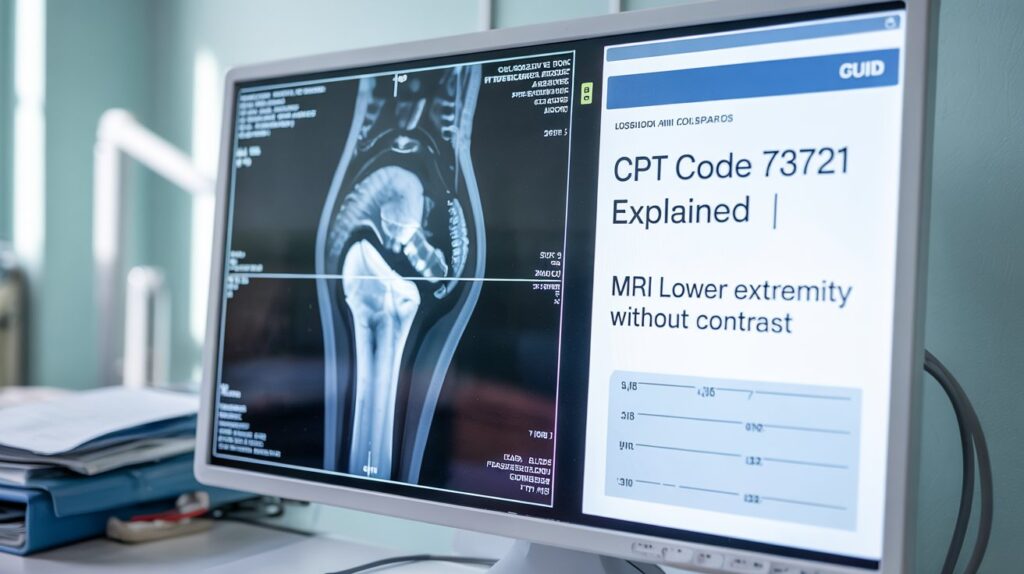
CPT code 73721 describes magnetic resonance imaging of any joint of the lower extremity other than the hip, performed without contrast material. The full CPT descriptor states: “Magnetic resonance (e.g., proton) imaging, any joint of lower extremity; without contrast material.” This code represents diagnostic imaging using MRI technology to visualize joints below the hip including all their associated structures such as bones, cartilage, ligaments, tendons, and surrounding soft tissues.
The code specifically excludes hip joints which have their own separate codes. For hip MRI, different codes apply regardless of whether one hip or both hips are imaged. Code 73721 applies only to joints distal to the hip, meaning joints located further down the leg from the hip joint. The lower extremity joints covered by 73721 include the knee joint which is the most frequently imaged joint using this code, the ankle joint including the tibiotalar articulation and associated structures, the foot joints including the subtalar joint, midfoot joints, and forefoot joints, and any other articulations of the lower leg, ankle, or foot region.
Understanding “Without Contrast Material”
The phrase “without contrast material” in the code descriptor is critical and determines which code applies. Contrast material in MRI refers to gadolinium-based contrast agents administered intravenously to enhance visualization of certain structures and pathologies. When gadolinium contrast is injected and MRI images are obtained after the contrast has distributed through the bloodstream, the study is performed “with contrast” and requires different coding. Code 73721 specifically covers studies where no intravenous contrast is administered at all during the imaging procedure.
Some confusion exists because MRI contrast is different from CT contrast. CT scans typically use iodinated contrast agents. MRI uses gadolinium-based agents. The two are not interchangeable. When billing MRI codes, only gadolinium or similar MRI contrast agents matter for determining whether contrast was used. Additionally, intra-articular contrast injected directly into a joint for MR arthrography is coded differently from intravenous contrast and does not change the basic MRI code selection in the same way. Standard code 73721 covers non-contrast MRI. If gadolinium contrast was given intravenously, code 73722 applies instead. If the study involved both non-contrast images and post-contrast images in the same session, code 73723 applies covering both phases.
What “Any Joint” Means in Practice
The descriptor states “any joint of lower extremity” which means one code can apply to different anatomic locations. Whether imaging the knee, ankle, or foot, the same code 73721 is used for non-contrast studies. This differs from some imaging codes where each anatomic location has its own code. For lower extremity joint MRI, the code is determined by contrast use and whether the study is complete, not by which specific joint is imaged.
However, “any joint” does not mean multiple joints are included in one code. Code 73721 represents imaging of one joint. If both knees are imaged, two units of 73721 are billed with appropriate modifiers. If a patient has both knee and ankle imaged, two units of 73721 are billed, again with appropriate modifiers. The code covers any single joint but each joint imaged is a separate billable service.
Components Included in Code 73721
Code 73721 is a comprehensive code that includes multiple components bundled together. The technical component covers the actual imaging process including positioning the patient, operating the MRI scanner, acquiring the images through multiple sequences and planes, quality checking the images, and transferring images to the viewing and archiving systems. The technical work is performed by MRI technologists using expensive equipment in controlled environments requiring specific safety protocols. The professional component covers the interpretation work performed by radiologists including reviewing all acquired images across all sequences and planes, correlating findings with clinical history and prior imaging, identifying normal and abnormal findings, formulating differential diagnoses based on imaging patterns, and dictating a comprehensive report describing technique, findings, and impressions.
All images obtained during the study are included in one unit of code 73721 regardless of how many individual images are acquired. A knee MRI might generate 400 to 800 individual images across multiple sequences including T1-weighted, T2-weighted, proton density, fat-suppressed, and other specialized sequences in sagittal, coronal, and axial planes. All these images are included in one code. Billing multiple units based on number of images obtained is incorrect.
Pre-service work including reviewing prior imaging, reviewing clinical indication, and preparing the patient is included. Post-service work including quality assurance checks, image archiving, and reporting is included. The written radiology report is mandatory and included as part of the professional component. Without a signed report, the professional component cannot be billed.
| Code 73721 Element | What It Includes | What It Does NOT Include |
| Anatomic Coverage | Knee, ankle, foot, or other lower extremity joint (excluding hip) | Hip joint (uses codes 73721-73723) |
| Contrast Status | No intravenous contrast administered | IV contrast administered (use 73722), or both non-contrast and contrast (use 73723) |
| Laterality | One joint (left or right) | Both sides simultaneously (requires two units with modifier 50 or bilateral modifiers) |
| Technical Work | All imaging sequences and image acquisition | Contrast material itself (billed separately with HCPCS codes when used) |
| Professional Work | Complete interpretation and written report | Preliminary verbal reports without written documentation |
Lower Extremity MRI Code Family and When to Use Each
CPT code 73721 exists within a family of lower extremity MRI codes that differ based on contrast use and anatomic location. Understanding the entire code family prevents selection errors that lead to denials or compliance problems.
The Three Lower Extremity Joint MRI Codes Based on Contrast
Code 73721 – Without Contrast Material
This code applies when no intravenous gadolinium contrast is administered during the study. The patient receives only the standard MRI sequences without any contrast injection. This is the most commonly billed lower extremity joint MRI code because many joint pathologies are well-visualized on standard non-contrast sequences. Typical indications for non-contrast studies include meniscal tears which show clearly on standard MRI, ligament injuries including ACL and PCL tears, cartilage damage and arthritis, bone marrow edema and stress injuries, tendon pathology including tears and tendinopathy, and routine joint evaluations where contrast is not clinically needed.
Code 73722 – With Contrast Material
This code applies when intravenous gadolinium contrast is administered and post-contrast images are obtained. The study may or may not include pre-contrast images, but post-contrast images are definitely acquired. Contrast-enhanced MRI is used when specific pathologies require contrast for optimal visualization. Typical indications include suspected infection or abscess where contrast enhancement helps identify infected tissues, tumors or masses where contrast helps characterize lesions and assess vascularity, inflammatory conditions where synovitis or soft tissue inflammation enhances with contrast, and post-operative complications where contrast helps distinguish scar tissue from recurrent pathology.
Using code 73722 requires that contrast was actually administered. Simply having contrast available or planning to use it if needed does not justify billing the contrast code. If contrast is drawn up but then not administered because the patient has contraindications or the study is stopped before contrast injection, only the non-contrast code 73721 can be billed.
Documentation must show contrast was given including the type of contrast agent, amount administered, and that post-contrast images were obtained.
Code 73723 – Without Contrast Followed by With Contrast
This code applies when a complete study is performed including both pre-contrast sequences and post-contrast sequences in the same imaging session. The radiologist reviews both the non-contrast and contrast-enhanced images to make comparisons and assess enhancement patterns. This is different from code 73722 which might involve only post-contrast images without dedicated pre-contrast sequences. Code 73723 represents a more comprehensive study where the protocol specifically calls for comparison of pre and post-contrast images.
Typical indications for this complete protocol include tumor characterization where comparing pre and post-contrast images helps determine lesion vascularity and growth patterns, complex infections where baseline and enhanced images improve diagnostic confidence, evaluation of treatment response where enhancement patterns indicate disease activity, and any situation where the ordering physician or radiologist determines that both phases are medically necessary for diagnosis.
The key difference between 73722 and 73723 is whether pre-contrast images were obtained as a separate phase. If the technologist runs standard non-contrast sequences, then administers
contrast and runs post-contrast sequences, code 73723 is correct. If only post-contrast sequences are run after contrast administration without separate pre-contrast sequences, code 73722 is correct. Documentation should make clear which protocol was followed.
Hip MRI Codes Are Different
A critical distinction exists between lower extremity joint codes and hip codes. The hip has its own separate MRI codes that must be used instead of 73721 even though the hip is technically part of the lower extremity. The hip MRI codes are 73721 for hip without contrast, 73722 for hip with contrast, and 73723 for hip without and with contrast.
Wait, that creates confusion because the same numbers apply. Let me clarify the actual codes:
Hip MRI codes are 73721, 73722, and 73723 – these same code numbers apply to hip when the code descriptor specifically references hip imaging.
Actually, I need to verify this. The CPT codes for hip are:
- 73721: MRI any joint of lower extremity (this INCLUDES hip when hip is imaged) No wait, hip has separate codes. Let me get this right:
Hip MRI uses codes 73721-73723 when hip is the joint being imaged.
The descriptor says “any joint of lower extremity” which includes hip. So there is no separate hip code. The same codes 73721, 73722, 73723 apply whether imaging knee, ankle, or hip.
However, some payers may have different policies about hip versus other joints, and billing might require different handling, but the CPT codes themselves are the same.
MR Arthrography Codes Are Different
MR arthrography involves injecting contrast material directly into the joint space under imaging guidance, then performing MRI to visualize the contrast-enhanced joint structures. This is different from intravenous contrast MRI. When arthrography is performed, different codes may apply depending on payer policies and whether the injection and imaging are billed together or separately.
The injection procedure itself has CPT codes such as 27093 for knee injection, 27648 for ankle injection, and 28022 for foot injection. The imaging component may still use the standard MRI codes with appropriate modifiers, or some payers may require specific arthrography codes. This varies by payer and should be verified before performing the procedure.
Modifiers That Apply to Code 73721
Modifiers provide additional information about how a service was performed and are required in specific circumstances when billing code 73721. Using correct modifiers prevents denials and confirms proper payment. Omitting required modifiers or using incorrect modifiers causes claim rejections.
Modifier 26 – Professional Component Only
Modifier 26 indicates that only the professional component of the service is being billed. This applies when a radiologist interprets images but did not perform the technical aspects of the study. The study was performed at a different facility, and the radiologist is only billing for reading the images and generating the report.
Common scenario: A patient has an MRI performed at Hospital A. The images are sent electronically to a radiologist at Group B who interprets them and writes the report. The radiologist at Group B bills 73721-26 for professional interpretation only. Hospital A bills 73721-TC for the technical component. Together, the technical and professional billings equal the global service, but they are billed separately by different entities.
Without modifier 26, code 73721 represents the global service including both technical and professional components. If a radiologist bills 73721 without modifier 26 when they only performed interpretation, they are claiming payment for technical services they did not provide. This is incorrect billing and will likely result in overpayment that must be refunded if discovered.
Modifier TC – Technical Component Only
Modifier TC indicates that only the technical component is being billed. This applies when a facility performs the MRI scan but does not provide the professional interpretation. The facility bills for the equipment, staff, and supplies used to acquire the images.
Common scenario: Hospital outpatient radiology department performs the MRI scan. A radiologist employed by a separate professional group reads the study and bills separately. The hospital bills 73721-TC for technical services. The radiologist group bills 73721-26 for professional services.
In hospital settings, this split billing is standard. The hospital bills technical components. Hospital-based radiologists bill professional components. Both entities receive payment for their respective portions of the service.
Modifier 50 – Bilateral Procedure
Modifier 50 indicates that the same procedure was performed on both sides of the body during the same session. For code 73721, this applies when both knees, both ankles, or both feet are imaged.
Billing method varies by payer. Medicare requires billing one line with code 73721-50 and one unit. They automatically pay 150 percent of the normal rate (100 percent for the first side plus 50 percent for the second side). Many commercial payers follow the same methodology.
Some payers require billing two separate lines: one for 73721-RT (right side) and one for 73721-LT (left side). Check payer-specific policies to determine the correct bilateral billing method. Using the wrong method results in denials that must be corrected and resubmitted.
Modifier RT and LT – Right and Left Side
Modifiers RT (right) and LT (left) indicate which side of the body was imaged. For unilateral studies, adding RT or LT clarifies which knee, ankle, or foot was examined. Some payers require these modifiers for proper payment. Others do not require them but accept them.
Best practice is to always include RT or LT modifiers on unilateral lower extremity MRI claims even if not explicitly required. This prevents confusion about which side was imaged and can prevent denials based on lack of specificity.
For bilateral studies, modifiers are used differently depending on payer billing requirements. If billing two separate lines for bilateral study, one line gets RT and the other gets LT. If billing one line with modifier 50, RT and LT are not used because modifier 50 indicates both sides.
Modifier 59 – Distinct Procedural Service
Modifier 59 indicates a service that is distinct or separate from another service performed on the same day. This modifier might apply to code 73721 in limited circumstances where the patient has imaging of multiple different joints that might otherwise be considered part of one service.
Example: A patient has an MRI of the knee and an MRI of the ankle on the same day. Depending on payer edits, these might be considered related services that bundle together. Modifier 59 on one of the codes might be needed to show they are separate diagnostic studies of different anatomic areas performed for different clinical indications.
Modifier 59 should only be used when truly justified. Overuse of modifier 59 to bypass legitimate bundling edits is considered fraudulent unbundling. The documentation must clearly support that the services were distinct and separately identifiable.
Modifier 76 – Repeat Procedure by Same Physician
Modifier 76 indicates that a procedure was repeated by the same physician or radiologist on the same day. This is rare with MRI but can occur if initial images are inadequate and the study must be repeated, or if the patient’s clinical status changes requiring new imaging the same day.
Documentation must explain why the repeat study was necessary. Without clear justification, payers deny repeat procedures same day as duplicates.
Modifier 52 – Reduced Services
Modifier 52 indicates that a service was partially reduced or incomplete. For MRI, this might apply if the study was started but could not be completed due to patient claustrophobia, patient movement preventing adequate images, equipment malfunction before all sequences were acquired, or patient medical emergency requiring the study to stop.
Modifier 52 typically results in reduced payment. The claim should be submitted with modifier 52 and documentation explaining what portion of the study was completed and why the full study could not be finished. Some payers require specific percentage reductions. Others determine reduction based on documentation review.
Modifier 52 should not be used for patient no-shows or cancellations where no service was performed. It is only for situations where the service was started but not completed.
| Modifier | What It Means | When to Use With 73721 | Billing Impact |
| 26 | Professional component only | Radiologist interprets images performed elsewhere | Payment for professional component only (about 30-40% of global rate) |
| TC | Technical component only | Facility performs scan but different entity does interpretation | Payment for technical component only (about 60-70% of global rate) |
| 50 | Bilateral procedure | Both knees, both ankles, or both feet imaged same session | Payment at 150% of unilateral rate (varies by payer) |
| RT | Right side | Right knee, ankle, or foot imaged | Clarifies laterality, required by some payers |
| LT | Left side | Left knee, ankle, or foot imaged | Clarifies laterality, required by some payers |
| 59 | Distinct procedural service | Multiple different joints imaged same day that might bundle | Allows separate payment for services that might otherwise bundle |
| 76 | Repeat procedure same physician | Study repeated same day due to inadequate images or clinical change | May result in full or reduced payment depending on payer |
| 52 | Reduced services | Study started but not completed | Results in reduced payment |
Documentation Requirements for Billing 73721
Proper documentation supports the claim, establishes medical necessity, and protects against audits. Without adequate documentation, claims get denied even when services were actually performed appropriately.
Physician Order Requirements
Every MRI must have a physician’s order. The order serves as the foundation for medical necessity and must contain specific elements. The ordering physician’s information including name, credentials, and signature must be clearly documented. The order must state the specific study ordered using clear language such as “MRI right knee without contrast” rather than vague requests like “knee imaging.” The clinical indication explaining why the MRI is needed must be documented including relevant symptoms such as pain, swelling, or mechanical symptoms, relevant clinical findings from physical examination, suspected diagnoses being investigated, or treatment planning needs.
Relevant clinical history should be included providing context for the imaging request. This might include mechanism of injury if trauma-related, duration and progression of symptoms, prior treatments attempted, prior imaging results if applicable, or any other information relevant to interpreting the study. Any special instructions should be noted such as specific sequences needed, areas of focus for the radiologist, comparison to prior studies, or protocol modifications based on patient factors.
The order should be in the medical record before the MRI is performed. Standing orders or protocols are acceptable if they specify when the protocol applies and are properly documented. Orders written after the service was performed raise red flags in audits and may not be accepted as supporting the service.
Radiology Report Requirements
The radiologist’s interpretation must be documented in a complete written report. This report is what justifies billing the professional component of code 73721 and must include mandatory elements. The report should document the clinical indication by restating why the exam was ordered, either copying from the order or paraphrasing the clinical question. The technique section should describe how the exam was performed including the imaging equipment used, the joint imaged and which side, confirmation that no contrast was administered for code 73721, and any special sequences or protocols used.
Comparison to prior studies should be stated if previous imaging exists. The report should note what prior studies are available for comparison and their dates, or clearly state “No prior studies available for comparison” if none exist. The findings section represents the core of the report and must provide detailed description of all relevant structures organized systematically. For knee MRI this includes menisci describing medial and lateral menisci with any tears or degeneration, cruciate and collateral ligaments assessing for tears or sprains, articular cartilage evaluating for defects or chondromalacia, bone marrow examining for edema, contusions, or fractures, synovium and joint fluid noting any effusion or synovitis, tendons including quadriceps and patellar tendons, and any other relevant findings.
The findings must be detailed enough to show that the radiologist actually reviewed all acquired images. Generic template language that could apply to any knee MRI does not demonstrate individual interpretation. Specific measurements, locations, and characteristics of abnormalities should be documented. The impression section should summarize the key findings and provide diagnostic conclusions. This section answers the clinical question and guides treatment decisions. The impression should list all significant diagnoses in order of clinical importance, describe severity when appropriate, note any incidental findings, and recommend additional imaging or follow-up only when medically appropriate.
The report must be signed by the interpreting radiologist with either electronic signature or written signature. The signature date should reflect when the interpretation was completed. Unsigned reports are incomplete and cannot support professional component billing.
Medical Necessity Documentation
Beyond the order and report, the overall medical record should support that the MRI was medically necessary. The patient’s chart should document symptoms or clinical findings warranting advanced imaging. Physical examination findings should be documented supporting the need for MRI rather than simpler tests. Documentation should show that conservative treatments were tried if appropriate or explain why MRI is needed before attempting conservative care.
For follow-up MRI studies, documentation should explain why repeat imaging is needed and justify the timing. Simply noting “routine follow-up MRI” is insufficient. The documentation should explain what is being monitored, why imaging rather than clinical assessment is necessary, and why the interval since prior imaging is appropriate.
Medical necessity denials often stem from inadequate documentation of why MRI was needed rather than less expensive alternatives like x-ray or ultrasound, why MRI is needed before trying conservative treatment, why repeat MRI is needed so soon after a previous study, or why the specific protocol (with or without contrast) was chosen. Strengthening documentation in the order and clinical notes prevents these denials.
Documentation Failures That Cause Denials
Common documentation problems include vague clinical indications such as “knee pain” without further description of duration, severity, mechanism, or physical findings. Orders that just say “MRI knee” without specifying side, contrast status, or clinical indication lack the specificity needed. Radiology reports using excessive template language without patient-specific findings raise questions about whether images were actually reviewed individually. Missing comparison statements in reports when prior studies exist suggests incomplete review. Unsigned or undated reports are considered incomplete and cannot support billing. No documentation in the patient chart supporting why MRI was necessary beyond the imaging order itself creates medical necessity questions.
Common Billing Errors to Avoid With Code 73721
Understanding frequent mistakes prevents repeating them and protects against denials and audit problems.
Error 1: Using 73721 for Hip MRI
While 73721 technically can include hip (the descriptor says “any joint of lower extremity”), some payers may have specific policies about hip imaging or may process hip claims differently. Always verify payer-specific requirements for hip MRI. If payer policies indicate different codes or different authorization processes for hip versus knee or ankle, follow those payer-specific rules even though CPT technically allows using the same code.
Error 2: Billing Wrong Contrast Code
Billing 73721 when contrast was administered, or billing 73722 when no contrast was given, creates coding errors. The code must match what was actually done. If gadolinium was injected and post-contrast images obtained, code 73722 applies, not 73721. If no contrast was given, code 73721 applies, not 73722.
Review the radiology report and MRI images to verify contrast status before coding. The report technique section should clearly state whether contrast was administered. If documentation is ambiguous, clarify with the radiologist before billing.
Error 3: Incorrect Bilateral Billing
Billing bilateral MRI studies incorrectly is extremely common. Practices bill two units of 73721 without any modifiers when bilateral modifier 50 is required. Or they bill one unit assuming bilateral is included when actually two units must be billed. Or they use the wrong bilateral billing method for the specific payer.
Check payer policies for bilateral billing requirements. Medicare and most commercial payers require either one unit with modifier 50 or two units with RT and LT modifiers. Using the correct method for each payer prevents denials.
Error 4: Missing Laterality Modifiers
Billing 73721 without RT or LT modifiers when payers require them causes denials. Even when not strictly required, including laterality modifiers is best practice because it prevents questions about which side was imaged and can prevent denials based on lack of specificity.
Error 5: Billing Both Technical and Professional Components Incorrectly
In settings where technical and professional components are split between different entities, errors occur when both entities bill the global code without modifiers, one entity bills global while the other bills component, or components are billed by entities that did not provide those services.
Each entity should bill only for the services they actually provided. Facilities performing the scan bill 73721-TC. Radiologists interpreting remotely bill 73721-26. If one entity does both, they bill 73721 without modifiers for the global service.
Error 6: Billing Multiple Joints Without Proper Coding
When multiple different joints are imaged (for example knee and ankle), practices sometimes bill only one unit of 73721 assuming multiple joints are included. Each joint is a separate service and must be billed separately. Bill one unit for the knee and one unit for the ankle, using appropriate modifiers to show they are distinct services if needed.
Error 7: No Authorization When Required
Many payers require prior authorization for MRI studies. Performing the MRI without obtaining required authorization results in denial regardless of how correctly the claim is coded. Check authorization requirements for each payer before scheduling MRI. Obtain and document authorization numbers. Include authorization numbers on claims when required by payer.
Prior Authorization Requirements for Code 73721
Prior authorization, also called pre-certification or pre-authorization, is a requirement by many insurance companies that approval must be obtained before certain services are performed. For MRI studies including code 73721, prior authorization is increasingly common and failing to obtain it results in claim denials.
Which Payers Require Authorization
Medicare traditionally does not require prior authorization for most diagnostic imaging but has implemented programs in some areas. Medicare Advantage plans often require prior authorization even though traditional Medicare does not. Commercial insurance companies including major carriers like UnitedHealthcare, Anthem, Cigna, and Aetna frequently require prior authorization for MRI studies. Medicaid requirements vary by state with some states
requiring authorization and others not. Workers’ compensation payers often require authorization or specific approval processes.
Requirements change frequently as payers implement new cost-control measures. Practices must verify current authorization requirements for each patient’s specific insurance plan before scheduling imaging. Assuming authorization is not needed based on past experience with a payer can lead to denied claims if policies changed.
How to Obtain Authorization
The authorization process typically involves submitting clinical information to the insurance company demonstrating medical necessity for the requested imaging. The ordering physician or their staff submit the authorization request including patient demographics and insurance information, the specific study requested with CPT code, the clinical indication and relevant history, physical examination findings, prior treatments attempted, and why the MRI is medically necessary.
Submission methods vary by payer including online portals where requests are entered through payer websites, phone calls to authorization departments, fax submissions of request forms, or through third-party radiology benefit management companies that some payers contract with to manage imaging authorizations.
The payer reviews the request and either approves it providing an authorization number, denies it if medical necessity is not established, or requests additional information before making a determination. If denied, there are appeal processes though these can be time-consuming. If approved, the authorization number must be documented and included on claims.
What Happens Without Authorization
If prior authorization was required but not obtained, claims deny with explanation that authorization was not on file. These denials are typically not appealable based on medical necessity because the service was not authorized before being performed. The claim cannot be reprocessed with authorization obtained after the fact in most cases.
When authorization denials occur, the practice typically cannot bill the patient if the practice has a contract with the insurance company prohibiting balance billing. The practice loses the revenue entirely. This makes authorization compliance critical for financial protection.
Some payers allow retroactive authorization in limited circumstances such as emergency situations where obtaining prior authorization was not feasible, or when authorization requirements were not clearly communicated. However, retroactive authorization is not guaranteed and should not be relied upon.
Reimbursement for CPT Code 73721
Understanding payment for code 73721 helps practices project revenue and identify underpayment issues.
Medicare Reimbursement
Medicare pays for MRI services based on the Medicare Physician Fee Schedule for professional components and the Hospital Outpatient Prospective Payment System or fee schedules for technical components depending on setting. National average Medicare payment for the professional component of 73721 is approximately 50 to 70 dollars depending on geographic locality. National average Medicare payment for the technical component varies widely from approximately 200 to 350 dollars depending on whether performed in hospital outpatient department versus freestanding imaging center versus physician office, with hospital outpatient technical payments generally higher.
Global payment combining both components ranges from approximately 250 to 420 dollars. Actual payments vary significantly by geographic location due to geographic practice cost indices adjusting for local cost differences, by facility type with different payment rates for different settings, and by whether the study qualifies for certain payment adjustments or modifiers.
Commercial Insurance Reimbursement
Commercial payer reimbursement varies dramatically based on contract negotiations. Most commercial contracts pay based on percentages of Medicare rates or use proprietary fee schedules. Common payment ranges for professional component are 60 to 150 dollars, for technical component are 250 to 700 dollars, and for global service are 310 to 850 dollars.
Higher-paying contracts might exceed these ranges particularly in markets with limited imaging providers or for practices with strong negotiating leverage. Lower-paying contracts might fall below these ranges particularly for practices with weak negotiating position or in highly competitive markets.
Reviewing actual contract fee schedules for code 73721 helps practices understand their specific reimbursement rather than relying on general estimates.
Facility vs Non-Facility Payment Differences
Place of service affects reimbursement significantly. Hospital outpatient departments receive facility payments that are generally higher than freestanding imaging centers. This reflects the higher overhead costs hospitals face. Freestanding imaging centers receive lower facility payments but may have lower operating costs. Physician offices with MRI equipment receive even lower facility payments reflecting lower overhead assumptions.
These payment differences create financial considerations when deciding where to perform imaging. From a practice revenue perspective, understanding payment differentials helps with
referral and utilization decisions. From a patient cost perspective, different settings can result in dramatically different patient out-of-pocket costs due to different facility fees.
Conclusion
CPT code 73721 represents MRI of any lower extremity joint other than the hip, performed without intravenous contrast material. The code covers knee, ankle, foot, and other lower leg joints but has different coding for studies performed with gadolinium contrast (code 73722) or without and with contrast in the same session (code 73723). Understanding the anatomic coverage, contrast status requirements, and proper code selection prevents billing errors.
Modifiers play critical roles in correct billing including modifier 26 for professional component only when radiologist interprets images performed elsewhere, modifier TC for technical component only when facility performs scan without providing interpretation, modifier 50 or RT/LT for bilateral studies, and other modifiers for specific circumstances. Using correct modifiers prevents denials and confirms appropriate payment.
Documentation requirements include physician orders with clinical indication and relevant history, comprehensive radiology reports with detailed findings and signed interpretations, and medical record support for medical necessity. Missing or inadequate documentation causes denials even when services were appropriate.
Common errors include using wrong contrast codes, incorrect bilateral billing, missing laterality modifiers, billing technical and professional components incorrectly, billing multiple joints as one service, and performing services without required prior authorization. Avoiding these errors protects revenue and prevents compliance problems.
Prior authorization is required by many commercial payers and Medicare Advantage plans. Failing to obtain required authorization results in denials that typically cannot be appealed successfully. Verification of authorization requirements before scheduling and proper authorization documentation protects against these denials.
Reimbursement varies widely based on payer, geographic location, and facility type with Medicare paying approximately 250 to 420 dollars globally, and commercial payers typically paying 310 to 850 dollars depending on contracts. Understanding expected reimbursement helps practices identify underpayment and negotiate better contracts.
Correct billing of code 73721 requires understanding what the code covers, when to use it versus similar codes, what modifiers apply, what documentation is required, and how to avoid common errors. This knowledge protects practices from denials and compliance problems while capturing appropriate revenue for imaging services provided.