
A patient arrives for surgery. The billing staff verifies insurance and finds the patient has two insurance plans. One through their employer. One through their spouse’s employer. The staff member panics. Which insurance should be billed first? Which one pays second? What if both insurance companies refuse to pay because they claim the other should pay first? The surgery costs thousands. Getting this wrong means the practice might not get paid at all.
This scenario happens daily in medical practices. Millions of Americans have coverage from more than one insurance plan. When a patient has multiple insurance policies, those policies must coordinate to determine who pays what. This process is called coordination of benefits. Get it right and claims get paid. Get it wrong and claims bounce between insurance companies while the practice waits months for payment that may never come.
Coordination of benefits affects claim payment speed, payment amounts, patient responsibility, and practice revenue. Understanding COB rules, determining which insurance is primary and which is secondary, billing in the correct order, and handling COB claims properly is required for practices that serve patients with multiple insurance coverages.
This guide explains what coordination of benefits is, why it exists, how to determine which insurance is primary, how to bill COB claims correctly, common COB scenarios and how to handle them, COB rules for different insurance types, what happens when COB goes wrong, and how to prevent COB billing errors.
What Coordination of Benefits Means
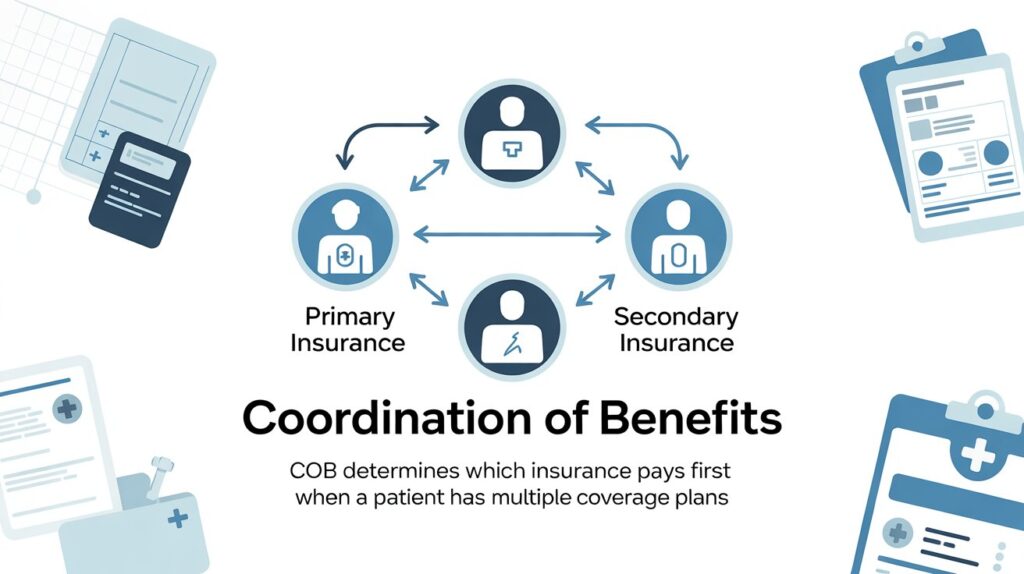
Coordination of benefits is the process insurance companies use to determine the order of payment when a patient has coverage from more than one insurance plan. COB rules establish which insurance pays first, which pays second, and how much each insurance pays. The goal is for the patient’s insurance to pay up to 100% of the allowed amount, without any duplicate payment or overpayment.
Without coordination of benefits, a patient with two insurance plans might try to collect full payment from both insurers for the same service. They could potentially receive more money than the service cost. Insurance companies prevent this through COB rules that specify payment order and limit total reimbursement to the actual allowed amount.
Primary vs Secondary Insurance
When a patient has multiple insurance coverages, one plan is designated as primary and the other as secondary. The terms have specific meanings that determine the billing order.
Primary insurance is the plan that pays first on a claim. The claim is submitted to primary insurance first. Primary insurance processes the claim according to their coverage policies and pays their portion based on their allowed amount, the patient’s deductible and coinsurance, and their plan benefits. Primary insurance pays without considering what any other insurance might pay. They process the claim as if they are the only insurance.
Secondary insurance is the plan that pays second on a claim. The claim is submitted to secondary insurance only after primary insurance has processed and paid their portion. Secondary insurance reviews what primary insurance paid and may pay some or all of the remaining patient responsibility. Secondary insurance can never pay more than they would have paid if they were primary. Their payment is limited to covering gaps left by primary insurance.
Some patients have tertiary insurance, which is third-level coverage that pays after both primary and secondary. This is less common but follows the same principle. Each level of insurance pays after the previous levels have processed the claim.
Why COB Rules Exist
Insurance companies created coordination of benefits rules to prevent duplicate payment for the same services. If both insurance plans paid as primary, the patient and provider could receive double payment. The patient might collect more than 100% of the cost, which would be inappropriate.
COB rules also prevent insurance companies from shifting responsibility to each other. Without clear rules about which insurance pays first, both insurance companies might claim the other should pay, leaving the claim in limbo indefinitely. COB rules establish clear hierarchy so there is no ambiguity about payment order.
The rules protect both insurance companies and patients. Insurance companies avoid overpayment. Patients receive maximum benefits by having two layers of coverage without paying premiums for duplicative benefits. Providers benefit by having clear rules about which insurance to bill first and in what order.
The Birthday Rule
One of the most common COB rules is the birthday rule. This rule applies when a child is covered under both parents’ insurance plans. The birthday rule states that the insurance plan of the parent whose birthday comes first in the calendar year is the child’s primary insurance. The other parent’s plan is secondary.
The birthday rule uses only the month and day of birth, not the year. If the father’s birthday is March 15 and the mother’s birthday is September 22, the father’s insurance is primary for the child because March comes before September. The year does not matter. Even if the mother is older, the father’s insurance is still primary because his birthday is earlier in the calendar year.
If both parents have the same birthday (month and day), the plan that has covered the parent longer is primary. Some states have different rules that override the birthday rule, but it is the standard in most states for dependent children with coverage from both parents.
Other Common COB Rules
The active vs inactive rule applies when one plan is from active employment and another is from retiree coverage or COBRA. The active employment plan is primary. The retiree or COBRA plan is secondary.
The Medicare secondary payer rules determine when Medicare is primary or secondary. These rules are complex and based on factors like employer size, disability status, and end-stage renal disease. Medicare is not always primary even though it is a government program.
The longer/shorter length of coverage rule may apply in certain situations. The plan that has covered the patient longer is primary. The newer plan is secondary. This applies when other rules do not establish a clear primary.
The right of recovery allows an insurance company that paid as primary to recover their payment if they later determine they should have paid as secondary. This can happen years after service if COB information changes or was incorrect initially.
| COB Term | Definition |
| Primary Insurance | Insurance plan that pays first on a claim |
| Secondary Insurance | Insurance plan that pays second after primary pays |
| Tertiary Insurance | Third level of coverage if patient has three plans |
| Birthday Rule | For dependent children, parent with earlier birthday in calendar year provides primary coverage |
| Active vs Inactive | Active employment coverage is primary over retiree or COBRA coverage |
| Medicare Secondary Payer | Rules determining when Medicare is secondary instead of primary |
| Allowed Amount | Maximum amount insurance considers appropriate for a service |
| COB Savings | Amount secondary insurance does not pay because primary already paid |
How to Determine Which Insurance is Primary
Determining the correct primary insurance is the most important step in COB. Getting this wrong causes claim denials, payment delays, and potential refunds. Multiple rules apply depending on the patient’s situation.
When Patient Has Two Plans in Their Own Name
When an adult has two insurance plans both in their own name, specific rules determine which is primary. If one plan is through current active employment and the other is retiree coverage, the active employment plan is primary. Active coverage always takes precedence over retiree coverage.
If the patient has coverage through their own employer and also through a spouse’s employer, the patient’s own employer plan is primary. The spouse’s plan is secondary. This applies even if the spouse’s plan has better benefits or lower out-of-pocket costs. Your own coverage is always primary over coverage through someone else.
If the patient has two active employer plans because they work two jobs, the plan from the job where they work more hours is typically primary. Some insurance companies use the longer coverage rule where the plan that has covered the patient longer is primary. Check with both insurance companies to determine their specific rule.
If one plan is from active employment and the other is COBRA continuation coverage, the active plan is primary. COBRA is always secondary to active coverage. If someone is on COBRA from a previous employer and starts a new job with insurance, the new employer plan becomes primary immediately.
When Child Has Coverage from Both Parents
The birthday rule is the standard for determining primary coverage for dependent children covered under both parents’ insurance plans. The plan of the parent whose birthday falls earlier in the calendar year is the child’s primary insurance. Only the month and day matter, not the year or who is older.
If the father’s birthday is January 10 and the mother’s birthday is December 5, the father’s plan is primary because January comes before December. If the mother’s birthday is February 28 and the father’s birthday is March 1, the mother’s plan is primary because February comes before March.
When both parents have the same birthday (same month and day), the plan that covered the parent longer is primary for the child. If the father has been on his employer plan for 10 years and the mother just started her employer plan, the father’s plan is primary.
If parents are separated or divorced, different rules apply. If a court order specifies which parent’s insurance is primary, the court order controls. If there is no court order, the birthday rule typically still applies. If a court order states that one parent is responsible for providing health insurance, that parent’s plan is primary.
If the parent with custody has remarried, the order is usually: custodial parent’s plan first, stepparent’s plan second, non-custodial parent’s plan third. This can vary by state and insurance company, so verification is important.
When Patient Has Medicare
Medicare coordination of benefits follows complex Medicare Secondary Payer rules. Whether Medicare is primary or secondary depends on multiple factors including the patient’s age, employment status, employer size, disability status, and presence of specific conditions.
For patients age 65 or older with employer coverage, Medicare is secondary if the employer has 20 or more employees. The employer plan is primary. Medicare is primary if the employer has fewer than 20 employees. The employer size determines the order. This applies when the patient or their spouse is actively employed.
For patients under 65 with Medicare due to disability who also have employer coverage, Medicare is secondary if the employer has 100 or more employees. The employer plan is primary. Medicare is primary if the employer has fewer than 100 employees.
For patients with Medicare due to end-stage renal disease (ESRD), the rules are different. The employer plan is primary for the first 30 months after dialysis starts or kidney transplant, regardless of employer size. After 30 months, Medicare becomes primary. This 30-month coordination period allows employer coverage to pay first initially.
For patients with Medicare and retiree coverage, Medicare is always primary. Retiree plans are always secondary to Medicare. The same applies to COBRA coverage. Medicare is primary over COBRA.
For patients with Medicare and Medicaid, Medicare is primary. Medicaid is secondary. Medicaid may pay Medicare deductibles and coinsurance as secondary coverage.
For patients with Medicare Advantage plans, the Medicare Advantage plan replaces Medicare Parts A and B. It coordinates with other coverage the same way traditional Medicare would based on the rules above.
When Patient Has Medicaid
Medicaid is almost always the payer of last resort. When a patient has Medicaid plus any other insurance, the other insurance is primary and Medicaid is secondary. This applies to commercial insurance, employer coverage, Medicare, and most other coverage types.
The only exception is when Medicaid is the patient’s only coverage. Then Medicaid is primary because there is no other coverage. Some Medicaid programs have specific rules for certain situations, so checking with the state Medicaid program is advisable when questions arise.
Patients who have both Medicare and Medicaid are called dual eligible. Medicare is primary and Medicaid is secondary. Medicare processes the claim first. Medicaid then covers Medicare’s deductible, coinsurance, and services Medicare does not cover if those services are covered by Medicaid.
When Patient Has TRICARE
TRICARE has specific coordination rules. For active duty service members, TRICARE is primary over all other insurance. For retired military and family members, TRICARE coordinates based on the situation.
TRICARE is secondary to employer-sponsored coverage when the patient or sponsor is actively employed. TRICARE is secondary to Medicare for Medicare-eligible beneficiaries. TRICARE is primary over Medicaid. TRICARE is primary over individual marketplace plans.
TRICARE For Life is specifically designed as secondary coverage to Medicare. For Medicare-eligible TRICARE beneficiaries, Medicare pays first and TRICARE For Life pays second, covering most of what Medicare does not cover.
Verifying Primary Coverage
The best way to verify which insurance is primary is to check with both insurance companies. Call the provider services line for each insurance and ask which they consider primary for this specific patient. Explain the patient has both plans and ask them to confirm primary/secondary order.
Many insurance companies provide this information on eligibility verification systems. When running eligibility, the system may indicate if other insurance is on file and whether it is primary or secondary. This electronic verification is faster than phone calls but should be verified if there is any doubt.
Ask the patient which insurance they believe is primary. While patients are not always correct, they often know based on previous medical claims. If the patient says one insurance always pays first and another always pays second, that is good indication of the COB order, though it should still be verified with the insurance companies.
Document the COB determination in the patient’s account. Note which insurance is primary, which is secondary, the date verified, who verified it, and what method was used. This documentation is important if questions arise later about why claims were billed in a specific order.
How to Bill COB Claims Correctly
Billing claims when a patient has multiple insurance coverages requires following a specific sequence and including the right information at each step. The process differs from billing when a patient has only one insurance.
Step 1: Bill Primary Insurance First
The first claim is submitted to primary insurance exactly as you would if the patient only had one insurance. The claim includes the patient’s information, provider information, date of service, diagnosis codes, procedure codes, charges, and all other standard claim elements. Do not mention secondary insurance on the primary claim. Bill primary insurance as if they are the only coverage.
Primary insurance processes the claim according to their policies. They apply the patient’s deductible if not yet met. They apply coinsurance percentages. They apply any copays. They calculate their payment based on their allowed amount and coverage rules. Primary insurance pays their portion and issues an Explanation of Benefits showing what they paid, what they adjusted, and what patient responsibility remains.
The amount primary insurance pays might be the full allowed amount if the patient has met their deductible and has good coverage. Or primary insurance might pay only a portion if the patient has a high deductible not yet met or high coinsurance percentage. Either way, primary insurance pays what they would pay if they were the only insurance, without considering that secondary insurance exists.
Wait for the primary insurance EOB before billing secondary insurance. Do not submit to secondary until primary has finished processing. Submitting to secondary too soon results in denial because secondary cannot process until they know what primary paid.
Step 2: Bill Secondary Insurance After Primary Pays
Once primary insurance has processed and paid, submit the claim to secondary insurance. The secondary claim must include additional information that the primary claim did not require.
The secondary claim must show the name of the primary insurance company, what primary insurance allowed, what primary insurance paid, what primary insurance adjusted as contractual write-off, and what patient responsibility remained after primary insurance. This information is usually pulled from the primary insurance EOB.
Most practice management systems can generate secondary claims that automatically include this information in the proper fields. For electronic claims, the primary payment information goes into the coordination of benefits segments. For paper CMS-1500 claims, it goes in specific boxes.
On the CMS-1500 form, Box 11-d asks “Is there another health benefit plan?” This box must be marked “Yes” when billing secondary insurance. Box 9 through 9-d contain information about the other insurance (the primary insurance). Include the primary insurance company name, policy group number, and other required information.
The claim to secondary insurance must also include a copy of the primary insurance EOB. Secondary insurance needs to see exactly what primary paid to determine their payment. Without the primary EOB, secondary insurance cannot process the claim. Send a clear copy of the EOB with every secondary claim.
Step 3: Secondary Insurance Processes the Claim
Secondary insurance reviews the claim and the primary EOB to see what primary insurance paid. They calculate what they would have paid if they were primary. This becomes their maximum potential payment.
Secondary insurance then looks at what patient responsibility remained after primary insurance paid. They may pay some or all of this remaining balance, up to their maximum. The payment from secondary insurance plus the payment from primary insurance cannot exceed the provider’s billed charge or the secondary insurance’s allowed amount, whichever is less.
Several scenarios are possible. If primary insurance paid the full allowed amount, secondary insurance pays nothing because there is no remaining patient responsibility. Secondary insurance saves money because primary covered everything.
If primary insurance left patient responsibility, secondary insurance may pay all of it, some of it, or none of it depending on their coverage policies. If secondary insurance has the same allowed amount as primary and would have paid the same amount, they pay whatever primary left as patient responsibility. The patient ends up with zero out-of-pocket.
If secondary insurance has a lower allowed amount than primary, they may pay nothing even though patient responsibility remains. They cannot pay more than they would have paid as primary. If their allowed amount is less than what primary already paid, they consider the claim paid in full.
Step 4: Determine Final Patient Responsibility
After both insurances have processed, the final patient responsibility is calculated. This is the amount the patient actually owes to the provider.
Final patient responsibility = Total billed charges minus primary insurance payment minus secondary insurance payment minus contractual adjustments.
Or more simply: Final patient responsibility = What primary insurance said patient owes minus what secondary insurance paid toward that amount.
This final amount is what the patient is billed. Do not bill the patient for amounts that were contractual adjustments between the provider and either insurance company. Only bill the patient for the actual remaining patient responsibility after both insurances have processed.
Some secondary insurance plans are designed to cover all patient responsibility from primary insurance. These are called wraparound or gap policies. When functioning properly, the patient owes nothing out of pocket because secondary covers all deductibles and coinsurance from primary.
Other secondary plans only partially cover patient responsibility. The patient will still owe something even after secondary pays. The patient statement should clearly show what each insurance paid and what the patient’s final responsibility is.
Electronic vs Paper COB Claims
Electronic claims for coordination of benefits work the same way as paper but with different fields. The claim to primary insurance is a standard electronic claim with no COB information. The claim to secondary insurance includes COB segments that contain the primary insurance information and payment details.
The Other Subscriber Information loop (2330) contains information about the primary insurance coverage. The Claim Level Adjustments loop (2430) contains information about how much primary insurance paid and adjusted. These electronic segments replace the information that would go in boxes 9-11 on a paper CMS-1500.
Most practice management systems and clearinghouses handle the technical details of formatting electronic COB claims. The biller enters the primary payment information into the system, and the system formats it correctly for the electronic claim. Always verify that systems are configured correctly to send COB information to secondary insurance.
Paper claims for COB require careful completion of specific boxes on the CMS-1500 form. Common errors include forgetting to mark Box 11-d “Yes,” not completing boxes 9-9d with primary insurance information, not attaching the primary EOB, or putting primary payment information in wrong boxes. Use the most current CMS-1500 claim form instructions for coordination of benefits.
| Billing Step | What to Do |
| 1. Bill primary first | Submit claim to primary insurance as if they are only coverage |
| 2. Wait for primary EOB | Do not bill secondary until primary has processed and paid |
| 3. Post primary payment | Record primary payment, adjustments, and remaining patient responsibility |
| 4. Bill secondary | Submit claim to secondary with primary payment information and EOB |
| 5. Wait for secondary EOB | Allow secondary insurance to process before billing patient |
| 6. Post secondary payment | Record secondary payment and calculate final patient responsibility |
| 7. Bill patient | Send statement for remaining balance after both insurances have paid |
Common COB Scenarios and How to Handle Them
Several typical coordination of benefits situations occur regularly in medical billing. Understanding how to handle each scenario prevents errors and speeds payment.
Both Parents Employer Coverage for Child
This is one of the most common COB scenarios. A child has coverage under both mother’s employer plan and father’s employer plan. The birthday rule determines which insurance is primary.
Check both parents’ birthdates. The parent with the earlier birthday in the calendar year provides primary coverage. Remember to use only month and day, not year. Submit the claim to primary insurance first. After primary processes, submit to secondary with the primary EOB.
In most cases, the child receives excellent coverage because between two employer plans, most or all patient responsibility is covered. Primary insurance pays first. Secondary insurance covers the deductible and coinsurance from primary. The parents may owe little or nothing out of pocket.
Document in the patient account which parent’s coverage is primary and which is secondary based on birthdays. Note the actual birthdays so staff can verify the order if questions arise. Update this information annually when insurance coverage renews, as parents may change jobs or coverage.
Patient with Employer Coverage and Spouse Coverage
An adult patient has coverage through their own employer and also through their spouse’s employer. The patient’s own employer coverage is always primary. The spouse’s coverage is secondary.
Submit the claim to the patient’s own employer plan first. Wait for that claim to process. Then submit to the spouse’s plan as secondary with the primary EOB attached. The spouse’s plan may cover some or all of the deductible and coinsurance from the patient’s own plan.
This scenario is common when both spouses work and both have good insurance benefits. Rather than both enrolling in one plan, they each keep their own employer coverage and add each other as dependents. This provides robust coverage with two layers.
Some couples discover that the cost of adding the spouse to one plan is high, so they maintain separate coverage through their own employers. Others find that having two plans provides better coverage than either plan alone. Billing staff must verify the COB order regardless of the reason for dual coverage.
Patient with Medicare and Employer Coverage
Whether Medicare or employer coverage is primary depends on employer size and the patient’s age or disability status. For patients 65 or older, Medicare is secondary if the employer has 20+ employees. Medicare is primary if the employer has fewer than 20 employees.
When employer coverage is primary, submit the claim there first. After the employer pays, submit to Medicare as secondary. Include the employer’s EOB with the Medicare claim.
Medicare will pay some or all of the remaining patient responsibility up to what they would have paid as primary.
When Medicare is primary, submit to Medicare first. Medicare processes and pays. Then submit to the employer plan as secondary with the Medicare EOB. The employer plan acts as supplemental coverage, potentially covering Medicare’s deductible and 20% coinsurance.
Verify the employer size before each claim. Employers grow and shrink, changing whether they meet the 20-employee threshold. The insurance company or patient may not always know the current employee count. Document the employer size and how it was verified.
Patient with Medicare and Medigap
Medicare beneficiaries often purchase Medigap (Medicare Supplement) policies to cover Medicare’s gaps. Medicare is always primary. Medigap is always secondary.
Submit the claim to Medicare first. Medicare processes according to their fee schedule and pays 80% after the Part B deductible is met. The patient would normally owe the deductible plus 20% coinsurance. Medicare sends the claim electronically to Medigap through the Medicare Crossover process in most cases.
Medigap receives the claim automatically from Medicare and processes it as secondary. Depending on the Medigap plan type (Plan A, Plan G, Plan N, etc.), Medigap pays some or all of Medicare’s deductible and coinsurance. The patient owes whatever Medigap does not cover.
Most Medigap claims process automatically through crossover without the provider needing to submit a separate claim. Verify that crossover is working by checking if Medigap payments are received. If Medigap does not seem to be processing automatically, contact Medigap company to troubleshoot the crossover.
Patient with Medicare and Medicaid
Patients who qualify for both Medicare and Medicaid are called dual eligible. Medicare is always primary. Medicaid is always secondary.
Submit the claim to Medicare first. Medicare processes and pays according to their fee schedule. Medicare then automatically crosses the claim over to Medicaid electronically in most states. Medicaid receives the claim and processes as secondary.
Medicaid as secondary will typically pay Medicare’s deductible and coinsurance, bringing the patient’s out-of-pocket cost to zero. Medicaid may also pay for services Medicare does not cover if those services are covered by Medicaid. The claim is submitted to Medicaid for services Medicare denied as non-covered.
Providers who accept both Medicare and Medicaid cannot balance bill dual eligible patients. Any amount not covered by Medicare and Medicaid must be written off. The patient owes nothing except for non-covered services if they were properly notified in advance.
Verify that automatic crossover to Medicaid is functioning. Most states have electronic crossover, but some require manual billing to Medicaid. Check with the state Medicaid program to understand their crossover process and whether manual claims are needed.
Patient with Commercial Insurance and Medicaid
When a patient has commercial insurance and Medicaid, commercial insurance is primary and Medicaid is secondary. Submit the claim to commercial insurance first. After commercial insurance pays, submit to Medicaid as secondary with the commercial insurance EOB.
Medicaid as secondary will pay some or all of the patient responsibility from commercial insurance. This includes deductibles, coinsurance, and copays. Medicaid may also pay amounts the commercial insurance denied if those services are covered by Medicaid.
Providers who accept Medicaid cannot balance bill Medicaid patients for services covered by Medicaid. The patient owes nothing for covered services after both insurance processes. Any amount not paid by commercial insurance and Medicaid must be written off unless the service is not covered by Medicaid and the patient was properly notified.
Some commercial insurance plans have deductibles of thousands of dollars. When Medicaid is secondary, Medicaid covers this deductible, protecting low-income patients from high out-of-pocket costs. This coordination allows patients to access care even if they have high-deductible commercial insurance plans.
Patient with Three or More Insurances
Some patients have three or even four insurance plans. This is less common but happens. The same COB principles apply with additional layers.
Determine the order of all insurances using applicable COB rules. The first insurance is primary. The second is secondary. The third is tertiary. Bill in order: primary first, secondary after primary pays, tertiary after secondary pays.
Each insurance in the sequence receives a claim showing what all previous insurances paid. Tertiary insurance sees what both primary and secondary paid before calculating their payment. Each insurance pays up to what they would have paid if they were primary, but only to the extent there is remaining balance.
With three or more insurances, patient responsibility is often zero. The layers of coverage combine to pay the full allowed amount. Practices receive maximum reimbursement for services, though the billing process takes longer as claims move through each insurance sequentially.
Document the insurance order clearly and verify it annually. Three-way or four-way COB is complex and prone to errors if the order is incorrect. Take time to verify with each insurance company which order they expect claims to be submitted.
COB Rules for Specific Insurance Types
Different insurance types have different coordination of benefits rules. Understanding these type-specific rules prevents billing errors.
Medicare COB Rules
Medicare coordination of benefits is governed by Medicare Secondary Payer (MSP) rules. These rules are federal law and override other insurance company policies. Getting Medicare COB wrong can result in serious compliance issues.
Medicare is primary for most Medicare beneficiaries most of the time. But Medicare is secondary when the beneficiary has employer coverage and the employer meets size thresholds (20+ employees for age-based Medicare, 100+ employees for disability-based Medicare), when the claim is related to a work injury covered by workers’ compensation, when the claim is related to an auto accident with no-fault insurance or liability coverage, when the claim is related to black lung disease, or during the first 30 months of ESRD for patients with employer coverage.
Providers must ask Medicare beneficiaries about other insurance coverage. CMS provides a questionnaire for determining MSP situations. Providers must document responses and bill accordingly. Billing Medicare as primary when they should be secondary can result in overpayment recovery and penalties.
When Medicare is secondary, they require specific information about why they are secondary. The claim must include the MSP reason code (working aged, ESRD, disability, etc.) and information about the primary insurance. Medicare will not process as secondary without this information.
Medicare has the right to recover payments made as primary if they later discover they should have been secondary. These recoveries can happen years later. Providers who received Medicare payment when employer coverage should have paid first may have to refund Medicare.
Medicare Advantage COB Rules
Medicare Advantage plans replace Medicare Parts A and B. They coordinate with other insurance the same way traditional Medicare would based on MSP rules. If traditional Medicare would be primary in a situation, Medicare Advantage is primary. If traditional Medicare would be secondary, Medicare Advantage is secondary.
The difference is that Medicare Advantage plans have their own provider networks, authorization requirements, and claims processing procedures. When Medicare Advantage is secondary to employer coverage, the employer plan is billed first. After the employer pays, the claim goes to Medicare Advantage, not traditional Medicare.
Medicare Advantage plans often have different allowed amounts than traditional Medicare. Their secondary payment may be more or less than traditional Medicare would have paid. Some Medicare Advantage plans have copays for services even when they are secondary, though they cannot charge more than they would have charged if they were primary.
Verify whether a Medicare patient has traditional Medicare or Medicare Advantage before billing. The two systems are completely separate for billing purposes even though both are Medicare programs.
Medicaid COB Rules
Medicaid is nearly always the payer of last resort. Medicaid pays after all other available insurance has paid. This is federal law for Medicaid programs.
Providers must attempt to collect from all other insurance before billing Medicaid. If a patient has commercial insurance and Medicaid, the commercial insurance must be billed first. Only after commercial insurance has been processed can Medicaid be billed as secondary.
Each state Medicaid program has specific requirements for coordination of benefits. Some states require providers to submit claims to Medicaid within certain timeframes after primary insurance pays. Some states accept automatic crossover from Medicare or commercial insurance. Others require manual submission of secondary claims.
When Medicaid is secondary, they typically pay the patient’s out-of-pocket costs from primary insurance including deductibles, coinsurance, and copays. Medicaid may also pay for services the primary insurance denied if those services are Medicaid-covered.
Providers cannot balance bill Medicaid patients for covered services. Any amount not paid by primary insurance and Medicaid must be written off. Patient billing for covered services violates Medicaid provider agreements.
Medicaid has third-party liability (TPL) programs that pursue other insurance coverage on behalf of Medicaid patients. If Medicaid discovers a patient has other insurance that was not billed, Medicaid can deny claims and require billing the other insurance first, even retroactively.
Commercial Insurance COB Rules
Commercial insurance companies each have their own COB rules within the framework of standard practices. Most follow National Association of Insurance Commissioners (NAIC) model COB regulations, but variations exist.
Standard commercial COB rules include: patient’s own employer coverage is primary over coverage as a dependent on someone else’s policy, active employment coverage is primary over COBRA or retiree coverage, the plan covering the patient longer is primary when both are in the patient’s own name, and the birthday rule applies for dependent children.
Commercial insurance as primary processes claims normally without considering other coverage. Commercial insurance as secondary reviews what primary paid and may pay some or all of remaining patient responsibility up to what they would have paid as primary.
Some commercial plans are designed specifically as secondary or gap coverage. These plans only exist to cover out-of-pocket costs from primary insurance. They work well in COB situations because they intentionally fill gaps.
Provider contracts with commercial insurance may specify how COB is handled. Some contracts require providers to accept the combined payment from both insurances as payment in full.
Others allow balance billing for amounts not covered. Review contracts to understand each payer’s specific COB requirements.
TRICARE COB Rules
TRICARE coordinates with other insurance based on the beneficiary’s status. For active duty service members, TRICARE is always primary. Other insurance is secondary.
For TRICARE beneficiaries who are not active duty, TRICARE coordinates based on the type of other insurance. TRICARE is secondary to employer-sponsored plans for the beneficiary or sponsor. TRICARE is secondary to Medicare. TRICARE is primary over Medicaid and CHAMPVA.
TRICARE For Life is specifically designed as secondary coverage to Medicare for TRICARE beneficiaries age 65+. Medicare pays first. TRICARE For Life pays second, covering most of what Medicare does not cover. Together, Medicare and TRICARE For Life provide comprehensive coverage with little patient out-of-pocket cost.
When TRICARE is secondary, they require the primary insurance EOB to be submitted with the claim. TRICARE will not process secondary claims without proof of primary payment. TRICARE has specific forms and procedures for secondary claims that differ from their primary claim procedures.
TRICARE also has a double coverage provision. If a beneficiary has other health insurance, they must inform TRICARE. Failing to report other coverage can result in claims being denied or TRICARE seeking reimbursement for amounts they paid that should have been covered by the other insurance.
What Happens When COB Goes Wrong
Coordination of benefits errors cause claim denials, payment delays, incorrect patient billing, and compliance problems. Understanding what goes wrong helps prevent these issues.
Billing in Wrong Order
The most common COB error is billing insurances in the wrong order. If secondary insurance is billed before primary insurance, the claim will be denied. Secondary insurance requires proof that primary insurance already processed the claim. Without that proof, they cannot determine their payment responsibility.
When this happens, the secondary insurance denial states something like “primary insurance must process first” or “coordination of benefits issue.” The claim must be withdrawn from secondary insurance, submitted to primary insurance, and then resubmitted to secondary after primary pays.
This error delays payment significantly. The claim goes to the wrong insurance first and gets denied. Then it goes to the correct primary insurance and waits in their processing queue. After primary pays, it goes back to secondary insurance and waits again. What could have been a 30-day payment becomes a 90-day or longer process.
Prevention requires verifying insurance orders before submitting any claim. Check with both insurance companies to confirm which is primary. Document the verification. Create system flags that prevent billing secondary insurance until primary has paid.
Both Insurances Deny as Secondary
Sometimes both insurance companies claim they are secondary and both deny the claim stating the other insurance should pay first. This creates a standstill where neither insurance will pay.
This happens when COB information is wrong in one or both insurance companies’ systems. Insurance A thinks they are secondary because their records show other insurance is primary. Insurance B thinks they are secondary because their records show Insurance A is primary. Both deny the claim.
Resolving this requires contacting both insurance companies and providing documentation that establishes the correct primary insurance. This might include employment verification letters, coverage effective dates, birth dates for birthday rule situations, or employer size verification for Medicare situations.
One insurance company needs to acknowledge they are actually primary and accept the claim. Once they process as primary, their EOB is used to bill the other insurance as secondary. The process can take weeks or months of back-and-forth communication with insurances.
Prevention involves ensuring both insurance companies have correct information about the other coverage in their systems. When verifying benefits, ask if they show other insurance on file and verify they have the correct primary/secondary designation.
Primary Insurance Pays, Secondary Denies
Sometimes primary insurance processes and pays, but when the claim is submitted to secondary insurance, they deny it. Common denial reasons from secondary insurance include: claim not received from primary insurance (crossover failure), primary EOB not attached to manual claim, secondary insurance allowed amount is less than what primary already paid so nothing additional is due, service not covered by secondary insurance even though covered by primary, or patient not eligible for secondary coverage on date of service.
Each denial reason requires different resolution. If crossover failed, contact secondary insurance to set up crossover or submit the claim manually with primary EOB. If primary EOB was missing, resubmit with complete EOB attached. If secondary allowed amount is lower, explain this to the patient and bill them for the difference if allowable. If service is not covered by secondary, write off the amount if balance billing is not permitted or bill the patient if it is permitted. If patient eligibility is questioned, provide proof of coverage to secondary insurance.
Some denials from secondary insurance are appropriate, and the patient remains responsible for the balance. Other denials are erroneous and should be appealed with documentation.
Determine which situation applies before deciding whether to appeal or bill the patient.
Incorrect Patient Responsibility Billed
When COB claims are not handled correctly, patients may be billed incorrectly. Common errors include billing the patient before secondary insurance has processed, billing the patient for amounts that are contractual adjustments, billing the patient for amounts secondary insurance will pay, or not crediting the patient’s account when secondary insurance pays.
These errors damage patient relationships and may violate billing regulations. Patients who receive bills for amounts they do not owe will complain, dispute the charges, and may refuse to pay legitimate amounts they do owe.
Prevention requires having clear procedures for when patient statements are generated in COB situations. Do not bill the patient until both primary and secondary insurance have processed.
Make sure staff clearly understand which amounts are the patient’s responsibility and which are contractual adjustments. Post secondary insurance payments promptly and credit patient accounts.
When patients are billed incorrectly, issue corrected statements immediately. Apologize for the error. Explain what happened and what the correct amount is. If the patient already paid an amount they did not owe, refund it promptly.
Insurance Reprocesses and Takes Back Money
Sometimes an insurance company that previously processed a claim as primary or secondary reprocesses it and takes back their payment. This happens when they receive updated COB information showing they should have paid differently.
Common scenarios include: insurance finds out patient had other coverage on date of service that they did not know about when they originally processed, insurance determines they were secondary when they paid as primary and now wants the money back, insurance determines they were primary when they paid as secondary and now wants to pay the right amount, or claim was processed twice by mistake.
When insurance takes back money (called recoupment or recovery), they typically deduct it from future payments to the provider. The provider’s account with that insurance suddenly shows a negative balance. The provider receives a letter explaining the recoupment.
Providers must then determine if the recoupment is valid. If the insurance company is correct and they overpaid due to COB issues, the provider must accept the recoupment. If other insurance should have paid, that insurance must now be billed. If the recoupment is incorrect, it must be appealed with documentation showing the original payment was correct.
Prevention requires collecting accurate insurance information upfront, verifying all coverage before services, documenting COB determinations, and billing insurances in the correct order. Most recoupments are avoidable if COB is handled correctly initially.
Preventing COB Billing Errors
Coordination of benefits errors are preventable with proper systems and procedures. Implementing these practices reduces denials and speeds payment.
Verify All Coverage at Every Visit
Never assume a patient has the same insurance they had last time. Verify coverage at every visit. Ask if the patient has any other insurance coverage besides what is on file. Ask if anything has changed with their insurance. Check both insurance cards.
Run electronic eligibility verification on all insurance coverage. Many systems can identify when a patient has multiple coverages. The eligibility response may indicate other insurance is present and whether it is primary or secondary.
Ask specific questions: Do you have insurance through your employer? Does your spouse have insurance through their employer? Are you covered on your spouse’s plan? Does your child have insurance through the other parent? Do you have Medicare? Do you have Medicaid? Do you have TRICARE? Each question helps identify all possible coverage.
Document all coverage in the patient’s account with effective dates. Update insurance information whenever changes occur. Mark which insurance is primary and which is secondary with verification date and method.
Contact Insurance Companies to Confirm COB Order
Do not guess which insurance is primary. Call both insurance companies and confirm the COB order. When you call, state that the patient has both Insurance A and Insurance B, and ask which insurance they consider primary.
Most insurance companies can confirm this during the eligibility verification call. They will state “we show we are primary” or “we show we are secondary to [other insurance].” Document this confirmation.
If the two insurance companies give conflicting information about which is primary, work with them to resolve it. Provide information needed to establish the correct order based on COB rules. This might include birth dates, employment information, or coverage effective dates.
Resolving COB order discrepancies before submitting claims prevents denials and delays. The few minutes spent verifying saves hours of appeals and resubmissions later.
Use System Flags and Edits
Configure practice management systems to flag accounts with multiple insurance coverages. Create alerts that remind staff to verify COB order. Set up system edits that prevent billing secondary insurance until primary has paid.
Some systems can automatically determine primary insurance based on COB rules programmed into the system. If birth dates are entered for parents, the system applies the birthday rule. If Medicare and employer coverage are both on file, the system asks about employer size to determine order.
Even with automated systems, staff should verify the system’s determination is correct. Technology helps but should not replace human judgment and verification. Use technology as a tool to support the COB process, not as the sole determinant.
Train Staff on COB Rules
All staff who handle registration, insurance verification, and billing must understand coordination of benefits rules. Provide training on the birthday rule, active vs inactive coverage, Medicare secondary payer rules, and Medicaid as payer of last resort.
Use real examples to illustrate COB scenarios. Walk through how to determine primary insurance in different situations. Practice identifying which insurance to bill first. Review actual denials that occurred due to COB errors and discuss how to prevent them.
Test staff knowledge periodically. Give scenarios and ask staff to identify which insurance is primary. Review COB rules during staff meetings. Keep reference materials easily accessible.
When new COB rules or payer-specific requirements are identified, communicate them to all relevant staff immediately. COB rules can change, and staying current prevents errors.
Document COB Verification
Document when and how COB order was verified. Note in the patient account: “COB verified [date] – Insurance A is primary per phone call with both insurances” or similar documentation.
This documentation serves multiple purposes. It shows the claim was submitted to the correct insurance first based on verification at the time. It provides a reference point if insurance later questions the order. It confirms that staff followed proper procedures.
If a claim is later denied for COB issues and the practice can show they verified the order with both insurance companies, the appeal is stronger. The practice can demonstrate they acted on information provided by the insurance companies themselves.
Handle Primary and Secondary Claims Separately
Create separate workflows for primary and secondary claims. Primary claims can be submitted as soon as services are rendered. Secondary claims must wait until primary pays.
Set up a holding area or work queue for claims awaiting secondary submission. When primary insurance EOB arrives, the claim moves to this queue for secondary billing. This helps prevent secondary claims from being overlooked and makes sure they are submitted promptly after the primary claim is processed.
Track the time between primary payment and secondary submission. Long delays mean lost interest on the money and patient frustration. Aim to submit secondary claims within a few days of receiving primary payment.
Monitor COB Claim Denials
Track all denials related to coordination of benefits. Categorize them by denial reason: wrong order, missing EOB, eligibility issues, etc. Analyze patterns to identify root causes.
If many denials occur for one specific reason, implement targeted solutions. If claims are frequently denied because EOBs were not attached, create a checklist for secondary claim submission. If claims go to the wrong insurance first, enhance front-end verification.
Review COB denials at regular billing meetings. Discuss what went wrong and how to prevent it. Share successful resolution strategies. Celebrate when COB denial rates decrease due to process improvements.
Conclusion
Coordination of benefits is the process insurance companies use to determine payment order when patients have multiple insurance coverages. COB rules establish which insurance is primary, which is secondary, and how much each pays. The goal is ensuring patients receive full coverage up to 100% of allowed amounts without overpayment.
Primary insurance is the plan that pays first. Claims are submitted to primary insurance without mentioning other coverage. Primary pays according to their policies without considering other insurance exists. Secondary insurance pays second after reviewing what primary paid.
Secondary may pay some or all remaining patient responsibility up to what they would have paid as primary.
Common COB rules include the birthday rule for dependent children (parent with earlier birthday in calendar year provides primary coverage), patient’s own employer coverage is primary over spouse coverage, active employment coverage is primary over retiree or COBRA coverage, and Medicare secondary payer rules determine when Medicare is primary or secondary based on employer size and other factors.
Determining correct primary insurance requires understanding the patient’s insurance situation, applying appropriate COB rules, and verifying with both insurance companies. Billing COB claims correctly requires submitting to primary first, waiting for primary payment, then submitting to secondary with primary EOB attached, and billing patients only for final remaining balance after both insurance processes.
Common COB errors include billing in the wrong order, both insurances denied as secondary, incorrect patient responsibility billed, and insurance recouping payments when COB information changes. These errors cause payment delays, additional work, and patient dissatisfaction.
Prevention strategies include verifying all coverage at every visit, contacting insurance companies to confirm COB order, using system flags and edits, training staff thoroughly on COB rules, documenting verification, handling primary and secondary claims separately, and monitoring COB denials to identify improvement opportunities.
Understanding coordination of benefits and following proper procedures helps claims get paid correctly and on time when patients have multiple insurance coverages. COB expertise is required for practices serving patients with employer coverage, Medicare, Medicaid, and other insurance combinations.