Skip to main content
A Complete Guide to Medical Billing Codes and Their Uses
(ICD-10, CPT, POS, DRG, Revenue Codes, NDC, CDT and HCPCS)
Medical billing can feel like learning a new language. Doctors see patients, help them get better, and then need to get paid for their work. But insurance companies need proof. They need to know exactly what the doctor did and why.
That’s where medical billing codes come in. These codes are like a special language that doctors and insurance companies both understand. Every treatment, every test, and every medicine has its own code.
Think of it like a menu at a restaurant. The kitchen needs to know exactly what you ordered. The same way, insurance companies need to know exactly what medical care you got.
This guide will help you understand all the different types of codes used in medical billing. We’ll keep it simple and clear.
What Are Medical Billing Codes?
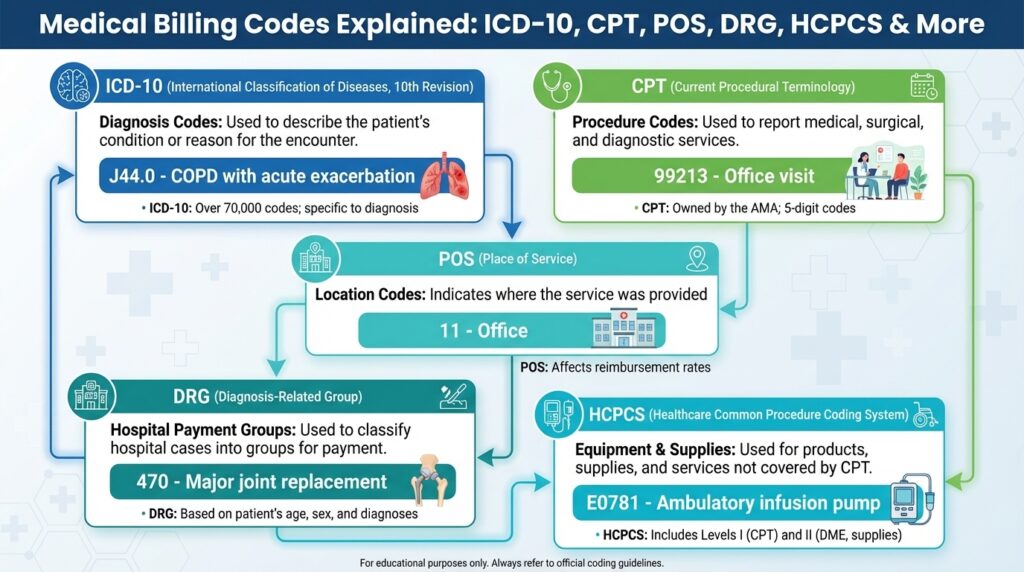
Medical billing codes are short numbers or letters that stand for medical services. When you visit a doctor, everything that happens gets written down using these codes.
Your doctor examines you. That’s a code. You get a blood test. That’s another code. You receive medicine. That’s yet another code.
These codes go on your medical bill. Insurance companies read these codes to decide if they will pay. No codes means no payment.
Different codes do different jobs. Some codes tell what’s wrong with you. Other codes tell what the doctor did to help. Some codes tell where you got treatment.
Let’s look at each type of code and learn how they work.
ICD-10 Codes: What Is Wrong With You
ICD-10 stands for International Classification of Diseases, 10th Edition. These codes tell insurance companies what health problem you have.
Did you break your arm? There’s an ICD-10 code for that. Do you have diabetes? There’s a code for that too. Even a common cold has its own code.
ICD-10 codes usually have 3 to 7 characters. They start with a letter, then have numbers. Sometimes they have more letters at the end.
For example, the code E11.9 means Type 2 diabetes. The code J20.9 means acute bronchitis.
Doctors must pick the right ICD-10 code. If they pick the wrong one, insurance might not pay. The code must match what the patient actually has.
Common ICD-10 Code Categories
ICD-10 codes are organized by body system and type of disease. Each letter at the start tells you what kind of problem it is.
Codes that start with “I” are for heart and blood vessel problems. Codes starting with “J” are for breathing problems. “M” codes are for bone and muscle issues.
This system helps keep everything organized. It makes it easier to find the right code.
Why ICD-10 Codes Matter
These codes are very important. They prove that treatment was necessary. Insurance companies check if the treatment makes sense for the diagnosis.
If a patient has a broken leg, getting a cast makes sense. But if the ICD-10 code says “sore throat,” insurance will question why the doctor put on a cast.
The codes must match the treatment. This is called medical necessity.
CPT Codes: What the Doctor Did
CPT stands for Current Procedural Terminology. These codes describe what the doctor actually did during your visit.
Did the doctor examine you? That’s a CPT code. Did they do surgery? That’s a different CPT code. Every action has its own number.
CPT codes are 5-digit numbers. They were created by the American Medical Association. Doctors across the country use the same codes.
For example, code 99213 is for a regular office visit. Code 80053 is for a basic blood test panel.
Three Categories of CPT Codes
CPT codes come in three main groups.
- Category I codes are the most common. They cover most medical services like exams, surgeries, and tests.
- Category II codes are optional. They help track quality of care. Not all practices use them.
- Category III codes are for new procedures. When doctors start doing something new, it gets a temporary Category III code.
How CPT Codes Work With ICD-10
CPT and ICD-10 codes work together like a team. ICD-10 says what’s wrong. CPT says what was done about it.
A patient comes in with chest pain (ICD-10 code). The doctor does an EKG (CPT code). Together, these codes tell the complete story.
Insurance looks at both codes. They check if the procedure matches the diagnosis. Both codes must make sense together.
Place of Service (POS) Codes: Where Treatment Happened
POS codes are simple. They tell where the patient got medical care.
Was it at the doctor’s office? At a hospital? In an ambulance? Each location has its own 2-digit code.
These codes matter because insurance pays different amounts based on location. Hospital care costs more than office care. The POS code helps insurance know what to expect.
Common POS Codes You Should Know Here are some POS codes you might see: Common Place of Service Codes
| POS Code | Location | When It’s Used |
| 11 | Doctor’s office | Regular checkups and visits |
| 12 | Patient’s home | Home health care visits |
| 21 | Inpatient hospital | Staying overnight in hospital |
| 22 | Outpatient hospital | Hospital visit without staying |
| 23 | Emergency room | Emergency medical care |
| 81 | Independent lab | Blood tests and other lab work |
The right POS code makes sure everyone knows where care happened. It helps prevent confusion and billing mistakes.
DRG Codes: Hospital Payment Groups
DRG stands for Diagnosis Related Group. These codes are only used when patients stay in the hospital overnight.
Hospitals don’t bill for every single thing separately. Instead, they group related services together. That’s what DRG codes do.
Let’s say someone has their appendix removed. The DRG code covers the surgery, the hospital room, meals, nursing care, and medicines. Everything is bundled together.
Medicare created DRG codes to control hospital costs. Now many insurance companies use them too.
How DRG Codes Are Assigned
When you leave the hospital, coders look at your medical records. They check your diagnosis, what procedures you had, and if you had complications.
All this information gets turned into one DRG code. That code determines how much the hospital gets paid.
Hospitals get the same payment for everyone with the same DRG code. This encourages hospitals to be efficient.
DRG Codes and Length of Stay
Each DRG code has an expected length of stay. If someone stays longer than expected, the hospital might not get extra money.
This system pushes hospitals to get patients healthy and home as quickly as safely possible.
But it also means hospitals must code correctly. The wrong DRG code means wrong payment.
Revenue Codes: Hospital Department Charges
Revenue codes are another type of hospital code. They tell which hospital department provided the service.
Did you get X-rays in the radiology department? That department has a revenue code. Did you stay in the intensive care unit? That’s a different revenue code.
Revenue codes are 4-digit numbers. They appear on detailed hospital bills.
Common Hospital Revenue Codes
Sample Revenue Codes by Department
| Revenue Code | Department | What It Covers |
| 0120 | Room and board | Basic hospital room charge |
| 0250 | Pharmacy | Medications given in hospital |
| 0300 | Laboratory | Blood tests and lab work |
| 0320 | Radiology | X-rays and imaging tests |
| 0450 | Emergency room | ER visit and treatment |
| 0710 | Recovery room | Post-surgery recovery care |
These codes help track charges from different departments. They make hospital bills more detailed and clear.
Why Hospitals Need Revenue Codes
Hospitals are big organizations with many departments. Each department needs to track its charges.
Revenue codes help hospitals manage their money. They show which departments are busiest and which services cost most.
Insurance companies also look at revenue codes. They check if charges match the DRG code and make sense.
NDC Codes: Medicine Identification Numbers
NDC stands for National Drug Code. These codes identify specific medicines.
Every medicine bottle has an NDC code. This includes pills, liquids, injections, and creams.
NDC codes have 10 or 11 digits split into three parts. The first part tells who makes the medicine. The second part tells what the medicine is. The third part tells the package size.
For example, a bottle of 100 aspirin tablets has a different NDC code than a bottle of 30 aspirin tablets. Same medicine, different package, different code.
When NDC Codes Are Required
Doctors’ offices must use NDC codes when they give you medicine during your visit. If a doctor gives you a shot, they bill the NDC code for that medicine.
Pharmacies always use NDC codes. Every prescription filled gets recorded with its NDC code.
Medicare and Medicaid require NDC codes for medicine billing. Many private insurance companies do too.
NDC Codes Prevent Fraud
These codes help stop billing fraud. They prove exactly what medicine was given.
Without NDC codes, someone could say they gave expensive medicine when they really gave cheap medicine. The codes keep everyone honest.
NDC codes also help track medicine shortages and safety recalls.
CDT Codes: Dental Treatment Codes
CDT stands for Code on Dental Procedures and Nomenclature. These are codes just for dental care.
Dentists use different codes than medical doctors. They have their own system because teeth are special.
CDT codes start with the letter “D” followed by 4 numbers. They cover everything from teeth cleaning to root canals.
Common Dental Procedures and Their Codes
Basic CDT Codes for Dental Care
| CDT Code | Procedure | Description |
| D0120 | Periodic oral evaluation | Regular checkup visit |
| D0220 | X-rays (first film) | First dental X-ray image |
| D1110 | Prophylaxis (cleaning) | Basic teeth cleaning |
| D2140 | Amalgam filling (one surface) | Simple silver filling |
| D7140 | Tooth extraction | Removing a tooth |
| D9230 | Nitrous oxide | Laughing gas for pain |
Dental insurance works differently than medical insurance. Many dental plans have yearly limits. CDT codes help track how much of that limit has been used.
Why Dentists Need Special Codes
Teeth and dental work are very different from other medical care. Dentists need codes that make sense for what they do.
Medical codes don’t have good options for things like braces, crowns, or teeth whitening. That’s why CDT codes exist.
The American Dental Association creates and updates these codes every year.
HCPCS Codes: Supplies and Special Services
HCPCS stands for Healthcare Common Procedure Coding System. These codes cover things that CPT codes don’t include.
HCPCS codes handle medical supplies, equipment, and some services. Things like wheelchairs, walkers, ambulance rides, and hearing aids all have HCPCS codes.
There are two levels of HCPCS codes.
Level I HCPCS: Just Another Name for CPT
Level I HCPCS codes are actually the same as CPT codes. It’s just a different name. When people say HCPCS, they usually mean Level II.
Level II HCPCS: Equipment and Supplies
Level II HCPCS codes start with a letter from A to V. Then they have 4 numbers.
These codes cover a wide range of items and services. Prosthetic limbs, diabetic supplies, and durable medical equipment all use HCPCS codes.
HCPCS Code Categories
| Letter Range | What It Covers | Examples |
| A codes | Medical supplies | Bandages, crutches, surgical trays |
| E codes | Durable medical equipment | Wheelchairs, hospital beds, walkers |
| J codes | Injectable drugs | Vaccines, IV medications |
| K codes | Temporary codes | New items waiting for permanent codes |
| L codes | Orthotics and prosthetics | Artificial limbs, back braces |
| V codes | Vision and hearing | Glasses, hearing aids, contacts |
When You’ll See HCPCS Codes
If you get medical equipment, you’ll see HCPCS codes on your bill. If you need a wheelchair, that’s an E code. If you get a special bandage, that’s an A code.
Ambulance companies use HCPCS codes. So do companies that provide oxygen tanks or hospital beds for home use.
These codes help insurance know exactly what equipment or supplies were provided.
How All These Codes Work Together
Medical billing uses multiple codes at once. Each code tells part of the story. Here’s an example of how it works:
A patient goes to their doctor’s office with a cough. The doctor examines them and orders a chest X-ray. The patient has pneumonia. The doctor prescribes antibiotics.
Now let’s see the codes:
- ICD-10 code: J18.9 (pneumonia)
- CPT code: 99213 (office visit)
- CPT code: 71046 (chest X-ray)
- POS code: 11 (doctor’s office)
- NDC code: For the antibiotic given
All these codes together tell the complete story of what happened.
The Billing Process Step by Step
When you get medical care, here’s what happens behind the scenes:
First, the doctor or nurse writes notes about your visit. They document what’s wrong and what they did.
Next, a medical coder reads those notes. They pick the right codes based on what the notes say.
Then, someone creates a claim. This is like a bill that goes to insurance. It has all the codes on it.
The insurance company receives the claim. They check all the codes. They make sure everything makes sense together.
If approved, insurance pays. If something looks wrong, they ask for more information.
Why Correct Coding Matters
Getting codes right is very important. Wrong codes can cause big problems.
If codes are wrong, insurance might deny payment. The doctor’s practice doesn’t get paid for their work. The patient might get a surprise bill.
Wrong codes can also cause legal trouble. Using the wrong code on purpose to get more money is fraud. People can go to jail for billing fraud.
That’s why medical coders get special training. They learn how to read medical notes and pick the right codes. It’s an important job.
Common Coding Mistakes to Avoid
Even with training, mistakes happen. Here are some common coding errors:
Common Medical Billing Coding Errors
| Mistake | What It Means | Why It’s a Problem |
| Upcoding | Using a code for more complex service | Makes it look like more was done than really happened |
| Downcoding | Using a code for less complex service | Doctor gets paid less than they should |
| Unbundling | Billing separately for things that should be bundled | Charges more than allowed |
| Wrong diagnosis code | ICD-10 doesn’t match what patient has | Insurance denies claim for no medical necessity |
| Missing modifier | Not adding extra code that gives important details | Claim gets rejected or paid wrong |
| Duplicate billing | Billing for same service twice | Looks like fraud even if it’s an accident |
These mistakes can be honest errors or done on purpose. Either way, they cause problems.
How to Prevent Coding Mistakes
Good practices have systems to catch errors. They might have two people check important codes. They use computer programs that flag weird code combinations.
Regular training helps too. Coding rules change every year. Coders need to stay up to date.
Some practices hire coding specialists. These experts focus only on getting codes right. They don’t do other office work.
Changes and Updates to Medical Codes
Medical codes don’t stay the same forever. They get updated regularly.
ICD-10 codes get small updates every year on October 1st. Sometimes new diseases are discovered. Old codes might need to be more specific.
CPT codes change every January 1st. New medical procedures get added. Old procedures that no one does anymore get removed.
Why Codes Change
Medicine is always advancing. New treatments are invented. New diseases are discovered. The codes need to keep up.
Technology brings new changes too. When MRI machines were invented, they needed new codes. When robot surgery became possible, it needed codes.
Insurance rules change as well. Sometimes codes get split into more specific versions. This helps insurance understand exactly what was done.
Staying Current With Code Changes
Medical coders must learn the new codes every year. Many take classes or attend training sessions.
Coding books get published every year with all the updates. Practices buy new books so they have current information.
Computer billing systems also get updated. When codes change, the software needs to change too.
The Future of Medical Billing Codes
Medical coding keeps getting more detailed and specific. The trend is toward more codes, not fewer.
Some people think artificial intelligence will help with coding. Computers might read doctor’s notes and suggest codes automatically. Humans would still check to make sure the computer picked correctly.
Moving Toward Electronic Systems
More practices are going paperless. Everything is stored in computers now.
Electronic health records can suggest codes based on what the doctor types. This makes coding faster and more accurate.
Claims get sent electronically too. This speeds up the whole billing process. Payments come faster.
International Standardization
Different countries are working to use similar codes. This helps when people travel or move between countries.
ICD codes are already used worldwide. Other code systems might become more international too.
This makes it easier to compare health data between countries. It helps track diseases that spread across borders.
Tips for Patients About Medical Codes
You don’t need to memorize all these codes. But knowing they exist helps you understand your medical bills.
Here are some things patients should know:
What Patients Should Do With Medical Codes
| Action | Why It Helps | When to Do It |
| Keep copies of bills | Track what you were billed for | After every visit or hospital stay |
| Check codes against visit notes | Make sure billing matches what happened | When you get your bill |
| Ask for code explanations | Understand what you’re paying for | If a bill doesn’t make sense |
| Report suspected errors | Fix mistakes before they cause problems | As soon as you spot something wrong |
| Save EOB forms | Track what insurance paid and what you owe | When you get explanation of benefits |
| Request itemized bills | See every code and charge separately | If your bill seems too high |
You have the right to understand your medical bills. Don’t be afraid to ask questions.
How to Read Your Medical Bill
Your medical bill might look confusing at first. But once you know what to look for, it gets easier. Look for the date of service. This tells you when you got care.
Find the codes. They might be labeled as ICD, CPT, or just listed as procedure codes and diagnosis codes.
Check the charges. Each code has a dollar amount next to it.
See what insurance paid. Most bills show the insurance payment and what you owe. If something looks wrong, call the billing office. They can explain or fix mistakes.
Why Medical Billing Codes Help Everyone
These codes might seem annoying. But they actually make healthcare work better.
Codes create a standard language. A doctor in New York uses the same codes as a doctor in California. This consistency helps.
Codes track health trends. Researchers can use coded data to study diseases. They can see what treatments work best.
Codes help control costs. When everyone uses the same system, it’s easier to compare prices. It’s easier to spot waste or fraud.
Codes protect patients too. They make sure you only get billed for what actually happened. They help insurance pay correctly.
The People Behind the Codes
Real people work hard to make this system function. Medical coders spend years learning their job. They take certification exams to prove their skills.
Doctors and nurses document everything carefully. They know their notes will become codes. Billing specialists follow up on claims. They fix problems and answer questions.
All these people work together to turn medical care into codes and codes into payment.
Why Outsourcing Medical Coding Is a Smart Choice for Practices
Running a medical practice is hard work. Doctors need to focus on treating patients and keeping them healthy. But behind every patient visit is a mountain of paperwork and coding work that needs to get done.
Medical coding takes time and skill. Someone has to read through patient notes, pick the right codes, and submit claims to insurance. If codes are wrong, the practice doesn’t get paid. This puts practices in a tough spot.
Many practices are now choosing to outsource their medical coding. This means they hire an outside company to handle all the coding work. Instead of doing it themselves, they let experts take care of it.
This choice is becoming more popular every year. Small practices, medium practices, and even some large hospital systems are outsourcing. There are good reasons why so many practices are making this move.
The biggest reason is accuracy. Professional coding companies employ certified coders who do nothing but coding all day long. They know all the rules. They stay updated on code changes.
They catch mistakes before claims get submitted. When codes are right the first time, insurance pays faster and practices get their money sooner.
Hiring your own coding staff is expensive. You need to pay salaries every month. You need to provide benefits like health insurance and vacation time. You need office space and computers for them to work. You need to pay for their training and certification courses. All of this adds up quickly.
Outsourcing turns these fixed costs into variable costs. You only pay for the work that gets done. If you have a slow month with fewer patients, you pay less. If you have a busy month, you pay more. This flexibility helps practices manage their money better.
Finding good coders is also getting harder. There’s a shortage of trained medical coders in many areas. Even when you find someone good, they might leave for another job. Then you have to start the hiring process all over again. This cycle wastes time and money.
When you outsource, staffing becomes someone else’s problem. The coding company worries about hiring, training, and keeping good employees. If a coder quits, the company replaces them. Your work still gets done without interruption.
Coding rules change constantly. New codes get added every year. Insurance companies update their requirements. Keeping up with all these changes takes effort. Your in-house staff needs regular training to stay current.
Outsourcing companies make staying updated part of their business. They have to know the latest rules or they can’t do their job. They invest in training their staff because it’s how they stay competitive. Your practice benefits from their knowledge without paying for the training.
Technology is another factor. Good coding requires specialized software. This software is expensive. It needs updates and maintenance. It requires technical support when something breaks.
Most outsourcing companies already have the best coding software. They’ve made the investment so you don’t have to. They handle all the technical issues. You get access to professional tools without buying them yourself.
Security matters a lot in medical billing. Patient information must be protected. HIPAA rules require strict privacy measures. Setting up proper security systems costs money and requires expertise.
Reputable coding companies have strong security already in place. They follow all HIPAA rules. They encrypt data. They train staff on privacy. They have backup systems in case of problems. This level of security would be expensive for a small practice to build on their own.
Outsourcing also speeds up your revenue cycle. Professional coders work fast because they do high volume. They submit claims quicker. They follow up on denials faster. Money comes in sooner instead of sitting in pending claims.
Some practices worry about losing control when they outsource. They think it means giving up too much. But good outsourcing relationships actually give you more control. You get detailed reports. You can see exactly what’s happening. You can track performance metrics. Many practices say they understand their billing better after outsourcing because the reports are so clear.
Your staff benefits too. When someone else handles coding, your office staff can focus on patients. They can answer phones, schedule appointments, and help people who come in. They’re not buried in coding work. This improves patient service and makes your practice run smoother.
The world is going digital and remote. Outsourcing fits this trend perfectly. Your coding can happen anywhere. Geography doesn’t matter. You can work with the best coding company even if they’re in another state.
For practices thinking about growth, outsourcing makes scaling easier. If you want to see more patients or add another doctor, you don’t need to hire more coding staff. You just tell your outsourcing partner you’ll have more volume. They handle it.
The bottom line is simple. Outsourcing medical coding saves money, improves accuracy, and lets doctors focus on medicine instead of paperwork. It’s a smart business decision that more practices are making every year. The question isn’t whether to outsource anymore. For many practices, it’s become a question of which company to choose.