Skip to main content
What is an NDC Code?
An NDC code is a special number given to every medicine sold in the United States. NDC stands for National Drug Code. Think of it like a social security number, but for drugs. Every bottle of medicine, every pill pack, and every liquid medication has its own unique NDC code.
The Food and Drug Administration (FDA) created this system. They give each drug company permission to make NDC codes for their products. When you look at any medicine bottle in America, you will see this number printed somewhere on the label.
The NDC code helps everyone in healthcare know exactly which medicine they are looking at. It tells them who made it, what drug it is, and how it comes packaged. This system “The Drug Listing Act” started in 1972 and is still used today.
Why NDC Codes Matter in Healthcare
NDC codes play a big role in keeping patients safe. When a doctor writes a prescription, the pharmacy uses the NDC code to make sure they give you the exact right medicine. This prevents mistakes that could hurt people.
These codes help insurance companies too. When you buy medicine, your insurance needs to know exactly what you bought. The NDC code tells them this information quickly and correctly. Without it, getting your medicine covered would take much longer.
Hospitals and practices use NDC codes every single day. They track what medicines they have in stock. They order new supplies using these codes. They bill patients and insurance companies with these codes. The whole healthcare system depends on NDC codes working properly.
Government agencies also need these codes. They track which medicines are being used across the country. They watch for safety problems. They make sure drug companies follow the rules. NDC codes make all of this possible.
The Three Parts of an NDC Code
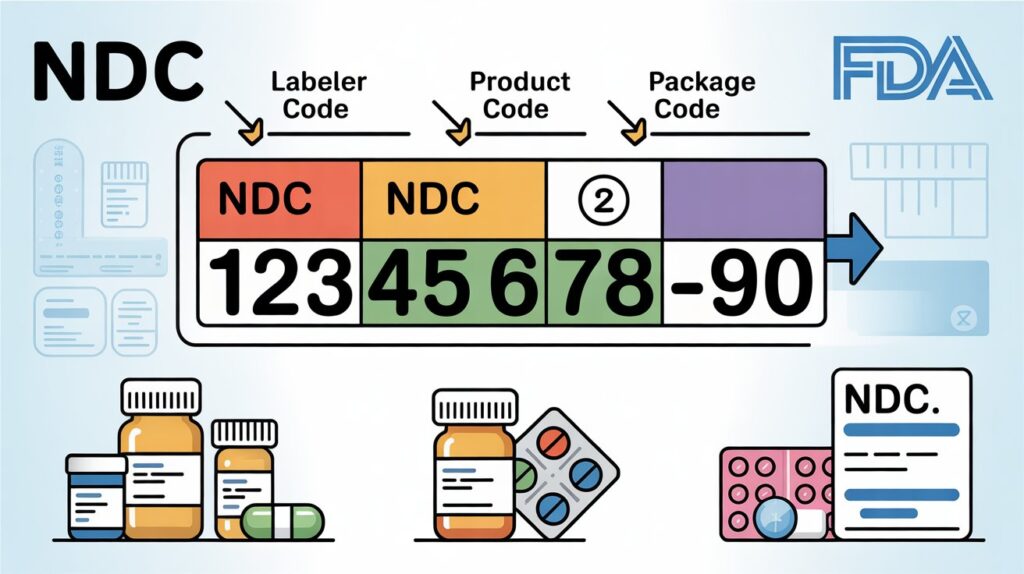
Every NDC code has three separate parts. These parts work together to identify a medicine completely. Understanding these three parts helps you read any NDC code.
First Part: The Labeler Code
The first part is called the labeler code. This tells you which company made or distributed the medicine. The FDA gives each drug company its own label code. This number can be 4 or 5 digits long.
For example, Pfizer has different label codes than Johnson & Johnson. When you see the label code, you know immediately which company is responsible for that medicine. This matters if there is ever a recall or safety issue.
Second Part: The Product Code
The second part is the product code. This tells you exactly which drug it is and how strong it is. Different strengths of the same medicine get different product codes.
Let me give you an example. Regular strength ibuprofen 200mg has one product code. Extra strength ibuprofen 400mg has a different product code. Even though they are both ibuprofen from the same company, the different strengths need different codes.
The product code can be 3 or 4 digits long. It identifies the active ingredient, the strength, and the form of the medicine (like tablet or liquid).
Third Part: The Package Code
The third part is the package code. This tells you how the medicine is packaged and sold. A bottle of 30 pills has a different package code than a bottle of 100 pills of the same medicine.
The package code can be 1 or 2 digits long. It describes the size and type of container. This part changes based on whether the medicine comes in a bottle, a box, a blister pack, or any other type of packaging.
NDC Code Format Explained
NDC codes can look different depending on how they are written. The FDA allows three different formats. All three formats contain the same information, just arranged differently.
The three formats are:
- 4-4-2 format (4 digits, then 4 digits, then 2 digits)
- 5-3-2 format (5 digits, then 3 digits, then 2 digits)
- 5-4-1 format (5 digits, then 4 digits, then 1 digit) For example, you might see:
- 0777-3105-02 (this is 4-4-2 format)
- 50458-625-30 (this is 5-3-2 format)
- 12345-0678-9 (this is 5-4-1 format)
Sometimes you will see the NDC code with dashes between the parts. Sometimes you will see it without any dashes as one long 10-digit number. Both ways are correct. The important thing is that all NDC codes have 10 digits total when you count them.
Many computer systems add an extra zero to make all NDC codes look the same. They make everything into an 11-digit code in 5-4-2 format. This makes it easier for computers to read and compare codes.
Categories of NDC Codes
The FDA organizes NDC codes into different categories based on who can sell the medicine and how it is used. Understanding these categories helps you know what type of medicine you are looking at.
Prescription Medicines
These are medicines that only a doctor can prescribe. You cannot buy them without a prescription. Most antibiotics, blood pressure medicines, and strong pain medicines fall into this category. Each prescription medicine has its own NDC code.
Over-the-Counter Medicines
These are medicines you can buy without a prescription. Pain relievers like acetaminophen, cold medicines, and allergy pills are examples. Even though you do not need a prescription, these medicines still have NDC codes.
Biological Products
Biological products are medicines made from living things. Vaccines, insulin, and many new cancer treatments are biological products. They have NDC codes just like regular medicines.
Homeopathic Products
Homeopathic products are alternative medicines that use very small amounts of natural substances. If these products are sold commercially in the United States, they need NDC codes too.
Medical Devices with Drugs
Some medical devices come with medicine built in. Examples include medicated patches, drug-coated stents, and inhalers. These combination products get their own NDC codes.
How Drug Companies Get NDC Codes
Drug companies cannot just make up their own NDC codes. They must follow a specific process set by the FDA.
First, the company applies to the FDA for a labeler code. The FDA reviews the application and assigns a unique label code to that company. This code belongs only to that company.
Next, the company creates product codes for each medicine they make. They decide these codes themselves, but they must register them with the FDA. The company tells the FDA what each product code means.
Finally, the company adds package codes for different package sizes. Again, they choose these codes but must report them to the FDA.
The FDA keeps a big database of all NDC codes. This database is public. Anyone can look up an NDC code and see what medicine it represents. The FDA updates this database regularly as companies add new products or stop making old ones.
Using NDC Codes in Medical Practices
Medical practices use NDC codes in many different ways every day. These codes make the practice run better and keep patients safer.
When a practice orders medicine, they use NDC codes. The supplier knows exactly what to send. There is no confusion about which product the practice wants. This prevents ordering mistakes.
When a practice gives a patient medicine, they record the NDC code. This goes into the patient’s medical record. Later, if anyone needs to know exactly what medicine the patient received, they can check the NDC code.
For medical billing, practices must include NDC codes on many insurance claims. Insurance companies want to know the exact medicine that was given. The NDC code provides this information in a standard format that all insurance companies understand.
Practices also use NDC codes to track their inventory. They know which medicines are running low. They can see which medicines expire soon. They can find medicines quickly when they need them.
What is an NDC to CPT/HCPCS Cross-Reference?
An NDC to CPT/HCPCS cross-reference is a tool that connects two different coding systems used in healthcare. Think of it as a translation guide. On one side, you have NDC codes that identify specific drug products. On the other side, you have HCPCS codes that healthcare providers use for billing purposes. The cross-reference tells you which NDC codes match up with which HCPCS codes.
This cross-reference is sometimes called a “crosswalk.” Medical practices and billing departments use crosswalks every day when they submit claims to insurance companies. Without this connection between the two coding systems, billing for medicines would be much more difficult and confusing.
The crosswalk does not list every single medicine and NDC code available in the United States. That would be too much information to manage. Instead, it focuses on the medicines that are commonly billed to insurance. It shows which specific NDC-identified drugs are assigned to which HCPCS billing codes. This makes the billing process clearer and more organized.
What the Crosswalk File Contains
The NDC/HCPCS crosswalk file is a database that contains important information. The main thing it provides is a list of NDC codes that are assigned to each Level II HCPCS code. Level II HCPCS codes are the specific codes used for medicines, medical supplies, and equipment.
For example, there might be one HCPCS code for “insulin injection.” But many different companies make insulin, and each product has its own NDC code. The crosswalk file shows all the different NDC codes that fall under that single HCPCS code. This helps billing staff know they are using the right combination of codes.
Besides listing the codes, the crosswalk file also provides conversion factors. These conversion factors are numbers used to calculate how much to charge for the medicine. Different insurance companies might pay different amounts for the same medicine. The conversion factors help practices figure out the correct price to put on the claim.
Another important feature of the crosswalk file is that it allows processing of claims filed using the NCPDP format. NCPDP stands for National Council for Prescription Drug Programs. This is a standard format that pharmacies and some medical practices use when they submit electronic claims. The crosswalk file makes sure these claims can be read and processed correctly by insurance companies.
Why Medical Practices Need Cross-References
Medical practices need cross-reference tools because they must speak two different coding languages at once. When a practice orders medicine or gives it to a patient, they use the NDC code. This tells them exactly what product they have. But when they bill insurance, they often need to use a HCPCS code instead of or in addition to the NDC code.
Using both codes correctly is required. If a practice only submits the NDC code, the insurance might reject the claim. If they only submit the HCPCS code without the required NDC
information, the claim might also be rejected. The cross-reference helps practices include both codes accurately.
Different insurance programs have different rules. Medicare Part B requires both HCPCS codes and NDC codes for most medicines. Medicaid programs also want both types of codes. Private insurance companies have their own requirements. The crosswalk helps practices follow all these different rules correctly.
How NDC Pricing is Calculated
NDC pricing is not simple. There are several different pricing standards used in the healthcare industry. Understanding these pricing methods helps practices know what they should charge and what they might be paid.
The first pricing standard is Average Wholesale Price, known as AWP. This is one of the most common pricing benchmarks in healthcare. AWP per unit tells you the average price for one unit of the medicine, such as one tablet or one milliliter. This price is what wholesalers typically charge pharmacies and medical practices when they buy medicines in bulk.
AWP package price is similar but calculates the price for an entire package instead of individual units. For example, if a medicine comes in a bottle of 100 tablets, the AWP package price tells you the cost for the whole bottle. This is useful when practices buy medicines by the package rather than counting individual doses.
Another pricing standard is Wholesale Acquisition Cost, abbreviated as WAC. WAC per unit shows the manufacturer’s list price for one unit of the medicine. This is the price before any discounts or rebates. It represents what the manufacturer says the medicine should cost. WAC is often lower than AWP, but this is not always the case.
WAC package price works the same way as AWP package price, but uses the manufacturer’s list price instead of the wholesale average. Some insurance companies prefer to use WAC instead of AWP when they calculate how much to pay for medicines. Practices need to know both pricing standards to submit accurate claims.
Direct Unit Price is another pricing method. This represents the actual price a practice pays when they buy one unit of medicine directly from a supplier. This price might be lower than both AWP and WAC because it includes negotiated discounts and special pricing agreements.
However, insurance companies usually do not reimburse based on what a practice actually paid. They use standard pricing formulas instead.
Direct Package Price follows the same principle as Direct Unit Price but applies to whole packages. This is the real price the practice paid for an entire package of medicine. Again, this might be different from what insurance will pay. Practices need to track both what they actually pay and what the standard pricing benchmarks say.
Using Conversion Factors
Conversion factors are multipliers that help calculate the final price for billing. These factors take the base price (like AWP or WAC) and adjust it according to insurance rules. Different insurance programs use different conversion factors.
For example, Medicare might pay AWP minus 20 percent for a certain type of medicine. The conversion factor would be 0.80 (which is 100 percent minus 20 percent). If a medicine has an AWP of 100 dollars, the practice would multiply 100 by 0.80 to get 80 dollars. That is the amount they would bill Medicare.
Medicaid programs in each state have their own conversion factors. Some states might pay AWP minus 15 percent. Others might pay WAC plus 3 percent. The crosswalk file includes these conversion factors so practices can calculate the right amount for each insurance program.
Private insurance companies also have conversion factors, and these can change over time. A practice might have contracts with ten different insurance companies, and each one might use different conversion factors. Keeping track of all these numbers is complicated. The crosswalk file helps by providing this information in one organized place.
Practical Applications in Medical Billing
When a medical practice gives medicine to a patient, the billing staff must prepare a claim. They start by finding the NDC code from the medicine package. Then they look up this NDC code in the crosswalk file. The crosswalk tells them which HCPCS code to use.
Next, they need to determine the price. They check which pricing standard the insurance company uses. They find the relevant price (AWP, WAC, Direct Price, etc.) for that NDC code. Then they apply the correct conversion factor. The result is the dollar amount they put on the claim.
This process happens hundreds or thousands of times in busy medical practices. Using accurate cross-reference tools and pricing information reduces errors. It helps practices get paid correctly and quickly. It also reduces the number of rejected claims that must be corrected and resubmitted.
The NDC to HCPCS cross-reference is an essential tool that connects product identification with billing requirements, making the complicated process of medical billing more manageable for practices across the country.
Insurance billing requires NDC codes for many types of medicines. Understanding how this works helps practices get paid correctly.
| Billing Requirement | When NDC is Needed | Format Required |
| Medicare Part B | For injectable drugs and some oral drugs | 11-digit format (5-4-2) |
| Medicaid | For all prescribed medicines | 11-digit format (5-4-2) |
| Private Insurance | Varies by company | Usually 11-digit format |
| Hospital Outpatient | For separately payable drugs | 11-digit format (5-4-2) |
When billing Medicare Part B, the practice must include three pieces of information:
- The NDC code in 11-digit format
- The quantity of medicine given
- The unit of measurement (like milligrams or milliliters)
If any of this information is wrong or missing, Medicare will reject the claim. The practice will not get paid until they fix it and resubmit.
Medicaid programs in every state require NDC codes. Each state has slightly different rules about when and how to include these codes. Practices need to know the rules for their state.
Many private insurance companies also want NDC codes on claims. Some require them all the time. Others only want them for expensive medicines. Practices should check with each insurance company to know their rules.
How to Submit NDC Codes on Insurance Claims
When you submit insurance claims for medicines, you must include the NDC code along with other important information. Following the correct format and rules helps your claims get processed quickly without rejections.
Basic Requirements
Every claim that includes medicine must have several pieces of information:
- The NDC code in the proper format
- The applicable HCPCS or CPT code for the service
- The number of HCPCS/CPT units you are billing
- The NDC qualifier that identifies what type of code you are submitting
- The number of NDC units (how much medicine was given)
- The NDC unit of measure (what you are counting)
- Your billable charge amount
All of these pieces work together. If you leave out any required information, the insurance company will reject your claim. You will need to fix it and submit it again, which delays your payment.
The 11-Digit Format Rule
The NDC code must follow a specific format when you submit it on claims. This format is called the 5-4-2 configuration. It means:
- 5 digits for the labeler (manufacturer) code
- 4 digits for the product code
- 2 digits for the package code
This creates an 11-digit number with no spaces, no hyphens, and no other special characters. It should look like this: 12345678901
The problem is that NDC codes on medicine packages do not always appear in this format. Some packages show the code as 10 digits. Some show it with hyphens between the parts. You must convert whatever format appears on the package into the 11-digit billing format.
Adding Leading Zeros
When the NDC on the package label has fewer than 11 digits, you must add a leading zero to make it fit the 5-4-2 format. A leading zero means putting a zero at the beginning of one of the three segments.
Here is how to do this:
If the package shows 4-4-2 format (10 digits total):
- Add a zero to the front of the first segment
- Example: 1234-5678-90 becomes 01234567890
If the package shows 5-3-2 format (10 digits total):
- Add a zero to the front of the second segment
- Example: 12345-678-90 becomes 12345067890
If the package shows 5-4-1 format (10 digits total):
- Add a zero to the front of the third segment
- Example: 12345-6789-0 becomes 12345678900
Getting this conversion right is very important. If you submit the NDC in the wrong format, the insurance company’s computer system will not recognize it. Your claim will be rejected.
Active NDC Requirement
The NDC code you submit must be active on the date you gave the medicine to the patient. This is called the date of service. Insurance companies check the FDA database to make sure the NDC was valid on that specific date.
If a drug company stopped making a product or if the FDA pulled it from the market, the NDC code becomes inactive. You cannot bill using an inactive code, even if that is the code on the package you actually used.
Before submitting claims, check that the NDC codes are still active. You can verify this by searching the FDA’s NDC database. If you discover a code is inactive, contact the insurance company to find out how to handle the situation.
NDC Qualifier, Units, and Measure
Besides the NDC number itself, you must include three additional pieces of information:
NDC Qualifier: This tells the insurance company what type of code you are submitting. For NDC codes, you always enter “N4” as the qualifier. This is a standard code that means “National Drug Code.”
Number of NDC Units: This is the quantity of medicine you gave to the patient. It is not the same as the number of HCPCS units. You must calculate this based on how the medicine is measured.
For example, if you gave a patient 5 milliliters of a liquid medicine, you would enter 5 as the number of NDC units. If you gave someone 2 tablets, you would enter 2.
Some insurance companies allow you to use decimal points in this field. Blue Cross Blue Shield of Illinois (BCBSIL), for instance, allows up to three decimal places. So you could enter 2.5 or 1.875 as the number of units. Using decimals accurately is important because it affects how much the insurance company will pay you. If you round incorrectly or leave out decimals, you might get paid the wrong amount.
NDC Unit of Measure: This tells the insurance company what you are counting. There are standard codes for different types of measurements:
- UN = Unit (for tablets, capsules, or other individual doses)
- ML = Milliliter (for liquid medicines)
- GR = Gram (for medicines measured by weight)
- F2 = International Unit (for medicines like insulin or vitamins measured in special units)
You must choose the code that matches how the medicine is packaged and measured. If you give 10 milliliters of liquid medicine, use ML. If you give 3 tablets, use UN.
Electronic Claim Submission Guidelines
When you submit claims electronically, you use a standardized format. For professional claims, this format is called ANSI 837P. For institutional claims (like hospital claims), the format is ANSI 837I. Both formats have specific fields where you must enter the NDC information.
Understanding Loop IDs and Segments
Electronic claims are organized into “loops” and “segments.” These are just sections of the claim form. Each piece of information goes in a specific location.
Loop 2410 is where drug information goes. Within this loop, different segments hold different details. The LIN segment is for product identification. The CTP segment is for pricing and quantity information.
Your billing software should have fields labeled with these loop and segment numbers. When you enter NDC information, make sure it goes in the correct fields. If you put information in the wrong segment, the claim will be rejected.
Common Problems with NDC Codes
Even though NDC codes are supposed to make things simple, problems still happen. Knowing these common problems helps practices avoid them.
Invalid or Inactive Codes
Sometimes an NDC code is no longer valid. Maybe the drug company stopped making that product. Maybe the FDA removed it from the market. When a practice tries to use an invalid code, the insurance claim gets rejected.
Practices should check NDC codes regularly. The FDA database shows which codes are currently active. Using outdated codes causes payment delays.
Wrong Format
Different computer systems want NDC codes in different formats. A pharmacy system might use 10-digit codes. An insurance billing system might want 11-digit codes. If the practice sends the wrong format, the claim gets rejected.
Many practices use software that automatically converts NDC codes to the right format. This prevents format errors.
Mismatched Information
Sometimes the NDC code does not match the other information on the claim. For example, the claim might say “insulin” but the NDC code is for “aspirin.” Insurance companies catch these mismatches and reject the claims.
Double-checking all information before submitting claims prevents these errors.
Package Size Confusion
The package code tells you how the medicine is packaged. But practices might buy medicine in one package size and then give it to patients in smaller amounts. Using the wrong package code causes problems.
Practices need to use the NDC code from the actual package they bought, not the amount they gave to the patient.
NDC Codes vs Other Medical Codes
Healthcare uses many different coding systems. NDC codes are just one type. Understanding how NDC codes relate to other codes helps avoid confusion.
HCPCS codes include some drug codes (J-codes), but these are different from NDC codes.
J-codes describe types of medicines in general. NDC codes identify exact products from specific manufacturers.
For example, there is one J-code for “insulin.” But there are many different NDC codes for insulin because many companies make it in many different strengths and package sizes.
Practices often need to use both J-codes and NDC codes when billing. The J-code goes in one field on the claim form. The NDC code goes in a different field.
How to Look Up an NDC Code
Anyone can look up NDC codes for free. The FDA provides tools that make this easy. The main tool is the NDC Directory on the FDA website. You can search by:
- The NDC code number
- The drug name
- The company name
- The active ingredient
When you search, the directory shows you all the details about that medicine. You see the company name, the drug name, the strength, the dosage form, and the package size.
Another useful tool is the FDA’s National Drug Code Directory Search. This is a more advanced search tool. You can filter results by many different factors.
Many pharmacy software programs also have NDC lookup features built in. These programs keep updated databases of all current NDC codes.
Some private companies sell NDC databases with extra features. These might include pricing information, drug pictures, or clinical details. Practices can subscribe to these services if they need more than the basic FDA information.
NDC Codes in Electronic Health Records
Modern medical practices use Electronic Health Records (EHR) systems. These computer systems track everything about patient care. NDC codes are an important part of EHR systems.
When a doctor prescribes medicine, the EHR system records the NDC code. When a nurse gives medicine to a patient, they scan the barcode on the medicine package. This barcode contains the NDC code. The EHR automatically records it.
This creates a complete record of every medicine every patient receives. If a patient has a bad reaction to a medicine, the practice knows exactly which product caused it. They can check the NDC code and report it to the FDA.
EHR systems also use NDC codes to check for drug interactions. When a doctor tries to prescribe a new medicine, the computer checks it against all the other medicines the patient takes. If there is a dangerous combination, the computer warns the doctor.
For inventory management, EHR systems track NDC codes of all medicines in the practice. When medicine is used, the system automatically updates the inventory. When supplies run low, the system can order more using the NDC code.
Barcode Standards and NDC Codes
Most medicine packages now have barcodes that include the NDC code. These barcodes make it faster and more accurate to record which medicine is being used.
Linear Barcodes
Linear barcodes are the traditional black and white stripes you see on most products. For medicines, these barcodes encode the NDC code in a format called GS1-128 or Code 128.
When a nurse scans a medicine bottle with a linear barcode, the scanner reads the NDC code. The computer system looks up this code and confirms it is the right medicine for that patient at that time.
2D Barcodes
Newer medicine packages use 2D barcodes, also called DataMatrix codes. These look like small squares filled with dots and patterns. They can hold more information than linear barcodes.
A 2D barcode on medicine might include:
- The NDC code
- The lot number
- The expiration date
- The serial number
Having all this information in one barcode helps practices track medicine even better. They can tell if medicine has expired. They can identify specific batches if there is a recall.
The FDA recommends that all medicine packages include both the NDC code and this extra information in 2D barcodes. This is part of the Drug Supply Chain Security Act (DSCSA).
NDC Code Changes and Updates
NDC codes do not stay the same forever. Drug companies update them for various reasons. Practices need to stay current with these changes.
When NDC Codes Change
A medicine gets a new NDC code when:
- The manufacturer changes the formula
- The strength changes
- The package size changes
- A different company starts making it
- The manufacturer changes the package design
Sometimes a medicine keeps the same label code and product code but gets a new package code. Other times, everything changes.
Staying Updated
The FDA updates its NDC database constantly. Practices should check this database regularly, especially for medicines they use often.
Many practices subscribe to update services. These services send alerts when NDC codes change for commonly used medicines. This helps practices update their computer systems quickly.
When insurance claims get rejected because of an NDC code, it might mean the code has changed. Practices should check the FDA database and update their records.
Future of NDC Codes
The NDC code system has worked for over 50 years, but it continues to evolve. New technology and new regulations are changing how NDC codes are used.
The FDA is working on a system called Global Unique Device Identification Database (GUDID) for medical devices. Similar systems might eventually work alongside or replace parts of the NDC system.
Blockchain technology might be used to track medicines through the supply chain. NDC codes would still identify the products, but blockchain would create a permanent record of where each medicine has been.
Artificial intelligence is helping practices use NDC codes better. AI systems can predict which medicines a practice will need based on historical NDC code usage. They can spot patterns that might indicate fraud or errors.
International standardization is another trend. The United States uses NDC codes, but other countries use different systems. Efforts are underway to make these systems work together better as medicine becomes more global.
Real-World Examples of NDC Code Usage
Looking at specific examples helps you understand how NDC codes work in practice.
Example 1: Prescribing Medicine
Dr. Smith prescribes 30 tablets of lisinopril 10mg to a patient. The pharmacy fills this prescription with a specific product. That product has NDC code 68180-0513-01. This tells us:
- 68180 = Lupin Pharmaceuticals made it
- 0513 = It is lisinopril 10mg tablets
- 01 = It comes in a bottle of 30 tablets
Example 2: Vaccine Administration
A practice gives a patient a flu vaccine. They use Fluzone Quadrivalent made by Sanofi Pasteur. The NDC code is 49281-0418-50. This tells us:
- 49281 = Sanofi Pasteur made it
- 0418 = It is Fluzone Quadrivalent vaccine
- 50 = It comes in a box of 10 single-dose syringes
The practice records this NDC code in the patient’s record. They also use it when billing the patient’s insurance.
Example 3: Drug Recall
The FDA discovers a safety problem with a specific batch of medicine. They announce a recall using the NDC code 0777-3105-02. Any practice that has medicine with this NDC code must remove it from their shelves immediately. The NDC code makes it easy to identify exactly which product is affected.
Best Practices for Managing NDC Codes
Medical practices that handle NDC codes well have fewer billing problems and keep better records. Here are the most important practices to follow:
- Keep your NDC database updated in all computer systems
- Train all staff who work with medicines on how to read and use NDC codes
- Double-check NDC codes when ordering new medicine shipments
- Verify NDC codes match the medicine before giving it to patients
- Use barcode scanners to reduce manual entry errors
- Check rejected insurance claims for NDC code problems first
- Keep a reference list of NDC codes for your most commonly used medicines
- Review NDC code accuracy during regular inventory checks
- Subscribe to FDA alerts about NDC code changes and drug recalls
- Document the NDC code for every medicine given to every patient
Following these practices helps your practice run better. You will have fewer insurance claim rejections. You will reduce medicine errors. Your records will be more accurate and complete.
Special Situations and NDC Codes
Some situations with NDC codes are more complicated than others. Knowing how to handle these special cases prevents problems.
Compounded Medicines
Compounded medicines are custom-made by pharmacies for specific patients. These do not have regular NDC codes because they are not manufactured products. Some compounding pharmacies have special label codes they use, but the rules are different than for regular manufactured medicines.
Repackaged Medicines
Sometimes a company buys medicine in bulk and repackages it into smaller containers. The repackager gets their own label code. They create new NDC codes for their packages. The medicine inside is the same, but the NDC code is different from the original manufacturer’s code.
Sample Medicines
Drug companies give doctors free samples of medicines. These samples have NDC codes just like regular packages. However, practices usually cannot bill insurance for sample medicines, so the NDC code is mainly used for record-keeping.
Combination Products
Some medicine packages contain two different drugs together. These get a single NDC code that represents the combination. Each part of the combination does not get its own separate code.
Read the Number Right and Save the Day
NDC codes are the foundation of medicine identification in the United States. These 10-digit numbers tell us exactly what medicine we are looking at, who made it, and how it is packaged. From the moment a drug company creates a new product to the moment a patient receives it, NDC codes track and identify that medicine.
Medical practices depend on NDC codes every single day. They use them to order supplies, give medicines safely, keep accurate records, and bill insurance correctly. The system is not perfect -,codes change, formats vary, and mistakes happen. But with proper training and good practices, these challenges can be managed.
As healthcare becomes more digital and interconnected, NDC codes will only become more important. They connect computer systems, enable data analysis, support research, and protect patients. Every healthcare worker should understand what NDC codes are and how to use them properly.
Whether you work in a small practice or a large hospital, whether you are a doctor, nurse, medical assistant, or billing specialist, NDC codes affect your work. Taking time to learn this system well will make you better at your job and help you provide better care to patients. The next time you see that 10-digit number on a medicine bottle, you will know it is much more than just a random number.