Skip to main content
What is CPT code 97112?
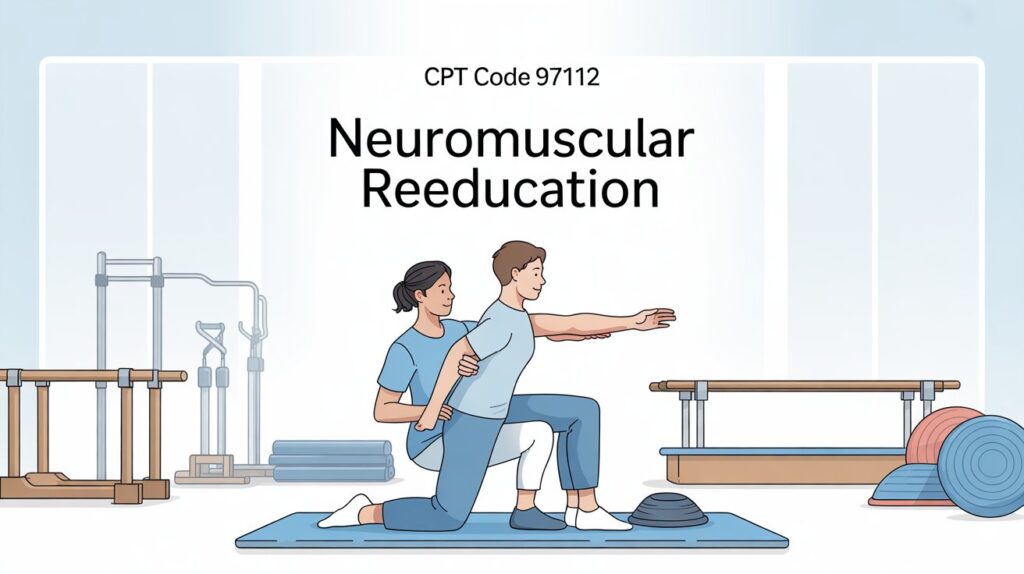
CPT code 97112 is a medical billing code which is used by physical therapists and occupational therapists when they provide neuromuscular reeducation to a patient. This code tells the insurance company that the therapist gave skilled treatment to improve balance, posture, coordination, and body control.
CPT 97112 is used when a patient has trouble moving because the nervous system is not working well. The nervous system includes the brain, spinal cord, and nerves. These parts control how muscles move. When this system is damaged by a stroke, brain injury, nerve injury, or illness, the body may not move the right way. The therapist works with the patient to retrain these movements. This work is billed using CPT 97112.
This code is used only when the therapist gives hands on and skilled care. The therapist must guide the patient, correct their movements, and give verbal and physical cues. The patient must be treated one on one. Group therapy or independent exercise does not qualify for CPT 97112.
CPT 97112 includes many types of neuromuscular training. This can include balance training, posture control, movement training, body awareness, and coordination exercises. The goal is to help the patient move in a safer and more controlled way during daily activities like walking, sitting, standing, and reaching.
CPT 97112 is a time based code. The therapist must spend direct time with the patient. At least 8 minutes of treatment is needed to bill one unit. More time means more units, based on the billing rules.
This code is used in physical therapy and occupational therapy clinics and follows strict billing rules set by insurance and CMS. Proper documentation is required to show why this treatment was needed and what was done during the session.
Why do therapists choose CPT 97112 when they send a bill to insurance?
Therapists choose CPT 97112 because it matches the type of care they give when they help a patient with balance, posture, and body control. When a patient cannot move well because their nerves are not working correctly, the therapist gives special training to help the brain and muscles work together. This type of training must be billed using CPT 97112.
Many patients have weak balance, poor posture, or poor control of their arms and legs. This can happen after a stroke, head injury, nerve damage, or long illness. These patients may fall, walk in a bad way, or not know where their body is in space. The therapist works closely with the patient to guide their movements, help them stand safely, and teach them how to move correctly. Because this is skilled neuromuscular training, CPT 97112 is used.
CPT 97112 is not used for simple exercise. It is used when the therapist gives hands on care, gives clear instructions, and makes real time corrections to how the patient moves. The therapist must be with the patient the whole time. This one on one care is required for CPT 97112.
Insurance companies need to know what type of therapy was given. If the therapist did balance training, posture training, or movement reeducation, they must use CPT 97112 instead of a basic exercise code. This helps make sure the claim is paid correctly and follows billing rules.
Therapists also use CPT 97112 to show medical need. This code tells the insurance company that the patient needed skilled care to improve how their nervous system controls their body. When the right code is used, it supports correct payment and proper patient care.
Because of these reasons, CPT 97112 is an important code for therapists who treat patients with movement and balance problems.
What type of problems are treated when CPT 97112 is used?
CPT 97112 is used when a patient has problems with how their body moves because their nerves and brain are not working in the right way. These problems are not simple muscle problems. They are problems of control, balance, and body awareness. The therapist uses neuromuscular reeducation to help the patient move better and feel more stable.
Many patients who receive CPT 97112 have trouble standing, walking, sitting, or using their hands. They may feel weak, shaky, dizzy, or off balance. They may fall often or move in a slow or unsafe way. These problems usually happen because of injury or disease in the nervous system.
Some of the most common medical problems that need CPT 97112 include stroke, brain injury, spinal cord injury, nerve damage, Parkinson disease, multiple sclerosis, and balance disorders. People with these problems often cannot control their muscles well even if the muscles are not very weak.
Here are some common problems where CPT 97112 is used:
| Patient Problem | How It Affects Movement |
| Stroke | Weak control on one side of the body |
| Brain injury | Poor balance and slow reactions |
| Nerve damage | Loss of feeling and poor muscle control |
| Parkinson disease | Shaking, slow movement, poor posture |
| Multiple sclerosis | Weakness and poor coordination |
| Balance disorder | Dizziness and falling |
| Spinal injury | Trouble standing and walking |
| Nerve palsy | One arm or leg does not move well |
These patients often know what they want to do, but their body does not listen. They may try to lift an arm, but it moves in the wrong way. They may try to walk, but their feet do not go where they should. CPT 97112 is used when the therapist helps correct these problems.
The therapist gives special training to help the brain and nerves send better signals to the muscles. This helps the patient gain better control, better balance, and better posture. Over time, the patient can move more safely in daily life.
CPT 97112 is used when these problems make it hard for the patient to do normal things like walking, dressing, standing, reaching, or sitting. Because these are real medical problems, this code is allowed when proper notes and skilled care are given.
What skills must a therapist have to use CPT 97112?
CPT 97112 can only be used when the therapist gives skilled neuromuscular training. This means the therapist must have special knowledge about how the brain, nerves, and muscles work together. The therapist must know how to watch movement, find problems, and correct them in a safe way.
The therapist must be able to see when a patient is losing balance, using the wrong muscles, or holding their body in a bad position. The therapist then gives hands on help, verbal cues, and physical guidance. This helps the patient move in a better and safer way. This type of care needs training and experience.
The therapist must also know how to change the treatment as the patient improves. If the patient starts to move better, the therapist must make the exercise harder. If the patient is tired or unsafe, the therapist must make it easier. This kind of decision making is part of skilled care and is required for CPT 97112.
Only qualified health workers can provide this service. This includes physical therapists, occupational therapists, and trained assistants working under proper supervision. These workers are trained to understand nerve problems, balance problems, and movement problems.
The therapist must also be able to write proper notes. They must explain what they did, how they helped the patient, and how the patient responded. This shows that the care was skilled and medically needed.
Because of these reasons, CPT 97112 cannot be used for simple exercise or unsupervised activity. It is only used when trained professionals give direct and skilled neuromuscular care to the patient.
Exercises Included in Neuromuscular Reeducation
Neuromuscular reeducation uses special exercises that help the brain and nerves control the muscles in a better way. These exercises are not normal gym exercises. They are guided by the therapist and are changed based on how the patient moves. The goal is to improve balance, posture, body control, and safe movement in daily life.
Balance Training
Balance training helps the patient stand and walk without falling. The therapist may ask the patient to stand on one foot, walk on a straight line, or shift weight from one side to the other. The therapist stays close and gives support and cues so the patient stays safe.
Posture Training
Posture training helps the patient sit and stand in the right way. Many patients lean to one side or bend forward. The therapist helps the patient feel the correct body position and guides them to keep their body straight.
Movement Reeducation
This training helps the patient move their arms, legs, and body in the right pattern. The therapist may help lift an arm, bend a knee, or step forward in a controlled way. The goal is smooth and safe movement.
Proprioception Training
This training helps the patient feel where their body parts are. The therapist may ask the patient to close their eyes and move an arm or leg. This helps the brain learn body position again.
Muscle Activation and Control
This helps weak or slow muscles turn on at the right time. The therapist may use touch, voice, or gentle resistance to help the muscle work better during movement.
All these exercises are done one on one with the therapist. The therapist watches every move and makes changes when needed. This is why these exercises fall under CPT 97112.
One on One Care Rule Explained
Why does CPT 97112 require one on one treatment?
CPT 97112 requires one on one care because neuromuscular reeducation needs close watching and direct help from the therapist. The therapist must guide every movement, correct mistakes, and keep the patient safe. This type of care cannot be done in a group or from far away.
When a patient has balance or nerve problems, even small mistakes can cause falls or injury. The therapist must stay close and give hands on support. This is why CPT 97112 is only allowed when one patient is treated at one time.
Insurance and CMS rules say that CPT 97112 cannot be shared between patients. The full time must belong to one patient. If two patients are treated at the same time, this code cannot be used.
| Situation | Can CPT 97112 Be Used |
| Therapist working with one patient | Yes |
| Therapist treating a group | No |
| Patient doing exercise alone | No |
| Therapist giving hands on guidance | Yes |
| Patient watched from across room | No |
| Therapist giving verbal and physical cues | Yes |
The therapist must be fully focused on one patient during the treatment. They must guide posture, balance, and movement all the time. This is what makes the care skilled and billable under CPT 97112.
If the patient becomes able to do the activity alone without help, then this code should no longer be used for that time.
How Time Is Counted for CPT 97112
CPT 97112 is a timed code. This means the therapist must spend a certain amount of direct care time with the patient to bill each unit. Time is counted carefully to follow insurance and CMS rules. One unit of CPT 97112 is billed for 8 to 22 minutes of direct skilled care. More time means more units can be billed.
Therapists must track only the hands-on or guided treatment time . Time spent on breaks, setting up equipment, or talking with family is not counted . Only time spent giving skilled neuromuscular reeducation to the patient counts for billing.
Here is a table that shows how minutes convert to CPT 97112 units:
| Units Billed | Direct Care Time Required (Minutes) |
| 1 unit | 8 – 22 minutes |
| 2 units | 23 – 37 minutes |
| 3 units | 38 – 52 minutes |
| 4 units | 53 – 67 minutes |
| 5 units | 68 – 82 minutes |
| 6 units | 83 – 97 minutes |
| 7 units | 98 – 112 minutes |
| 8 units | 113 – 127 minutes |
Therapists often divide sessions into 15-minute blocks because it is easy to track. But even 8 minutes of skilled care is enough for one unit . If a therapist spends 30 minutes working on balance training and posture, they can bill 2 units .
The AMA Rule of Eights allows the therapist to combine multiple short treatments in a day for total time. For example, if the therapist does 10 minutes in the morning and 15 minutes in the afternoon with the same patient, the total 25 minutes can count as 2 units .
Accurate time tracking confirms proper reimbursement. Insurance can deny claims if time is not recorded correctly. That’s why therapists must document exact start and end times of the skilled CPT 97112 interventions.
What is the 8 minute rule and why is it important for CPT 97112?
The 8 minute rule is a rule used by insurance and CMS to decide how many units of CPT 97112 can be billed. It tells therapists the minimum time of direct care needed for one unit. A unit is a 15-minute block used for billing. But even if the session is shorter than 15 minutes, one unit can be billed if it is at least 8 minutes of hands-on care.
This rule makes sure that the patient receives enough skilled therapy, and the therapist bills the correct amount. The 8 minute rule applies only to timed services like CPT 97112. Each unit must have a separate period of direct care, and it cannot overlap with another patient or service.
Here are 15 key points about the 8 minute rule for CPT 97112:
- One unit equals at least 8 minutes of direct skilled care
- Two units require 23–37 minutes of care
- Three units require 38–52 minutes of care
- Four units require 53–67 minutes of care
- The rule helps calculate units for any session length
- Time must be direct hands-on care with the patient
- Setup time is not included in the 8 minutes
- Therapist supervision without guidance does not count
- Each unit must be billed separately in the notes
- Units cannot be combined with group therapy time
- AMA Rule of Eights allows combining separate periods in a day
- Units are billed in 15-minute increments even if exact time varies
- Shorter sessions under 8 minutes cannot be billed
- Accurate timing prevents claim denials by insurance
- Documentation must show start and end times for each unit
Following the 8 minute rule confirms proper billing, supports medical necessity, and keeps therapy claims compliant with CMS and insurance regulations.
How Many Units You Can Bill in One Day
When a therapist gives neuromuscular reeducation to a patient, they need to count the time carefully. CPT 97112 is a timed code. This means the therapist must spend real, direct time with the patient giving skilled care. One unit of CPT 97112 equals at least 8 minutes of hands-on treatment. More time can be counted as more units.
The Centers for Medicare and Medicaid Services (CMS) set rules for this. These rules say how many units a therapist can bill in one day for CPT 97112. The usual limit is four units per patient per day . This means a therapist can spend up to 67 minutes giving neuromuscular reeducation and bill four units. Sometimes, the therapist may spend more time, but they need special documentation to show why more units are needed.
The therapist must record the exact start and end times of each activity. They must show what exercises or activities were done for the patient, and how the therapist gave help. The therapist must show that the care was skilled, hands-on, and one-on-one. The therapist cannot include time when the patient is doing exercises alone, taking breaks, or when the therapist is talking to another person. Only the time where the therapist gives guidance, correction, and support counts for billing CPT 97112.
When calculating units, the therapist must follow the CMS 8-minute rule. This rule says a minimum of 8 minutes is needed for one unit. If the therapist spends 8 to 22 minutes, they can bill one unit. If they spend 23 to 37 minutes, they can bill two units. If they spend 38 to 52 minutes, they can bill three units. If they spend 53 to 67 minutes, they can bill four units.
If the therapist spends more than 67 minutes, they must explain in the notes why it was needed. Sometimes the AMA Rule of Eights is used. This rule allows the therapist to add separate periods of treatment in one day to calculate total time. For example, if the therapist works with a patient in the morning for 20 minutes and again in the afternoon for 25 minutes, the total 45 minutes can be billed as three units. This helps therapists bill accurately for multiple short sessions in one day.
The therapist must also follow rules about which patients and treatments qualify. CPT 97112 can only be used when skilled neuromuscular reeducation is given. The patient must have a problem with balance, posture, coordination, or muscle control caused by injury, illness, or a neurological condition. Examples include stroke, brain injury, nerve injury, spinal cord injury, Parkinson disease, multiple sclerosis, or balance disorders. If the patient only does unsupervised exercise or simple strengthening, CPT 97112 cannot be used. The therapist must be trained and qualified. Only physical therapists, occupational therapists, and properly supervised assistants can use this code.
Proper documentation is very important. The therapist must write what was done, how long each activity took, and how the patient responded. They must show the start and end times for each unit. They must explain which exercises were used and how the therapist gave hands-on help. They must also show how the care matches the patient’s treatment plan and goals. Insurance companies often check these notes. If the notes are missing or incomplete, the claim can be denied. Clear notes protect the therapist and help the patient get the correct coverage.
Therapists also need to track multiple units carefully. For example, if a patient needs 60 minutes of therapy in one session, the therapist can bill four units. They must divide the time into 15-minute increments and show which activities were done in each time period. Each unit must include direct care. No unit can include time spent on other patients, setup, or teaching family members unless the teaching is part of the skilled treatment.
Sometimes patients improve and need less help. If the patient can do exercises alone or only needs supervision, CPT 97112 cannot be billed for that time. The therapist may need to use a different code, like a therapeutic exercise code, if the patient does exercises without hands-on guidance. This confirms that billing matches the actual care given.
Therapists should plan their sessions to maximize treatment time. They should organize exercises so that every minute of skilled care is counted. They should avoid interruptions and make sure all exercises fit the patient’s goals. Proper session planning helps the therapist bill the correct units and provide the best care.
Insurance companies follow CMS rules but may have their own policies. Therapists must check the payer rules for limits on units, allowed diagnoses, and documentation requirements. Some payers may allow more than four units if justified, but clear notes must explain why extra time was needed.
Therapists can bill up to four units of CPT 97112 per patient per day for standard care. Each unit equals 8–22 minutes of direct hands-on therapy. Units are calculated using the 8-minute rule and can include multiple short sessions in one day using the AMA Rule of Eights. Proper documentation of time, exercises, patient response, and skilled guidance is essential. Only trained therapists can give CPT 97112 care. Care must be one-on-one and focused on neuromuscular reeducation for balance, posture, movement, and body control. Following these rules confirms accurate billing, supports insurance claims, and reflects the skilled care given to the patient.
Therapy Modifiers and Discipline Specific Billing
When therapists bill CPT 97112, sometimes they must use special codes called modifiers .
Modifiers give more details about the therapy or who gave it. They tell insurance companies if the care was given in a special way. Using the correct modifier helps the claim get approved and avoids delays. Modifiers also show which discipline gave the care, for example, physical therapy, occupational therapy, or other professional services.
Different therapists and assistants may use CPT 97112, but the modifier tells exactly who performed the skilled care. Some payers need this information to know if the claim is correct. For example, a PT assistant may need a different modifier than a licensed physical therapist. Occupational therapy may need a modifier to show it is OT service. Chiropractors may also use CPT 97112 in certain cases, and modifiers show this clearly.
Modifiers also show special circumstances . Sometimes the therapist works with a patient at home, at a clinic, or in a special program. The modifier tells insurance where the service happened. This helps insurance understand the context of treatment.
Here is a table of common CPT 97112 modifiers and what they mean:
| Modifier | Who or What It Shows | Example Use |
| GP | Physical Therapy | CPT 97112 done by a physical therapist in a clinic |
| GO | Occupational Therapy | CPT 97112 done by an occupational therapist |
| GN | Speech Therapy | Rarely used but can indicate related neuromuscular work |
| CO | Chiropractor | CPT 97112 given by a chiropractor |
| CQ | PT Assistant | CPT 97112 given by a physical therapy assistant under supervision |
These modifiers are required by most payers . Without them, the claim may be denied or delayed. The modifier also protects the therapist. It tells the payer exactly who did the skilled treatment.
Another important point is that CPT 97112 is discipline specific . Physical therapists, occupational therapists, and chiropractors may use the same CPT code, but the modifier
distinguishes their discipline. Insurance needs to see this. It shows that a qualified professional delivered care according to their license.
Sometimes, payers also want to know if the therapy is part of special programs . For example, a rehab program in a hospital, a home health program, or an outpatient clinic program. The modifier can explain the setting without writing a long note.
Using modifiers correctly also helps in audits. Insurance reviewers can quickly see that the right professional gave CPT 97112 at the right place. This reduces errors, saves time, and makes billing smoother.
Modifiers also work with timed units . Each unit of CPT 97112 gets the same modifier. If a therapist bills 2 or 3 units, each unit must have the correct modifier to show who provided care. This is very important because sometimes assistants give part of the therapy under supervision. Modifiers show this without confusion.
By using CPT 97112 with the right modifiers, therapists can give clear information about:
- Who did the therapy
- Where it was done
- How many units were done
- That it was skilled care
This method of billing is like a secret map for insurance . It tells them step by step what happened, who did it, and where. It also protects the therapist and the clinic from errors or denials. Using modifiers may look small, but it makes a big difference in payment and documentation.
Documentation Tips to Avoid Denials
When a therapist bills CPT 97112, insurance wants to see proof . Proof means the therapist must write exactly what happened in the session. This is called documentation . Good documentation makes sure the claim gets paid. Poor documentation can cause denials or delays. Writing clear notes also helps other therapists understand the patient’s progress.
Therapists must write about what they did, how they helped, and how the patient responded . Notes must show that the care was skilled and one-on-one . Insurance reviewers read these notes to make sure CPT 97112 was used correctly. Notes are like a story. They tell what exercises were done, how long each exercise lasted, and what the patient learned or improved.
Here are key things to include in documentation to avoid denials:
- Date and time of session
- Start and end times for each unit of CPT 97112
- Number of units billed
- Exercises performed and sequence
- Hands-on guidance or verbal cues given
- Patient response to treatment (improved, tired, needed help)
- Changes in balance, posture, or coordination
- Safety precautions taken during session
- Any equipment used
- Modifiers applied and discipline of therapist
- Reason the treatment was needed (medical necessity)
- Progress toward treatment goals
- Patient education given during therapy
- Supervision provided for assistants, if any
- Notes must match treatment plan and diagnosis
Therapists should also write specific details , not general statements. Instead of writing “worked on balance,” they should write “patient stood on foam pad for 5 minutes with hands-on support, weight shifted side to side, trunk corrected for posture.” Specific details show the treatment is skilled and necessary.
Insurance reviewers check if the time matches the units billed. They also check if the therapist gave hands-on care. Writing clear notes prevents questions or denials.
Documentation also helps if a patient changes therapists. New therapists can read the notes and continue the right exercises safely. It helps the patient get better faster.
Good documentation is not just for insurance . It also protects the therapist and the clinic. If there is an audit, the notes show that every CPT 97112 unit was done correctly, at the right time, with the right patient, and by a qualified therapist.
Clear documentation with all required bullet points is the key to smooth billing . It saves time, avoids denials, and helps the patient progress safely.
Common Mistakes Therapists Make with CPT 97112
Many therapists make mistakes when they bill CPT 97112. These mistakes can cause insurance to deny claims or delay payment. Mistakes happen when therapists do not follow the rules for time, units, documentation, or modifiers. Sometimes therapists do not realize small errors can make the whole claim rejected. Knowing common mistakes helps therapists avoid problems and get paid correctly.
Some mistakes happen because therapists think CPT 97112 is just exercise . It is not. It is skilled neuromuscular reeducation. Only hands-on, guided therapy counts. Other mistakes happen because therapists miscount time or forget modifiers . Poor documentation is a very common reason for denials.
Here is a table of common mistakes and how they happen:
| Common Mistake | What Happens | How to Avoid |
| Billing more units than time allows | Insurance denies extra units | Track time carefully, use CMS 8-minute rule |
| Using CPT 97112 for group therapy | Insurance rejects claim | Only bill when one-on-one care is given |
| No start and end times in notes | Claim denied | Always write exact start and end times |
| Writing vague notes | Claim denied | Describe exercises, guidance, and patient response |
| Forgetting modifiers | Payment delayed | Include correct discipline or professional modifier |
| Counting setup time as treatment | Claim denied | Only count hands-on skilled care |
| Repeating same activity without skill | Claim denied | Show patient progress and skilled intervention |
| Including unsupervised exercise | Claim denied | Only bill for guided treatment |
| Billing CPT 97112 with another timed code | Claim denied | Do not overlap units with other timed services |
| Poor documentation of medical necessity | Claim denied | Explain why patient needs skilled therapy |
| Billing when patient performs alone | Claim denied | CPT 97112 requires therapist intervention |
| Ignoring AMA Rule of Eights | Underbilling or errors | Add separate periods correctly for total units |
| Incorrect patient info | Claim rejected | Always check patient name, DOB, and ID |
| Skipping signature or credentials | Claim rejected | Therapist must sign notes with license info |
| Not updating treatment plan | Claim denied | Notes must align with goals and plan of care |
These mistakes are very common but easy to avoid . Therapists need to carefully track time, write clear notes, use modifiers, and follow rules. Every CPT 97112 session should be fully documented with exact exercises, guidance, time, and patient response.
Avoiding these mistakes protects the clinic and patient. Insurance reviewers can see that skilled care was given and units billed are correct. This also confirms the patient gets proper therapy without interruption.
Insurance Coverage and Reimbursement Tips
Many therapists struggle with getting CPT 97112 reimbursed. Insurance companies want proof that the treatment was skilled, needed, and done correctly . If any information is missing, the claim can be delayed or denied. Knowing the right tips can make billing easier and faster.
Here are important points therapists should follow to get correct reimbursement for CPT 97112:
- Check patient insurance before therapy starts to see if CPT 97112 is covered
- Verify diagnosis codes match the patient’s condition for neuromuscular reeducation
- Use correct modifiers (GP, GO, CO, CQ) for the professional or assistant providing care
- Document medical necessity clearly in the notes, showing why the patient needs hands-on therapy
- Track exact start and end times for each unit of treatment
- Follow the CMS 8-minute rule when calculating units
- Use AMA Rule of Eights to combine separate periods of treatment in one day if needed
- Write clear, specific notes describing exercises, guidance, and patient response
- Avoid billing overlapping timed codes during the same session
- confirm all units match skilled intervention and are one-on-one care
- Update the treatment plan regularly to show progress and continued need for CPT 97112
- Check payer rules for maximum units allowed per day
- Submit claims with all required signatures and therapist credentials
- Keep copies of notes and claims for audits or follow-ups
- Communicate with billing team if there are special situations or questions about coverage
Following these tips helps the therapist reduce denials, speed up payments, and make sure the patient receives proper therapy. Clear documentation, correct modifiers, and proper timing are the most important steps.
Differences Between CPT 97112 and Other Therapy Codes
Many people think all therapy codes are the same, but they are not. CPT 97112 is special because it focuses on neuromuscular reeducation . This means the therapist helps the patient control muscles, balance, posture, and movement with hands-on guidance. Other therapy codes may be for exercise, stretching, or range of motion , which do not need the same level of skilled intervention. Understanding the differences helps therapists bill correctly and avoid denials.
Here is a table comparing CPT 97112 with some common therapy codes:
| CPT Code | Type of Therapy | Key Focus | Timing/Unit | Who Can Perform |
| 97112 | Neuromuscular Reeducation | Balance, posture, coordination, body control | Timed, 15 min per unit, 8 min min | PT, OT, Chiropractor, PT/OT Assistant (with supervision) |
| 97110 | Therapeutic Exercise | Strength, endurance, ROM | Timed, 15 min per unit | PT, OT, PTA, OTA |
| 97116 | Gait Training | Walking pattern, balance in walking | Timed, 15 min per unit | PT, OT |
| 97530 | Therapeutic Activities | Functional ADLs, task practice | Timed, 15 min per unit | PT, OT |
| 97140 | Manual Therapy | Joint or soft tissue mobilization | Timed, 15 min per unit | PT, OT, Chiropractor |
| 97535 | Self-Care/Home Management | Patient learning daily tasks | Timed, 15 min per unit | OT |
CPT 97112 is hands-on and one-on-one . The therapist must give guidance and correction for each movement. Codes like 97110 or 97530 may involve exercise or functional tasks, but they do not require the same neuromuscular reeducation skill .
Another difference is modifiers . CPT 97112 often needs discipline-specific modifiers like GP, GO, or CO to show who gave the care. Other codes may not always require these modifiers.
CPT 97112 is also very specific about timed units and documentation . Each unit must have direct skilled care. Other therapy codes may allow more flexibility, like including some supervised or independent exercise in the same time block.
Understanding these differences helps therapists:
- Choose the correct code for the patient’s needs
- Avoid claim denials
- Show insurance the treatment was skilled and medically necessary
- Track patient progress accurately
CPT 97112 is unique because it focuses on neuromuscular reeducation , not just exercise. Using the right code confirms proper billing and proper care for the patient.
Advanced Techniques Used in CPT 97112
What special techniques are used in neuromuscular reeducation?
CPT 97112 is not normal exercise. It uses advanced techniques to help the brain and
nerves control the body. The therapist guides the patient in specific ways to improve balance, posture, movement, and body awareness. These techniques need hands-on guidance and skilled intervention. Below are some key methods used in CPT 97112.
Proprioceptive Neuromuscular Facilitation (PNF)
PNF is a technique where the therapist helps the patient stretch and contract muscles in a special pattern. This helps the brain and nerves learn better control of movement. PNF includes:
- Hold Relax
- Contract Relax
- Hold Relax with agonist contraction
Postural Reeducation
Postural reeducation focuses on correcting the patient’s posture . The therapist guides the patient to sit, stand, and move in ways that reduce strain and improve stability.
Balance and Stability Training
Balance and stability exercises teach the patient to stand, walk, and move safely . The therapist may use foam pads, balance boards, or guided weight shifts to challenge the patient’s coordination.
Desensitization and Sensory Training
Some patients have nerve injuries or loss of sensation. Therapists use desensitization techniques and sensory exercises to help the patient feel movements and surfaces better. This improves safety and movement control.
Kinesthetic and Movement Reeducation
This technique helps the patient feel how to move correctly . The therapist gives cues and hands-on guidance so muscles fire at the right time. Patients learn how to control arms, legs, and trunk for daily activities.
These advanced techniques are skilled and specific , which is why CPT 97112 is used. Exercises are not random; each session is planned to improve neuromuscular function.
Therapists combine these techniques depending on the patient’s needs. Some patients need more balance work, some need more posture training. The therapist decides what method to use, how long to spend, and how to progress the exercises.
Summary of Techniques
| Technique | Purpose | How Therapist Guides |
| PNF (Hold/Contract Relax) | Muscle control and strength | Hands-on stretching and resistance |
| Postural Reeducation | Correct posture | Therapist cues body alignment during sitting/standing |
| Balance/ Stability | Safe movement and coordination | Use of boards, pads, and guided shifts |
| Desensitization | Improve sensory feedback | Touch, texture, and controlled stimulation |
| Kinesthetic/Movement Reeducation | Motor learning | Hands-on cues for correct muscle firing |
Using these techniques helps patients improve functional independence. CPT 97112 sessions are always direct, one-on-one , and focused on the patient’s neuromuscular control and safety .
Patient Safety During CPT 97112 Sessions
When a therapist gives neuromuscular reeducation, patients are learning to move, balance, and control muscles . Sometimes patients have weakness, nerve problems, or poor coordination. This means they can fall or get hurt if the therapist does not watch carefully. Safety is always the first priority in every CPT 97112 session.
Therapists must stay close and give hands-on guidance during exercises. Even small mistakes can cause injury. Safety is part of skilled care and must be documented in therapy notes. Patients feel more confident and learn faster when they know the therapist is supporting them.
Here are important points therapists follow for safety during CPT 97112:
- Always check the patient’s medical history before starting exercises
- Make sure the environment is safe (no slippery floors, sharp edges, or obstacles)
- Use supportive equipment like parallel bars, foam pads, or balance boards
- Stay close to the patient during every movement
- Give hands-on guidance to prevent falls or wrong posture
- Watch patient’s foot placement, trunk control, and hand support
- Correct balance errors immediately
- Avoid exercises that are too difficult for the patient
- Break down exercises into small steps
- Encourage patient to move slowly and carefully
- Make sure patient wears proper footwear for stability
- Supervise assistants if they help with exercises
- Document any safety measures in therapy notes
- Stop exercise immediately if patient feels pain or dizziness
- Use verbal cues to guide movements when needed
Following these steps helps patients learn safely and avoids accidents. Safety measures also show insurance that therapy is skilled and necessary . It protects the patient, therapist, and clinic from problems.
Safety is not just about preventing falls. It is also about building confidence . Patients who feel safe can try exercises fully and improve faster. CPT 97112 is effective only when safety is confirmd during every session.
Role of CPT 97112 in Occupational Therapy
Occupational therapy (OT) focuses on helping patients do daily activities like dressing, eating, bathing, or working. CPT 97112 is very important in OT because it teaches patients how to control their muscles and body so they can do these activities safely and effectively. The therapist uses skilled hands-on guidance to improve balance, coordination, posture, and movement .
Improving Daily Living Skills
CPT 97112 helps patients perform everyday tasks. For example, a patient may have trouble reaching a shelf, walking safely, or holding utensils . The therapist gives exercises and guidance to improve muscle control and body awareness.
Supporting Neurological Recovery
Patients with stroke, brain injury, or nerve damage often have poor motor control. CPT 97112 helps the brain and nerves learn better movement patterns . Occupational therapists use this to help patients regain independence in daily life.
Correcting Posture and Balance
Good posture and balance are important for safety and function. CPT 97112 includes postural reeducation and balance exercises to help patients sit, stand, and move without falling.
Customizing Therapy for Each Patient
Every patient is different. CPT 97112 allows therapists to customize exercises to the patient’s needs. Some may need more balance work, some need more upper body control. The therapist adjusts techniques and guidance for best results.
Integrating with Other OT Activities
CPT 97112 is often combined with functional training, adaptive techniques, and daily activity practice . It is not exercise alone; it is skilled intervention to improve real-life abilities .
Here are 15 key ways CPT 97112 supports occupational therapy:
- Improves balance for daily tasks
- Teaches correct posture
- Strengthens weak muscles safely
- Corrects hand-eye coordination
- Improves trunk stability for sitting and standing
- Teaches safe walking and movement
- Reduces risk of falls
- Helps regain fine motor skills
- Improves reach and grasp for ADLs
- Teaches muscle control after nerve injury
- Supports stroke recovery
- Helps patients perform tasks independently
- Increases confidence in movement
- Provides hands-on guidance from therapist
- Complements functional activity training
Using CPT 97112 in occupational therapy is essential for patients who need neuromuscular reeducation . It allows therapists to provide skilled, one-on-one care that directly improves daily living abilities and independence.
Why Proper Use of CPT 97112 is Important for Effective Neuromuscular Reeducation and Successful Therapy Sessions
Using CPT 97112 the right way is very important for both the patient and the therapist. This code is not just a number; it represents skilled, hands-on therapy that helps patients regain control of their muscles, balance, posture, and movement. Proper use confirms that the patient receives safe and effective care , the therapist is paid correctly , and insurance claims are approved without delays.
When therapists follow all the rules, like tracking exact time, using the right modifiers, documenting exercises and patient response, and giving one-on-one guidance ,they can show that the treatment was necessary and skilled . This protects them from denials and audits. It also helps other healthcare providers understand the patient’s progress and plan future care.
CPT 97112 plays a key role in improving daily life for patients. Patients learn to walk safely, reach for objects, balance when standing, and control their muscles during everyday tasks. When used properly, this therapy supports independence and confidence .
Good documentation, skilled techniques, correct billing, and safety measures are all connected. Each piece confirms the patient’s therapy is effective and continuous , and insurance reimbursement is correct. Even small mistakes, like forgetting a modifier or not tracking time properly, can cause problems, so attention to detail is important.
In the end, proper use of CPT 97112 means patients get the best care possible , therapists are recognized for their skill, and clinics run smoothly without insurance issues. It confirms that neuromuscular reeducation is safe, effective, and documented correctly , helping patients recover function and live more independently.
This is why every therapist must understand, apply, and document CPT 97112 carefully , because it is the foundation of successful therapy outcomes, patient safety, and proper reimbursement .