Skip to main content
Medical billing has two main parts that work together to get healthcare providers paid. These two parts are called front-end billing(pre-service) and back-end billing(post-service). Understanding both parts helps medical practices run smoothly and collect money faster. Many people think medical billing is just about sending claims to insurance companies, but that is only half of the story. What happens before the claim goes out matters just as much as what happens after.
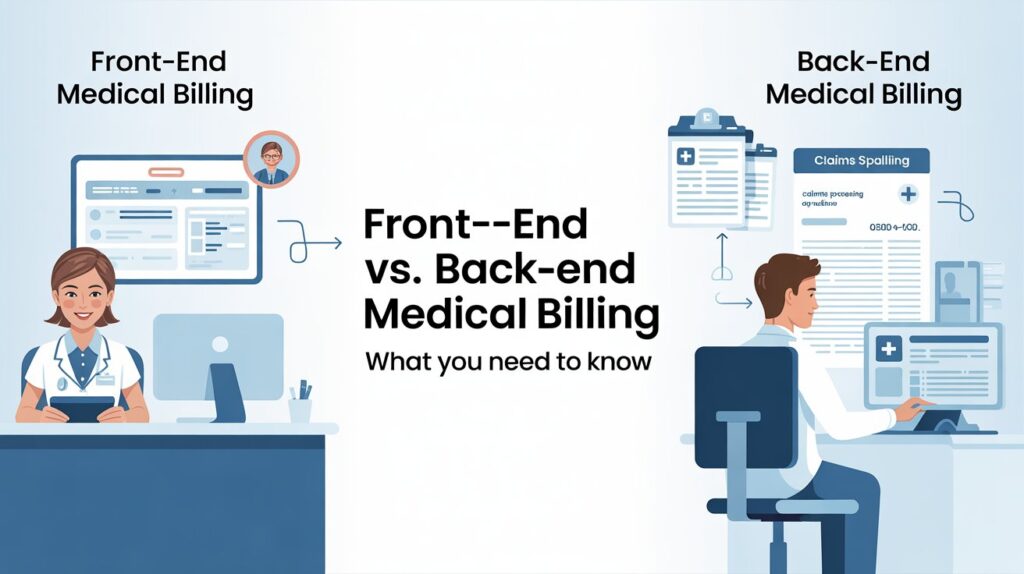
Front-end billing includes everything that happens before a patient receives care and before claims are sent out. Back-end billing covers everything that happens after the patient visit when claims are submitted and payments are collected. Both parts need to work well for a medical practice to succeed financially. Problems in front-end billing create problems in back-end billing. When front-end staff do their jobs correctly, back-end staff have an easier time getting claims paid.
This guide explains the differences between front-end and back-end medical billing. It shows what tasks belong to each part, who does the work, what skills are needed, and how both parts connect. Whether you work in a medical practice, want to work in medical billing, or just want to understand how healthcare billing works, this information will help you see the complete picture.
What is Front-End Medical Billing
Front-end medical billing covers all the tasks that happen before and during the patient visit. This is the preparation work that sets up everything else. Front-end staff interact directly with patients. They collect information, verify insurance, and make sure everything is ready for billing after the visit.
The front-end is like the foundation of a house. If the foundation is weak, the whole house has problems. If front-end billing is done poorly, back-end billing becomes much harder. Claims get denied. Payments are delayed. Money gets lost.
Front-end billing happens in the medical practice office. Patients see these staff members when they call to make appointments and when they arrive for visits. Front-end work requires good communication skills because staff talk to patients all day. They need to explain insurance benefits, collect payments, and answer questions in ways patients can understand.
Who Does Front-End Billing
Several different people in a medical practice handle front-end billing tasks:
Appointment Schedulers These staff members answer phones, schedule appointments, and collect basic patient information when appointments are booked.
Front Desk Receptionists They greet patients when they arrive, check them in for appointments, verify that information is correct, and collect co-payments.
Patient Registration Specialists In larger practices, these people focus only on registering new patients and updating information for returning patients.
Insurance Verification Specialists They contact insurance companies to check that patients have active coverage and that services will be covered.
Financial Counselors They discuss costs with patients, explain what insurance will cover, set up payment plans, and help patients who need financial assistance.
In small medical practices, one or two people might do all of these jobs. In large practices, each task might be done by different people or even different departments.
Front-End Billing Tasks and Responsibilities
Front-end billing involves many specific tasks. Each one matters for getting claims paid correctly later.
Patient Registration and Demographic Information
The first front-end task is collecting patient information. This happens when someone becomes a new patient or when an existing patient’s information changes.
Staff collect the patient’s full legal name exactly as it appears on their insurance card. They record date of birth, home address, phone number, and email address. They ask about emergency contacts and the patient’s preferred pharmacy.
This information must be accurate. One wrong number in a date of birth causes claim denials. An old address means bills go to the wrong place. A misspelled name does not match insurance records.
Staff should ask patients to review their information at every visit. People move, change phone numbers, get married and change names, or switch insurance. Keeping information current prevents billing problems.
Insurance Information Collection
Collecting insurance details is one of the most important front-end tasks. Staff need to see the actual insurance card, not just hear information from the patient. Many patients think they know their policy number but get it wrong.
Front-end staff record the insurance company name, the member or policy ID number, and the group number if there is one. They write down who the policyholder is if the patient is covered under someone else’s insurance, like a spouse or parent.
They check whether this is the patient’s primary insurance or if they have other insurance too. The order matters because claims must go to the correct insurance first.
Staff make copies of both sides of the insurance card. The front has basic information. The back often has important phone numbers and claim submission addresses. These copies go in the patient’s file.
For patients with government insurance like Medicare or Medicaid, staff collect those ID numbers and check for any secondary insurance.
| Front-End Task | What Gets Done | Why It Matters |
| Collect Patient Name | Get full legal name from ID | Must match insurance exactly |
| Record Birth Date | Write down patient’s date of birth | Used to identify patient in insurance system |
| Get Address | Current mailing address | Bills must reach the patient |
| Copy Insurance Card | Front and back copies | Proves what information patient provided |
| Verify Policyholder | Name of person who owns insurance | Needed when patient is dependent |
| Record Group Number | Group number from insurance card | Some policies require this |
| Check for Multiple Insurance | Ask about other coverage | Determines billing order |
Insurance Verification Before Appointments
After collecting insurance information, front-end staff verify that the insurance is active and will cover the planned services. This step happens before the patient arrives for their appointment.
Staff contact the insurance company by phone or through online systems. They check that the policy is currently active. They ask about coverage dates to make sure the policy will be active on the appointment date.
They find out the patient’s deductible amount and how much has already been paid toward it. They ask about co-payment amounts for the type of visit scheduled. They check whether the healthcare provider is in the patient’s insurance network.
For certain services like MRI scans, surgeries, or physical therapy, staff ask if pre-authorization is required. If it is, they start the authorization process before the appointment.
Verification prevents surprises. When staff know what insurance will cover, they can tell patients what they will owe. Patients appreciate knowing costs ahead of time.
Financial Counseling and Cost Estimates
Some medical practices have staff who discuss money with patients before services are provided. This is especially important for expensive procedures or for patients without insurance.
Financial counselors explain what services will cost. They tell patients what insurance will pay and what the patient will owe out of pocket. They discuss payment options including payment plans.
For patients who cannot afford care, counselors explain financial assistance programs. They help patients apply for charity care or payment discounts based on income.
Good financial counseling reduces bad debt. When patients know costs upfront and have payment options, they are more likely to pay their bills.
Obtaining Pre-Authorization and Referrals
Many insurance plans require approval before covering certain services. This is called pre-authorization or prior authorization. Front-end staff are responsible for getting these approvals.
Services commonly needing authorization include:
- MRI and CT scans
- Surgeries and procedures
- Specialty medications
- Durable medical equipment like wheelchairs
- Physical therapy beyond a certain number of visits
- Sleep studies
- Infusion therapy
Staff submit authorization requests to insurance companies along with clinical information explaining why the service is needed. The insurance company reviews the request and either approves or denies it.
Authorization can take days or weeks. Staff must start the process early so approvals arrive before scheduled services.
Some insurance plans also require referrals from primary care providers before patients can see specialists. Front-end staff make sure referrals are in place before specialist appointments.
Collecting Patient Payments at Time of Service
Front-end staff collect money from patients when they arrive for appointments. This includes co-payments, previous balances, and deposits for services.
Co-payments are fixed amounts the insurance plan requires patients to pay at each visit. A plan might have a $30 co-pay for primary care visits. Staff collect this $30 when the patient checks in.
If the patient has an unpaid balance from previous visits, staff ask for payment. Collecting old balances at check-in is easier than billing for them later.
For patients without insurance or for services not covered by insurance, staff might collect payment in full before services are provided. Some practices require deposits for expensive procedures.
Staff should have scripts to use when asking for payment. A professional, matter-of-fact approach works best. “Your co-payment today is $30. How would you like to pay?” Most patients expect to pay something and hand over their credit card or cash without complaint.
Patient Check-In Process
When patients arrive for appointments, front-end staff check them in. This involves several small but important tasks.
Staff verify the patient’s identity by checking a photo ID. They confirm that all information in the computer system is still correct. They ask if insurance has changed.
Patients sign consent forms for treatment. They acknowledge privacy notices. They might sign financial responsibility forms agreeing to pay for services their insurance does not cover.
Staff update any medical history forms. They give patients any paperwork that needs to be completed before seeing the healthcare provider.
Good check-in is quick and friendly. Patients should not wait long at the front desk. Everything should be ready so check-in takes just a few minutes.
What is Back-End Medical Billing
Back-end medical billing covers everything that happens after the patient visit. This is when claims are created, submitted to insurance, and followed up until payment is received. Back-end staff rarely interact with patients. They work with insurance companies, coding systems, and payment processing.
Back-end billing is like the engine of a car. Patients do not see it working, but it is what makes everything go. Without good back-end billing, medical practices do not get paid no matter how good the front-end work was.
Back-end billing requires different skills than front-end billing. Back-end staff need to understand medical coding, insurance policies, and billing regulations. They need patience for detailed work and persistence for following up on unpaid claims.
Who Does Back-End Billing
Different specialists handle various back-end billing tasks:
Medical Coders They review healthcare provider documentation and assign diagnosis and procedure codes. Many coders have special certifications like CPC (Certified Professional Coder).
Charge Entry Specialists They enter all the services and charges into the billing system after the visit.
Claims Specialists They generate claims, review them for errors, and submit them to insurance companies.
Payment Posters They record insurance payments and patient payments in the billing system.
Denial Management Specialists They review denied claims, figure out why they were denied, and work to get them paid.
Collections Specialists They follow up on unpaid patient balances, make collection calls, and manage payment plans.
Billing Managers They supervise the back-end team, review reports, and make sure everything runs smoothly.
In small practices, one person might do all these jobs. In large practices or billing companies, people specialize in one area.
Back-End Billing Tasks and Responsibilities
Back-end billing includes many steps that must be done carefully and in the right order.
Medical Coding
After the patient visit ends, medical coders review what the healthcare provider wrote in the medical record. They translate everything into standardized codes.
Two main types of codes are used:
ICD Codes for Diagnoses These codes describe what conditions the patient has. For example, J06.9 is the code for upper respiratory infection. E11.9 is the code for type 2 diabetes.
CPT Codes for Procedures These codes describe what the healthcare provider did. Code 99213 represents a standard office visit. Code 36415 represents drawing blood.
Coders must choose the most specific codes that match the documentation. They must make sure the diagnosis codes support the procedure codes – this is called showing medical necessity.
Good coding is extremely important. Right codes mean claims get paid. Wrong codes mean denials and lost money.
Charge Capture and Entry
After coding, staff enter all charges into the billing system. Each service provided gets entered with its code and the fee the practice charges.
Charge entry includes the office visit, any procedures done, laboratory tests performed, medications given, and supplies provided to the patient.
Complete charge capture means billing for everything the practice provided. Missing charges mean lost revenue. If a healthcare provider gives a patient a vaccine but nobody enters the charge, the practice loses money for that vaccine.
Staff review charts to make sure all services are captured. They check that quantities are correct. They verify that dates are accurate.
Claim Creation and Review
Once charges are entered, the billing system creates insurance claims. A claim is an electronic or paper form requesting payment from the insurance company.
The claim includes patient information, insurance information, provider information, diagnosis codes, procedure codes, and charge amounts. Every piece of information must be correct.
Before claims are sent out, they go through a review process. Automated software checks for common errors like invalid codes, missing information, or formatting problems. Claims with errors get kicked back for correction.
This review step is important because clean claims get paid faster. Claims with errors get rejected and must be fixed and resubmitted, delaying payment by weeks.
| Back-End Task | What Gets Done | Why It Matters |
| Medical Coding | Assign ICD and CPT codes | Tells insurance what was done |
| Charge Entry | Enter all services and fees | Creates the bill |
| Claim Scrubbing | Check claims for errors | Prevents rejections |
| Claim Submission | Send claims to insurance | Requests payment |
| Payment Posting | Record insurance payments | Updates account balances |
| Denial Management | Handle rejected claims | Recovers lost revenue |
| Patient Billing | Send statements to patients | Collects patient portion |
| Follow-Up | Track unpaid claims | Makes sure practice gets paid |
Claim Submission to Insurance
After claims pass review, they are submitted to insurance companies. Most claims go out electronically through a clearinghouse. A clearinghouse is a company that receives claims from medical practices and forwards them to insurance companies.
Electronic claims reach insurance companies in 24-48 hours. They process faster than paper claims sent by mail.
Staff track which claims were submitted and watch for acknowledgments from insurance companies confirming receipt.
Claims must be submitted within certain timeframes. Most insurance companies want claims within 90-180 days of the service date. Medicare requires submission within one year. Missing these deadlines means the practice cannot get paid.
Payment Posting
When insurance companies send payments, back-end staff record them in the billing system. This is called payment posting.
Staff match each payment to the correct patient and the correct services. They enter the amount insurance paid, the amount written off due to contracts, and the amount left for the patient to pay.
Payments come with remittance advice documents that explain how each claim was processed. Staff must read these documents carefully to post payments accurately.
Good payment posting keeps accounts up to date. It shows exactly where each patient account stands and what money is still owed.
Denial Management and Appeals
Not every claim gets paid. Insurance companies deny claims for many reasons. Back-end staff must handle these denials.
When a denial arrives, staff review why it happened. Was information missing? Were codes wrong? Did insurance decide the service was not covered?
Based on the denial reason, staff decide what to do:
- Correct errors and resubmit the claim
- Appeal the denial with additional information
- Accept the denial and bill the patient
- Write off the amount as uncollectible
Denials that are appealed need supporting documentation. Staff gather medical records, write appeal letters, and submit everything to the insurance company by the deadline.
Good denial management recovers money that would otherwise be lost. Practices that ignore denials leave thousands of dollars on the table.
Patient Billing and Statements
After insurance pays their portion, back-end staff bill patients for the remaining balance. The billing system generates statements showing what the patient owes.
Statements are mailed to patients monthly. They list services received, what insurance paid, and the current balance due.
Clear statements help patients understand their bills. They should explain charges in plain language, not billing codes. They should show payment options and due dates.
Some practices send statements electronically or offer online patient portals where patients can view bills and make payments.
Collections and Follow-Up
When patients do not pay their bills, back-end collections staff follow up. They call patients to discuss balances and offer payment plans.
Staff must follow laws about debt collection. They cannot harass patients or call at inappropriate times. They must be professional even when patients are angry.
For accounts that remain unpaid after multiple attempts, practices might send them to outside collection agencies or write them off as bad debt.
Follow-up also includes tracking unpaid insurance claims. Staff contact insurance companies to check on claims that are taking too long to process. They make sure claims did not get lost and push for payment.
Key Differences Between Front-End and Back-End Billing
Front-end and back-end billing are different in many ways. Understanding these differences helps medical practices hire the right people and train them properly.
Patient Interaction
Front-End : Staff talk to patients all day. They answer questions, explain costs, and collect payments face-to-face or over the phone. Customer service skills are very important.
Back-End : Staff rarely talk to patients. Most of their communication is with insurance companies, not people receiving care. Technical skills matter more than customer service.
Timing
Front-End : Work happens before and during patient visits. Everything is done in real-time while the patient is present or on the phone.
Back-End : Work happens after patient visits. Staff have time to research, review documentation, and correct errors without patients waiting.
Required Knowledge
Front-End : Staff need to know insurance plans, benefit structures, and how to explain things to patients who may not understand medical or insurance terms.
Back-End : Staff need to know medical coding, billing regulations, insurance policies, and appeals processes. More technical knowledge is required.
Primary Focus
Front-End : Making sure all information is collected correctly so billing can happen smoothly. Preventing problems before they start.
Back-End : Getting claims paid and collecting money owed to the practice. Solving problems that occur.
Performance Measures
Front-End : Success is measured by accuracy of information collected, percentage of insurance verified before visits, and money collected at time of service.
Back-End : Success is measured by claim acceptance rates, denial rates, days to payment, and total collections.
| Aspect | Front-End Billing | Back-End Billing |
| When It Happens | Before and during patient visit | After patient visit |
| Patient Contact | Direct, frequent | Minimal or none |
| Main Tasks | Registration, verification, pre-authorization | Coding, claims, payments, collections |
| Skills Needed | Communication, customer service | Coding knowledge, attention to detail |
| Who They Talk To | Patients, insurance companies | Insurance companies, collection agencies |
| Work Environment | Front desk, phones ringing, patients present | Office, computer work, quieter |
| Urgency | Immediate, patients are waiting | Deadlines but less immediate |
| Training Focus | Insurance benefits, customer service | Medical coding, billing regulations |
How Front-End and Back-End Billing Work Together
Front-end and back-end billing are not separate processes. They connect and depend on each other. Good front-end work makes back-end work easier. Problems in front-end create extra work for back-end.
Information Flow
Information collected at the front-end flows to the back-end. Patient demographics, insurance details, and authorization numbers all move from front-end systems into the billing system.
When front-end staff enter patient information correctly, back-end staff can submit clean claims. When front-end staff make mistakes, back-end staff must fix them before claims can go out.
This flow should be seamless. In practices with good computer systems, information entered once at the front desk automatically appears in the billing system. Staff do not need to retype anything.
In practices with poor systems, information must be entered multiple times. This creates opportunities for errors and wastes time.
Communication Between Teams
Front-end and back-end staff need to communicate regularly. Front-end staff should know which insurance companies cause the most claim problems so they can be extra careful with verification. Back-end staff should tell front-end staff when patient information is consistently wrong so training can fix the problem.
Regular team meetings help both sides understand how their work affects each other. When front-end staff see how their errors create denials, they become more careful. When back-end staff understand patient service challenges, they appreciate front-end work more.
Impact of Front-End Errors on Back-End Work
When front-end staff make mistakes, back-end staff pay the price:
Wrong Insurance Information Claims get rejected immediately. Back-end staff must contact the patient to get correct information, correct the claim, and resubmit. This delays payment by weeks.
Missing Pre-Authorization Insurance denies the claim. Back-end staff must try to get retroactive authorization, which rarely works. The practice might not get paid at all.
Incomplete Patient Information Claims reject for missing data. Back-end staff must track down the information and resubmit.
Wrong Date of Birth Insurance systems cannot identify the patient. Claims deny. Back-end staff must fix and resubmit.
Each of these errors adds work to the back-end process. In practices with lots of front-end errors, back-end staff spend most of their time fixing problems instead of submitting clean claims.
Impact of Back-End Work on Front-End
Back-end work affects front-end staff too:
Denials for Services Not Covered When services are denied as not covered, patients get surprised by bills. They call the front desk angry. Front-end staff must deal with upset patients about situations they did not create.
Slow Claim Processing When back-end staff are behind on claim submission, payments arrive late. Patients receive bills for services their insurance should have paid. They call the front desk confused.
Billing Errors If back-end staff post payments incorrectly, patients get billed wrong amounts. Front-end staff field the complaint calls.
Good back-end work makes front-end staff’s lives easier. Clean claims that pay quickly mean fewer patient complaints at the front desk.
Front-End Billing Best Practices
Medical practices can improve front-end billing by following proven methods.
Verify Insurance for Every Patient at Every Visit
Even established patients can lose insurance coverage. They might have changed jobs and gotten new insurance. They might have stopped paying premiums and lost coverage. Always verify insurance before every appointment, not just for new patients.
Automated verification tools can check insurance overnight for next-day appointments. This saves staff time and catches problems before patients arrive.
Collect Co-Payments at Check-In, Not Checkout
Ask for co-payments when patients arrive, not when they leave. Patients who have already seen the healthcare provider sometimes leave without checking out. They walk past the front desk and the practice never collects the co-payment.
When co-pays are collected at check-in, this problem disappears.
Make Copies of Insurance Cards Every Time
Even if a patient says nothing has changed, look at their insurance card and make new copies periodically. Insurance companies sometimes send new cards with new numbers. Patients forget to mention this.
Seeing the actual card catches these changes before they cause claim problems.
Get Pre-Authorizations Early
Start the pre-authorization process as soon as an appointment is scheduled. Do not wait until the day before. Authorizations can take days or weeks to come through.
Track authorization requests and follow up if responses do not arrive. Insurance companies sometimes lose requests.
Explain Costs Before Services
Tell patients what they will owe before they receive care. Surprise bills create angry patients who refuse to pay.
Patients who know costs upfront can decide whether to proceed, arrange payment, or postpone services.
Train Front-End Staff on Insurance Basics
Front desk staff should understand how insurance works. They should know what deductibles, co-payments, and co-insurance mean. They should be able to explain these concepts to patients in simple terms.
Regular training keeps staff knowledge current as insurance rules change.
Back-End Billing Best Practices
Back-end billing also improves with good practices.
Submit Claims Quickly
Get claims out within a few days of the patient visit. Fast submission means faster payment. Claims sitting for weeks before submission delay revenue.
Daily claim batches work better than weekly batches. Send out claims as soon as coding and charge entry are complete.
Review Claims Before Submission
Use claim scrubbing software to catch errors before claims go to insurance companies. Clean claims pay faster and with less hassle than claims that get rejected.
Even automated scrubbing benefits from human review. Have experienced staff spot-check claims for issues software might miss.
Post Payments Daily
Record insurance and patient payments every day. Daily posting keeps accounts current and helps identify problems quickly.
Payments that sit unposted for days or weeks create accounting confusion and make it hard to know what money is actually owed.
Follow Up on Denials Immediately
When a denial arrives, work on it right away. Denials have time limits for appeals. Waiting too long means losing the right to appeal.
Immediate follow-up also makes problems easier to solve. Details are fresh when a claim just got denied. Waiting weeks makes research harder.
Track Performance Metrics
Monitor denial rates, days in accounts receivable, and collection rates. These numbers show whether back-end billing is working well.
When numbers get worse, investigate why and fix problems. Regular tracking catches issues before they become serious.
Maintain Clean Accounts Receivable
Review aging accounts regularly. Claims over 30 days old with no response need follow-up. Claims over 60 days need aggressive follow-up.
Letting receivables age without action reduces the chance of ever collecting payment.
Common Front-End Billing Mistakes
Understanding common mistakes helps practices avoid them.
Not Verifying Insurance
Some practices skip verification to save time. This almost always creates bigger problems later when claims deny for inactive coverage or services not covered.
The few minutes spent verifying prevents hours of work fixing denied claims.
Accepting Insurance Information Over the Phone
Patients often give wrong policy numbers, spell insurance company names incorrectly, or forget their group numbers. Always see the actual insurance card.
A quick photo taken with a phone or scanner captures accurate information every time.
Failing to Collect Co-Payments
When staff do not consistently collect co-payments, patients learn they do not have to pay. Then patients expect to be billed instead of paying at the visit.
Billing for small co-payments costs more in postage and staff time than the co-payment is worth. Collect at the time of service.
Not Getting Pre-Authorizations
Services performed without required authorization rarely get paid. Insurance companies deny these claims and practices usually cannot bill patients either.
This is completely preventable. Check authorization requirements and get approval before scheduling services.
Poor Communication with Patients About Costs
Patients who do not understand what they will owe are shocked when bills arrive. They dispute charges and delay payment.
Clear cost discussions before services prevent these problems.
Common Back-End Billing Mistakes
Back-end staff make preventable errors too.
Submitting Claims with Errors
Rushing to submit claims without proper review causes rejections. It is faster to review carefully once than to fix rejections and resubmit.
Clean claims on first submission save time and accelerate payment.
Ignoring Denied Claims
Some practices give up on denials too easily. Many denials can be overturned with proper appeals.
Systematic denial management recovers significant revenue that would otherwise be lost.
Posting Payments Incorrectly
Posting insurance payments to wrong patient accounts creates chaos. Patients get billed for services that were actually paid. Other patients show credit balances when they owe money.
Careful matching of payments to charges prevents these errors.
Not Following Up on Unpaid Claims
Claims can get lost in insurance company systems. Without follow-up, they sit unpaid forever. Regular claim status checks catch lost claims while there is still time to resubmit.
Using Wrong Codes
Coding errors cause denials and underpayments. Services billed with incorrect codes do not get paid properly.
Proper coder training and regular coding audits improve accuracy.
Skills Needed for Front-End Billing
People who want to work in front-end billing need certain abilities.
Communication Skills
Front-end staff talk to patients constantly. They must explain complex insurance information in simple terms. They need to be friendly but professional.
Good communication includes speaking clearly, listening to patient concerns, and staying calm when patients are frustrated.
Customer Service Attitude
Patients are often stressed when they come to medical practices. They might be sick, worried, or confused. Front-end staff must be patient and helpful.
A positive attitude makes the practice feel welcoming and helps patients feel comfortable.
Attention to Detail
Recording insurance information requires careful attention. One wrong number causes claim problems. Names must be spelled exactly right.
Detail-oriented people succeed in front-end roles.
Computer Skills
Front-end staff use practice management software, insurance company websites, and other computer systems. Basic computer competency is necessary.
Fast typing and ability to learn new software help people work efficiently.
Problem-Solving Ability
Every day brings new situations. A patient’s insurance card does not match what is in the computer. An authorization gets denied. A patient cannot afford their co-payment.
Front-end staff need to think on their feet and find solutions.
Insurance Knowledge
Understanding how health insurance works is essential. Staff should know the difference between HMO and PPO plans, what deductibles are, how networks work, and what
pre-authorization means.
This knowledge can be learned on the job, but people who already understand insurance basics have an advantage.
Skills Needed for Back-End Billing
Back-end billing requires different skills than front-end work.
Medical Coding Knowledge
Back-end staff, especially coders, must know ICD and CPT coding systems. This means understanding medical terminology, anatomy, and disease processes.
Certified coders have passed exams proving their knowledge. Certification is not always required but helps people get hired and earn more money.
Attention to Detail
Like front-end work, back-end billing demands careful attention. A wrong code or missed charge costs money. Claims must be reviewed thoroughly before submission.
People who naturally notice small details do well in back-end roles.
Persistence
Following up on denials and unpaid claims requires not giving up. Insurance companies can be hard to reach. Representatives might give wrong information. Claims get lost.
Persistent people who keep trying until problems are solved succeed in back-end billing.
Analytical Thinking
Back-end staff must analyze denial reasons, research insurance policies, and determine why claims did not pay. This requires logical thinking and problem-solving.
People who enjoy puzzles and figuring things out fit back-end roles well.
Computer Proficiency
Back-end work involves extensive computer use. Staff work in billing software, clearinghouse systems, insurance portals, and spreadsheets.
Comfort with technology and ability to learn new systems quickly are valuable.
Understanding of Medical Terminology
Even non-coder back-end staff need to understand medical terms. Reading provider documentation, researching denials, and writing appeals all require medical vocabulary knowledge.
This can be learned through classes or on the job.
Technology Used in Front-End Billing
Front-end billing relies on several technology tools.
Practice Management Systems
These systems store patient information, insurance details, and appointment schedules. Front-end staff spend most of their time in the practice management system.
Popular systems include Epic, Athenahealth, NextGen, and many others.
Insurance Verification Tools
Automated verification systems check patient eligibility electronically. They connect to insurance company databases and return real-time information.
These tools save enormous time compared to calling each insurance company.
Payment Processing Systems
Credit card terminals and payment processing software allow staff to collect payments securely. Many systems integrate with practice management software so payments automatically post to accounts.
Patient Portals
Online portals let patients update their own information, view upcoming appointments, and make payments. This reduces front desk workload.
Electronic Forms
Tablets or kiosks where patients complete registration forms electronically eliminate paperwork and improve data accuracy.
| Technology Tool | What It Does | Benefits for Front-End |
| Practice Management System | Stores patient data, schedules | Central location for all information |
| Eligibility Verification | Checks insurance in real-time | Faster than phone calls |
| Payment Processing | Accepts credit cards | Easy collection at time of service |
| Patient Portal | Lets patients self-serve | Reduces staff workload |
| Electronic Forms | Captures patient information digitally | More accurate than handwriting |
| ID Card Scanner | Scans insurance cards | Faster than manual copying |
Technology Used in Back-End Billing
Back-end billing uses different technology tools.
Medical Coding Software
Coding programs help coders look up codes, check coding rules, and verify that codes match. They include code descriptions, coding guidelines, and cross-references.
Popular coding software includes Optum360 and 3M.
Claim Scrubbing Software
These programs check claims for errors before submission. They apply thousands of rules to catch missing information, invalid codes, and billing errors.
Many clearinghouses include scrubbing as part of their service.
Clearinghouses
Clearinghouses transmit claims from medical practices to insurance companies. They format claims correctly for each payer and provide claim tracking.
Major clearinghouses include Change Healthcare and Availity.
Electronic Remittance Advice Processing
ERA systems automatically import insurance payment information into billing systems. This eliminates manual payment posting for most payments.
Denial Management Software
Specialized programs track denials, categorize denial reasons, and manage the appeals process. They help practices identify patterns in denials.
Reporting and Analytics
Reporting tools create performance metrics showing collection rates, denial rates, days in accounts receivable, and other key numbers.
Career Paths in Front-End Billing
Front-end billing offers several career opportunities.
Entry-Level Positions
People often start as receptionists or schedulers. These positions require minimal experience and provide on-the-job training.
Pay Range : $12-$16 per hour typically Requirements : High school diploma, customer service skills
Patient Registration Specialist
With some experience, people can specialize in registration. These roles focus specifically on collecting and verifying patient information.
Pay Range : $14-$18 per hour typically Requirements : 1-2 years experience, knowledge of insurance
Insurance Verification Specialist
This role focuses entirely on verifying insurance and obtaining authorizations. It requires more insurance knowledge than basic front desk work.
Pay Range : $15-$20 per hour typically Requirements : Insurance knowledge, attention to detail, 1-2 years experience
Financial Counselor
Financial counselors discuss costs with patients and help with payment arrangements. This role requires excellent communication skills and understanding of both insurance and practice finances.
Pay Range : $17-$24 per hour typically Requirements : Several years experience, strong communication skills, financial knowledge
Front Office Supervisor or Manager
Experienced front-end staff can move into supervisory roles overseeing front desk operations.
Pay Range : $20-$30 per hour typically Requirements : 5+ years experience, leadership skills
Career Paths in Back-End Billing
Back-end billing also offers advancement opportunities.
Entry-Level Positions
People often start as billing clerks or payment posters. These positions handle routine tasks under supervision.
Pay Range : $14-$18 per hour typically Requirements : High school diploma, computer skills, attention to detail
Medical Coder
Coding is a skilled position that usually requires certification. Certified coders earn significantly more than non-certified coders.
Pay Range : $18-$28 per hour typically, higher with experience and specialty certifications
Requirements : CPC or CCS certification preferred, medical terminology knowledge
Claims Specialist
This role focuses on claim submission, tracking, and following up on unpaid claims.
Pay Range : $16-$22 per hour typically Requirements : 2-3 years billing experience, understanding of insurance policies
Denial Management Specialist
Specialists in denials work on appealing rejected claims. This requires analytical skills and insurance knowledge.
Pay Range : $18-$25 per hour typically Requirements : Several years billing experience, appeals experience
Collections Specialist
These staff focus on collecting patient balances and working with collection agencies.
Pay Range : $16-$22 per hour typically Requirements : Collections experience, communication skills
Billing Manager
Experienced back-end staff can become managers overseeing entire billing departments.
Pay Range : $25-$40 per hour typically Requirements : 5+ years experience, leadership ability, comprehensive billing knowledge
Improving Front-End and Back-End Collaboration
Medical practices succeed when front-end and back-end teams work together smoothly.
Regular Team Meetings
Bring front-end and back-end staff together monthly to discuss problems and solutions. Let each side explain challenges they face.
These meetings build understanding and teamwork.
Cross-Training
Have front-end staff spend time learning what back-end staff do, and vice versa. When people understand the whole billing cycle, they see how their work affects others.
Even a few hours of cross-training improves collaboration.
Shared Performance Goals
Instead of measuring front-end and back-end separately, create practice-wide goals. When everyone works toward the same targets, teamwork improves.
For example, make “practice clean claim rate” a goal instead of just “back-end clean claim rate.” This encourages front-end staff to provide accurate information.
Feedback Loops
Create systems for back-end staff to report front-end errors and for front-end staff to report back-end issues. This feedback should be constructive, not blaming.
Use errors as training opportunities to prevent future problems.
Shared Technology
When front-end and back-end staff use integrated systems where information flows automatically, collaboration is easier. Everyone sees the same patient information without re-entering data.
| Collaboration Method | How It Helps | Implementation Tips |
| Team Meetings | Builds understanding between groups | Monthly meetings, rotating topics |
| Cross-Training | Shows how roles connect | Start with short shadowing sessions |
| Shared Goals | Aligns everyone toward same outcomes | Pick 2-3 metrics everyone affects |
| Error Reporting | Identifies training needs | Make it non-punitive |
| Integrated Systems | Eliminates information gaps | Choose compatible software |
| Joint Problem-Solving | Uses whole team’s knowledge | Include all levels in discussions |
Challenges in Front-End Billing
Front-end billing faces specific difficulties.
Incomplete Patient Information
Patients sometimes do not know their insurance details. They might have left their insurance card at home. They might not know if they have a group number or what their policy number is.
Front-end staff must do the best they can with limited information, which creates risk for later billing problems.
Difficult Patients
Some patients are rude, demanding, or uncooperative. They might argue about co-payments or refuse to provide information.
Front-end staff need thick skin and good conflict management skills.
Complex Insurance Rules
Insurance plans have complicated rules about what is covered, which providers are in network, and what requires authorization. Front-end staff must understand these rules for dozens of different insurance companies.
This complexity makes training difficult and creates opportunities for mistakes.
Time Pressure
Front-end staff must work quickly because patients are waiting. They cannot spend 30 minutes verifying insurance when ten patients need to check in.
Balancing speed with accuracy is challenging.
Insurance Company Problems
Sometimes insurance company phone systems do not work. Website portals go down. Representatives give wrong information.
Front-end staff get blamed for insurance company failures they cannot control.
Challenges in Back-End Billing
Back-end billing has its own challenges.
Changing Coding Rules
Medical codes are updated regularly. ICD-10 added new codes in recent updates. CPT codes change annually. Back-end staff must constantly learn new codes and rules.
Staying current requires ongoing education.
Difficult-to-Reach Insurance Companies
Calling insurance companies often means long hold times. Representatives might not be helpful. It can take hours to check on one unpaid claim.
This frustration tests staff patience.
Incomplete Provider Documentation
Back-end staff can only code and bill what healthcare providers document. When documentation is vague or incomplete, billing suffers.
Coders must spend time asking providers for clarification, slowing the billing process.
Complex Claim Denials
Some denials are easy to understand and fix. Others are mysterious with unclear denial reasons. Figuring out what insurance companies want can be frustrating.
Persistent problem-solving is necessary.
High Workload
Medical practices generate lots of patient visits, which means lots of claims to process. Back-end staff often feel overwhelmed by the volume of work.
Efficient workflows and good time management help manage the load.
The Future of Front-End and Back-End Billing
Medical billing continues to evolve with new technology and changing healthcare.
Automation in Front-End Billing
More front-end tasks are becoming automated. Patients complete registration on tablets before arrival. Insurance verification happens automatically overnight. Payment processing becomes self-service.
This automation reduces front desk staffing needs but requires different skills. Staff shift from data entry to problem-solving for situations automation cannot handle.
Automation in Back-End Billing
Back-end automation is advancing even faster. Artificial intelligence suggests codes based on provider documentation. Robotic process automation posts payments and checks claim status automatically.
These technologies handle routine work, freeing staff to focus on complex situations, appeals, and problem accounts.
Value-Based Payment Models
Healthcare is slowly moving from fee-for-service (paying for each service) to value-based models (paying based on patient outcomes). This shift changes billing.
Practices must track quality metrics, patient satisfaction, and health outcomes in addition to services provided. Billing becomes more complex.
Price Transparency
New regulations require healthcare providers to publish prices. Patients increasingly want to know costs before receiving care.
This creates more front-end work for cost estimates and financial counseling.
Continued Complexity
Despite automation, medical billing keeps getting more complicated. More insurance plans, more regulations, and more requirements mean billing expertise remains valuable.
People who understand medical billing will continue to have good career opportunities.
Outsourcing Front-End and Back-End Billing
Some medical practices outsource billing functions to specialized companies. Outsourcing can include just back-end tasks, just front-end tasks, or both.
What Gets Outsourced
Back-End Only Many practices keep front-end functions in-house because these involve direct patient contact. They outsource coding, claims, and collections to billing companies. This is the most common outsourcing arrangement.
Front-End Only Less common is outsourcing front-end work. Some practices use call centers for appointment scheduling. Virtual assistants handle insurance verification remotely.
Complete Revenue Cycle Some practices outsource everything from scheduling through collections. The outsourcing company becomes the entire billing department.
Benefits of Outsourcing
Outsourcing offers several advantages:
Access to Expertise Billing companies employ certified coders, experienced claims specialists, and denial management experts. Small practices cannot afford this level of expertise in-house.
Reduced Overhead No need to hire, train, and manage billing staff. No need to buy billing software or pay for clearinghouse services.
Better Performance Professional billing companies often achieve higher collection rates and lower denial rates than practice-employed staff.
Scalability Billing companies can handle volume increases without the practice hiring more people.
Focus on Patient Care Healthcare providers and practice managers can focus on clinical care instead of billing problems.
Choosing to Outsource
Practices should consider outsourcing when:
- They are too small to employ specialized billing staff
- Their current billing performance is poor
- They are opening a new practice and do not want to build a billing department
- They want to focus resources on clinical care instead of billing Practices should keep billing in-house when:
- They have good billing staff already
- They want direct control over the billing process
- They have enough volume to justify the overhead
- Patient relationships are very important to their practice culture
Conclusion: The Partnership Between Front-End and Back-End Billing
Front-end and back-end medical billing are two halves of one complete process. Neither works well without the other. Front-end staff lay the groundwork by collecting accurate information and preparing patients for financial responsibility. Back-end staff build on that foundation by submitting clean claims, collecting payments, and resolving problems.
When front-end and back-end teams communicate well, respect each other’s work, and collaborate on solutions, medical practices thrive financially. Payments arrive quickly. Denials stay low. Patients understand their bills. Healthcare providers get paid fairly for their services.
Whether done by practice employees or outsourced to professional billing companies, both front-end and back-end billing require skilled, detail-oriented people who understand healthcare, insurance, and regulations. As medical billing continues to evolve with new technology and changing healthcare payment models, these skills remain valuable. People who master either front-end or back-end billing – or better yet, understand both – will find good career opportunities in healthcare for years to come.
The medical billing cycle needs both parts working together smoothly, just like a car needs both a steering wheel and an engine to get anywhere. Healthcare providers who invest in strong front-end and back-end billing processes position themselves for financial health and can focus their energy where it belongs – on taking care of patients.