Skip to main content
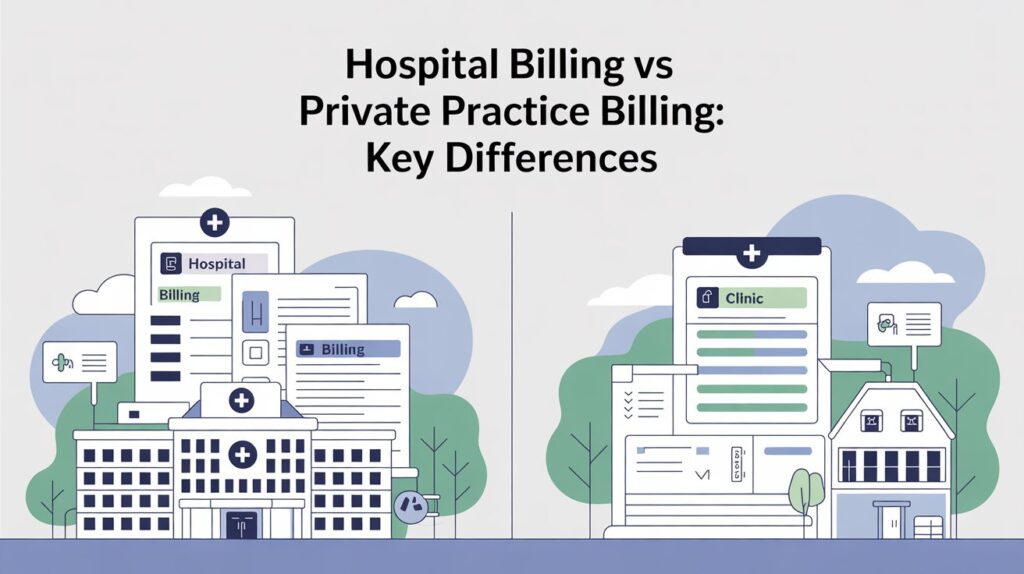
Medical billing works differently in private practices compared to hospitals. Private practices are small medical offices where one or a few doctors see patients. Hospitals are large facilities with many departments, hundreds of staff members, and patients who might stay overnight. The way these two types of facilities handle billing has major differences that affect how money gets collected, how staff work, and what technology gets used.
Understanding these differences matters for people who work in medical billing. Someone who learned billing in a private practice might feel lost working in a hospital billing department. The reverse is also true. The processes, software, codes, and daily tasks look very different between the two settings. For healthcare providers deciding how to structure their billing operations, knowing these differences helps them make better choices about staffing, systems, and whether to handle billing internally or outsource it.
This guide explains how medical billing workflows differ between private practices and hospitals. It covers the entire billing process from patient registration through final payment collection. It looks at staffing differences, technology needs, coding requirements, claim submission processes, and how outsourced billing companies handle each type differently. Whether you work in billing, manage a medical practice, run a hospital revenue cycle department, or want to understand healthcare billing better, this information helps you see how location and facility type shape billing workflows.
Understanding Private Practice Structure
Private practices are medical offices owned and operated by physicians or small groups of physicians. These practices are independent businesses, not part of larger hospital systems. A typical private practice might have one to ten physicians, though some are larger. The practice operates in an office setting, not a hospital building.
Types of Private Practices
Private practices come in different sizes and structures. Solo practices have just one physician who owns and runs everything. This doctor makes all business decisions, hires all staff, and keeps all profits after expenses. Small group practices have two to five physicians who share ownership and business responsibilities. Medium group practices have five to twenty physicians working together. Large group practices can have more than twenty physicians and might operate multiple office locations.
Private practices see outpatient patients only. Patients come to the office for appointments and go home the same day. No one stays overnight. The services provided include office visits, minor procedures done in the office, diagnostic tests the practice can perform onsite, and sometimes lab work or imaging if the practice has that equipment. More serious cases requiring hospitalization get referred to hospitals.
Business and Staffing Model
The business structure of private practices is relatively simple. The physicians own the practice and make business decisions. They hire staff including nurses, medical assistants, front desk staff, and billing personnel. The practice pays rent for office space, buys supplies and equipment, and covers all operating costs. Revenue comes from seeing patients and billing insurance companies or patients directly for those services.
Staffing in private practices is lean. A small practice with two or three doctors might have one person handling all billing, or the office manager might do billing along with other administrative tasks. Larger practices might have a dedicated billing department with two to five people. Staff members often wear multiple hats, handling various tasks beyond their primary role. The front desk person who checks patients in might also collect payments and verify insurance. This multi-tasking is common because small practices cannot afford specialized staff for every function.
Private practices typically specialize in one medical field. A practice might be family medicine, pediatrics, cardiology, orthopedics, or dermatology. This specialization means billing staff become very familiar with a limited set of procedure codes and insurance requirements for their specialty. A dermatology practice bills the same types of services repeatedly, so staff develop deep knowledge of those specific billing rules.
The financial model of private practices is straightforward. The practice bills for services, collects payment from insurance and patients, pays expenses, and distributes remaining profit to the physician owners. There is direct connection between how many patients are seen, how well billing is done, and how much money the physicians make. This creates strong motivation to bill accurately and collect payments efficiently.
Understanding Hospital Structure
Hospitals are large healthcare facilities that provide comprehensive medical services including emergency care, surgery, diagnostic testing, and inpatient care where patients stay overnight or longer. Hospitals can be non-profit organizations, for-profit corporations, or government-run facilities. They operate 24 hours a day, seven days a week, serving hundreds or thousands of patients daily.
Organizational Complexity
The business structure of hospitals is much more complicated than private practices. Hospitals have multiple departments including emergency departments, operating rooms, intensive care units, regular patient floors, outpatient clinics, radiology departments, laboratories, and pharmacies. Each department operates somewhat independently but under the umbrella of the overall hospital organization. Leadership includes a CEO, CFO, medical directors, nursing directors, and department heads. Decision-making involves many layers of management and committees.
Staffing in hospitals is extensive. A mid-sized hospital might employ 500 to 2,000 people. The billing and revenue cycle department alone might have 20 to 100 staff members depending on hospital size. These staff specialize in specific areas. Some handle emergency department billing, others handle surgical billing, and others focus on inpatient coding. There are separate teams for insurance verification, charge entry, payment posting, denial management, and patient collections. This specialization allows deep expertise but requires coordination between many people.
Service Variety and Financial Model
Hospitals provide both inpatient and outpatient services, creating billing complexity. Inpatient services involve patients admitted to the hospital who stay overnight. Outpatient services include emergency room visits, same-day surgeries, diagnostic tests, and clinic visits where patients go home the same day. These two types of services use completely different billing methods, codes, and payment structures. Hospital billing staff must understand both.
The variety of services hospitals provide is enormous. A hospital bills for emergency visits, surgeries ranging from simple to extremely difficult, intensive care, regular hospital room stays, MRI and CT scans, x-rays, thousands of different lab tests, medications, medical supplies, physical therapy, and dozens of other services. Each service type has different billing requirements. This variety means hospital billing is much more complicated than private practice billing.
Hospital financial models are different from private practices. Hospitals have large fixed costs including building maintenance, expensive equipment, extensive staffing, and regulatory compliance. They must negotiate contracts with multiple insurance companies, handle Medicare and Medicaid billing which have strict rules, manage charity care for patients who cannot pay, and balance profitability with community service obligations. Revenue cycle management in hospitals is a major operation requiring significant resources and expertise.
Patient Registration Workflow: Private Practice
Patient registration in private practices is a straightforward process that happens at the front desk. When a new patient calls to schedule an appointment, the scheduler collects basic information over the phone including the patient’s name, date of birth, phone number, reason for visit, and insurance information. This initial information gets entered into the practice management system.
New Patient Check-In Process
When the patient arrives for their appointment, they check in at the front desk. The front desk staff give the patient forms to complete. New patient forms collect detailed demographic information, medical history, current medications, allergies, emergency contacts, and insurance details. The patient signs consent forms for treatment and acknowledgment of the practice’s privacy policies. Established patients simply verify that their information is still correct and sign in.
Front desk staff collect the patient’s insurance card and make a copy of both the front and back. Many practices also copy the patient’s photo ID to verify identity and prevent fraud. These copies go into the patient’s file. Staff enter insurance information into the practice management system, including insurance company name, policy number, group number, and name of the policyholder if different from the patient.
Insurance verification happens either before the appointment or while the patient waits. Staff call the insurance company or check online to verify that coverage is active, the patient is eligible, services planned are covered, and to determine what the patient owes in copayments or deductibles. This verification prevents surprises where patients thought they had coverage but actually do not.
Payment Collection at Time of Service
Front desk staff collect copayments at check-in. If the patient’s insurance requires a $20 copayment for office visits, staff ask for that payment before the patient sees the doctor. Collecting copays upfront is much easier than billing for them later. Most practices require copayment at time of service. Staff also might collect previous balances if the patient owes money from earlier visits.
The entire check-in process in a private practice takes 5 to 15 minutes per patient. Staff work quickly because multiple patients arrive close together. The process is efficient because it happens the same way for every patient. Staff become very fast at these tasks through repetition.
After the patient sees the doctor and the visit ends, checkout happens at the front desk. Staff schedule any follow-up appointments needed, provide after-visit summaries or prescriptions, and collect any additional payments if needed. The encounter is marked complete in the system, triggering the billing process to begin.
| Registration Step | What Happens | Who Does It | Time Required |
| Phone Scheduling | Collect basic info, insurance | Scheduler | 5 minutes |
| Patient Arrival | Forms, ID copies, insurance cards | Front desk | 10 minutes |
| Insurance Verification | Check coverage and eligibility | Front desk or billing staff | 5 minutes |
| Copay Collection | Collect required payment | Front desk | 2 minutes |
| Checkout | Schedule follow-up, collect balance | Front desk | 5 minutes |
Patient Registration Workflow: Hospital
Patient registration in hospitals is more complicated because hospitals handle different types of patient encounters. Emergency patients, scheduled surgery patients, outpatient test patients, and clinic patients all register differently. Multiple registration desks exist throughout the hospital for different departments.
Pre-Registration for Scheduled Services
For scheduled services like outpatient surgery or imaging, registration begins days or weeks before the actual appointment. A scheduling department books the service and collects initial patient information over the phone. This information goes into the hospital’s registration system. Pre-registration staff then contact the patient to collect detailed demographics, insurance information, and medical history. They verify insurance, obtain pre-authorization if needed, and explain what the patient will owe. This advance work reduces wait time on the day of service.
On the day of the scheduled service, patients check in at the appropriate registration desk. They verify that pre-registered information is correct, sign consent forms specific to the procedure or service, and receive identification wristbands with their name and medical record number.
Registration staff enter any last-minute information updates and confirm the patient is ready for their service.
Emergency Department Registration
Emergency department registration works differently because patients arrive without appointments and often need immediate care. When someone arrives at the emergency room, triage nurses do a quick medical assessment first to determine urgency. The most sick patients go straight to treatment areas while registration happens later. Less urgent patients complete registration before or during their emergency visit.
Emergency registration collects basic demographic and insurance information quickly. Staff get what they need to start treatment and bill correctly but do not delay care for paperwork. If a patient is too sick to provide information, staff get details from family members or look up information in the hospital’s system if the patient was there before. Registration can be completed or corrected after treatment if necessary.
Inpatient Admission Process
Inpatient admissions involve the most detailed registration. When a patient is admitted to the hospital to stay overnight, admitting staff collect comprehensive information including demographics, insurance details, medical history, advance directives, emergency contacts, and financial information. They verify insurance coverage for inpatient stays, obtain authorizations, explain patient financial responsibility, and discuss payment plans if needed. This process is thorough because inpatient stays are expensive and proper documentation is required.
Hospital registration staff specialize by area. Emergency department registrars only handle ER patients. Surgical registration staff only handle surgery patients. Inpatient admitting staff only handle hospital admissions. This specialization allows staff to become expert in their specific registration type and its unique requirements.
Hospitals use sophisticated registration systems that connect to electronic health records. When a patient registers, their information flows into multiple systems including the medical record, billing system, laboratory system, pharmacy system, and any other department that will serve the patient. This integration means registration data must be accurate because many departments rely on it.
| Registration Type | Timing | Information Collected | Special Requirements |
| Pre-Registration | Days before service | Full demographics, insurance, history | Pre-authorization obtained |
| Day of Service | Upon arrival | Verification of pre-reg data | Consent forms signed |
| Emergency Department | Immediate upon arrival | Minimal info to start treatment | Can complete later if needed |
| Inpatient Admission | At admission | Comprehensive including financial | Advance directives discussed |
| Outpatient Clinic | Before appointment | Standard demographics and insurance | Similar to private practice |
Charge Capture Workflow: Private Practice
Charge capture in private practices is the process of recording all services provided so they can be billed. This happens during or immediately after each patient visit. The workflow is designed to be quick and efficient because the practice sees many patients daily.
Documentation and Encounter Forms
When the doctor sees a patient, they document the visit in the patient’s medical record. This documentation includes what the patient complained about, what examination was done, what diagnosis was made, and what treatment was provided. The doctor then indicates what services should be billed. Different practices use different methods for this.
Some practices use encounter forms, also called superbills. These are pre-printed forms that list all the common services the practice provides with checkboxes next to each one. As the doctor examines the patient, they check boxes for the services performed. Common items include the office visit level, any procedures done, tests ordered, and medications given. The doctor hands this completed form to checkout staff or billing staff.
Other practices use electronic systems where doctors select services from computer screens. In the exam room, the doctor clicks on services provided in the electronic health record system.
These selections automatically create charges in the billing system. This electronic method is faster and more accurate than paper forms because there is no manual data entry step.
Capturing Procedures and Supplies
For procedures or services beyond the basic office visit, the doctor or medical assistant notes these separately. If the doctor performs a minor surgery, gives an injection, or provides a vaccination, these items get documented and charged. Medical assistants often help with charge capture by documenting supplies used, medications administered, and tests performed under the doctor’s supervision.
Charge entry staff, who might be billing specialists or front desk staff in small practices, enter the charges into the practice management system if not already there electronically. They match each patient encounter from that day with the services documented. They enter procedure codes, called CPT codes, for each service and diagnosis codes, called ICD codes, explaining why services were needed. The system calculates charges based on the practice’s fee schedule.
Timing and Simplicity
The entire charge capture process in private practices usually completes within 24 hours of the patient visit. Staff enter charges the same day or the next morning at the latest. Quick charge entry is important because claims cannot be submitted until charges are captured. The faster charges are entered, the faster claims go out and payment comes in.
Private practice charge capture is relatively simple because the range of services is limited. A family practice bills mostly office visits, immunizations, and basic procedures. The billing staff know these services well and can enter charges quickly. Mistakes are less common because the same services get billed repeatedly.
Charge Capture Workflow: Hospital
Charge capture in hospitals is much more complicated than in private practices. Hospitals provide hundreds of different services across many departments. Each service, supply item, medication dose, and test must be captured and charged separately. The sheer volume and variety make hospital charge capture a major operation.
Department-Specific Charge Capture
Different hospital departments capture charges differently. In the emergency department, nurses and doctors document services in the electronic health record. Each medication given, test ordered, procedure performed, and supply used gets documented. This documentation triggers charges automatically in many systems. For example, when a nurse scans a medication barcode before giving it to a patient, the system automatically creates a charge for that medication.
In surgical areas, charge capture is very detailed. The operating room charges for room time by the minute, surgical supplies used, special equipment, medications and anesthesia drugs given, and the surgeon’s professional services. Operating room staff document everything used during surgery. Circulating nurses keep detailed records of supplies opened and used. Anesthesia providers track all drugs given. All this information flows into the charging system.
For inpatient floors where admitted patients stay, charges accumulate continuously throughout the stay. Room charges accrue daily. Every medication the patient receives generates a charge. Every lab test, x-ray, or other service creates a charge. IV supplies, bandages, equipment like heart monitors – everything gets charged. Floor nurses document what they give and do, creating charges in real-time or throughout their shifts.
Charge Description Master and Audits
Hospitals use Charge Description Masters, called CDMs or chargemasters. This is a massive database containing every billable item the hospital provides. The CDM lists tens of thousands of individual items, each with a unique charge code, description, price, and billing codes. When staff document providing a service, the system looks up that item in the CDM and applies the appropriate charge and codes.
Charge capture audits happen regularly in hospitals. Staff review patient accounts to find missing charges. If a patient received services that were not charged, charge capture staff add
those missing charges before the bill is finalized. This prevents lost revenue from services that were provided but not captured.
For inpatient stays, charges accumulate over days or weeks. The billing system tracks everything provided to the patient during their entire admission. Only when the patient is discharged do all charges get finalized and the claim gets submitted. This is different from outpatient services where charges are captured and billed quickly after the single visit.
Coordination Across Many Staff
Hospital charge capture requires many staff members across different departments all documenting accurately. Charge capture specialists review accounts to check completeness. Coding staff assign proper codes to charges. Revenue cycle analysts monitor charge capture rates to identify problems. It is a coordinated effort involving dozens or hundreds of people depending on hospital size.
The complexity of hospital charge capture means errors happen more easily than in private practices. A nurse might forget to document a medication given. A supply item might get used but not scanned. A lab test might be performed but not charged. Hospitals constantly work to improve charge capture completeness because even small percentages of missed charges add up to significant lost revenue.
| Charge Capture Element | Private Practice | Hospital |
| Services Captured | Office visits, procedures, tests | Thousands of different items and services |
| Documentation Method | Encounter forms or EHR selection | Multiple systems across departments |
| Who Captures | Doctors, medical assistants, billing staff | Nurses, doctors, technicians, many departments |
| Timing | Within 24 hours | Real-time to days after service |
| Complexity | Simple, repetitive services | Highly variable, complex tracking |
| Charge Database | Practice fee schedule (hundreds of items) | CDM with tens of thousands of items |
| Audit Process | Informal review | Formal charge capture audits |
Coding Workflow: Private Practice
Medical coding in private practices is straightforward because the variety of services is limited. Coding translates the doctor’s documentation into standardized diagnosis and procedure codes that insurance companies understand. Private practices use CPT codes for procedures and ICD-10 codes for diagnoses.
Who Does the Coding
In small private practices, coding often happens as part of charge entry. The person entering charges into the system also selects the appropriate codes. They read the doctor’s notes, determine what service was provided and why, and enter the corresponding codes. This might be a billing specialist, office manager, or trained front desk person.
For a typical office visit, coding is simple. The doctor documented an office visit for a patient with high blood pressure. The coder selects the CPT code for the appropriate office visit level, like 99213 for an established patient with moderate complexity. They select the ICD-10 code for high blood pressure, which is I10. These codes get entered with the charge, and the system is ready to create a claim.
More complex cases require more thought. If a patient came in with multiple problems such as diabetes, high blood pressure, and a skin infection, the coder must code all three diagnoses. If the doctor performed a procedure like removing a skin lesion, the coder must code both the office visit and the procedure with appropriate modifiers showing they were separate services.
Certification and Outsourcing Options
Some private practices employ certified professional coders, especially larger practices or those in specialties with hard coding like surgery or cardiology. These certified coders have training and passed certification exams. They review documentation, assign codes, and check that codes match documentation and follow all coding rules. Having certified coders reduces errors and denials.
Many private practices outsource coding to billing companies. The doctor finishes patient documentation and it gets sent electronically to the billing company. Professional coders at the billing company review the notes and assign codes. These codes come back to the practice’s system ready for claim submission. This outsourcing works well for practices that do not have staff with strong coding expertise.
Coding Volume and Quality Checks
Private practice coding focuses on outpatient services only. Coders use CPT codes for procedures and E/M codes for office visits. They use HCPCS codes for supplies and injections. They use ICD-10-CM codes for diagnoses. They do not use inpatient coding systems like ICD-10-PCS because private practices do not have inpatient admissions.
The volume of coding in private practices is manageable. A practice seeing 30 patients per day creates 30 encounters that need coding. An experienced coder can code these in a few hours. Coding happens daily, and claims go out regularly. The workflow is steady and predictable.
Quality checks on coding in private practices might be informal. The office manager periodically reviews coded claims to check for obvious errors. Denial patterns get reviewed, and if certain codes keep getting denied, coding might need adjustment. Some practices have monthly coding audits where sample charts get reviewed to verify coding accuracy.
Coding Workflow: Hospital
Medical coding in hospitals is far more complicated than in private practices. Hospitals employ teams of specialized coders who do nothing but coding all day. These coders have extensive training and most hold professional coding certifications like CCS for Certified Coding Specialist or CPC for Certified Professional Coder.
Inpatient Coding Process
Hospital coding divides into two main types: inpatient coding and outpatient coding. These require completely different knowledge and skills. Inpatient coders use ICD-10-CM for diagnoses and ICD-10-PCS for procedures. Outpatient coders use ICD-10-CM for diagnoses and CPT or HCPCS for procedures. Many coders specialize in one type or the other.
Inpatient coding happens after patients are discharged from the hospital. While the patient is still admitted, their record is incomplete because doctors are still documenting and services are still being provided. Only after discharge can coders access the complete medical record. Inpatient coders review the entire hospital stay including admission notes, daily progress notes from doctors, nursing notes, test results, operative reports if surgery was done, consultation reports from specialists, and the discharge summary.
The inpatient coder’s job is to identify the principal diagnosis, which is the main reason the patient was admitted. They also code all secondary diagnoses that affected the patient’s care or treatment during the stay. They code all procedures performed during the admission. They must use POA indicators, meaning present on admission indicators, showing which diagnoses the patient had when admitted versus which developed in the hospital. All of this coding determines the DRG, which is the Diagnosis Related Group, and this determines how much the hospital gets paid for that admission.
Inpatient coding is detailed work. A complicated case might take an experienced coder 30 to 60 minutes to code properly. They must read through potentially hundreds of pages of medical records, identify all relevant diagnoses and procedures, and apply complicated coding rules.
The stakes are high because the DRG assignment affects thousands of dollars in payment.
Outpatient and Specialty Coding
Outpatient coding in hospitals happens for emergency department visits, outpatient surgeries, diagnostic tests, and other same-day services. Outpatient coders review documentation for these encounters and assign CPT codes for procedures, HCPCS codes for supplies and drugs, and ICD-10-CM codes for diagnoses. This coding is more like private practice coding but with greater variety since hospitals provide more types of services.
Emergency department coding requires special expertise. ER coders must determine the appropriate level of emergency visit code based on the complexity of the case. Level 1 is simple, level 5 is life-threatening. They must code all procedures done in the ER, all medications given, all tests performed. They must understand emergency-specific coding rules.
Surgical coding requires understanding operative reports. Surgical coders read detailed descriptions of operations and translate them into procedure codes. They must know anatomy and surgical techniques to code accurately. They must apply modifiers correctly to show which procedures were done, on which side of the body, whether multiple procedures happened, and other important details.
Coding Department Organization
Hospital coding departments are organized with different teams. One team handles inpatient coding. Another team handles emergency department coding. Another handles outpatient surgery coding. Another handles clinic and diagnostic testing coding. Each team has a supervisor and quality auditor. This specialization allows coders to develop deep expertise in their area.
Coding workflow management is sophisticated in hospitals. Coding management systems assign cases to coders automatically. Coders log into the system each morning and see their queue of records to code. The system tracks how many records each coder completes, how long coding takes, and coding accuracy. Supervisors monitor these metrics to manage productivity and quality.
Quality assurance is formal and ongoing in hospital coding departments. Quality auditors randomly select coded records and re-code them to check accuracy. If the original coder’s codes match the auditor’s codes, the coding is correct. If they differ, the auditor and coder discuss why. Coding accuracy goals are typically 95% or higher. Regular training addresses common errors and keeps coders updated on coding changes.
Coding backlogs can be a problem in hospitals. If patients discharge faster than coders can code their records, a backlog builds up. This delays claim submission and delays payment. Hospitals monitor coding backlog carefully and add temporary staff if needed to keep the queue manageable.
Computer-assisted coding, called CAC, is becoming common in hospitals. CAC software reads physician documentation using technology that understands language and suggests codes automatically. Human coders review these suggestions and make final decisions. CAC speeds up coding, especially for straightforward cases, while coders focus on hard cases requiring human judgment.
| Coding Aspect | Private Practice | Hospital |
| Coder Volume | 1-3 coders typical | 20-100 coders depending on size |
| Coding Systems | CPT/HCPCS + ICD-10-CM only | CPT/HCPCS + ICD-10-CM for outpatient; ICD-10-PCS + ICD-10-CM for inpatient |
| Specialization | One coder handles all encounters | Separate teams for inpatient, ER, surgery, outpatient |
| Coding Timing | Same day as service | Inpatient after discharge; outpatient within 1-2 days |
| Time per Case | 5-15 minutes | Inpatient 30-60 minutes; outpatient 10-20 minutes |
| Quality Assurance | Informal reviews | Formal audit programs with targets |
| Technology | Basic encoder software | Advanced CAC and workflow systems |
Claim Submission Workflow: Private Practice
Claim submission in private practices is a streamlined process because the volume is manageable and services are straightforward. After coding and charge entry are complete, claims get created and submitted to insurance companies to request payment.
Claim Creation Process
Private practices use practice management software to create claims. The software pulls together all the information needed for the claim including patient demographics, insurance information, dates of service, procedure codes, diagnosis codes, and charges. This information populates a claim form, typically the CMS-1500 form used for professional services.
Before submission, claims go through claim scrubbing. Claim scrubbing software checks for common errors like missing information, invalid codes, duplicate claims, or formatting problems. The scrubbing software compares the claim against thousands of billing rules and highlights any issues it finds. Billing staff review flagged claims, fix the errors, and resubmit for scrubbing. Only clean claims that pass all edits get submitted to insurance.
Electronic vs Paper Submission
Most private practices submit claims electronically through a clearinghouse. A clearinghouse is a company that receives claims from healthcare providers and forwards them to insurance companies. The practice sends all their claims to one clearinghouse, and the clearinghouse routes each claim to the correct insurance company. This is much easier than the practice connecting directly with dozens of different insurance companies.
Electronic claims move fast. They typically reach the insurance company within 24 to 48 hours of submission. The clearinghouse provides confirmation that claims were received and accepted. If claims have errors, the clearinghouse sends them back to the practice for correction before they ever reach the insurance company.
Some practices still submit paper claims for certain situations, like claims that need extensive attachments or for insurance companies that do not accept electronic claims. Paper claims are printed, stuffed in envelopes with any necessary attachments, and mailed. This takes much longer and costs more in postage and supplies.
Submission Frequency and Tracking
Private practices typically submit claims daily or several times per week. Some practices batch all claims and submit once a week, but daily submission is better because it speeds up payment. The billing staff create a routine where claims from each day’s patients are scrubbed and submitted the next morning.
After submission, the practice tracks claim status. The clearinghouse provides reports showing which claims were accepted by insurance companies and which were rejected. Accepted claims are now in the insurance company’s system for processing. Rejected claims come back to the practice for correction.
The practice management system tracks the status of every claim. Staff can see which claims are pending with insurance, which have been paid, and which have been denied. Regular monitoring makes sure no claims get lost or forgotten.
Claim Submission Workflow: Hospital
Claim submission in hospitals is much more complicated than private practices due to the volume, variety, and complexity of services provided. Hospitals submit both inpatient and outpatient claims, each using different processes and forms.
Inpatient Claim Submission
Inpatient claims use the UB-04 claim form, also called CMS-1450. This form is different from the CMS-1500 used by private practices. The UB-04 includes information about the hospital admission including admission and discharge dates, room charges, all services provided, diagnosis codes, procedure codes, the DRG assignment, and total charges.
Inpatient claims cannot be submitted until after the patient is discharged and coding is complete. The coding determines the DRG, which determines payment. Once coding is finalized, the claim gets created in the hospital billing system. The claim goes through internal audits to verify accuracy. Then it gets submitted to the insurance company.
Because inpatient claims represent large dollar amounts, often tens of thousands of dollars, hospitals are very careful about accuracy before submission. Claim edits check for proper DRG assignment, correct coding, medical necessity, and compliance with insurance requirements.
Outpatient Claim Submission
Outpatient hospital claims also use the UB-04 form but filled out differently than inpatient claims. Outpatient claims show individual services provided with separate charges for each one.
Emergency department visits, outpatient surgeries, diagnostic tests, and other same-day services all generate outpatient claims.
Outpatient claims can be submitted quickly after the service is provided and coded. Many hospital outpatient claims go out within 24 to 72 hours of service. This is faster than inpatient claims because outpatient services are complete in one visit and do not require waiting for discharge.
Clearinghouse and Direct Submission
Hospitals use clearinghouses just like private practices, but on a much larger scale. A hospital might submit hundreds or thousands of claims per day. The clearinghouse scrubs all these claims, routes them to the correct insurance companies, and provides detailed reports back to the hospital about claim acceptance or rejection.
Some hospitals submit claims directly to major insurance companies, especially Medicare, without using a clearinghouse. They have direct electronic connections with these payers. Direct submission can be faster for high-volume payers but requires maintaining multiple connections and following each payer’s specific submission requirements.
Claim Hold and Review Processes
Hospitals often have claim hold processes for certain types of claims. High-dollar claims, claims for experimental treatments, claims requiring special documentation, or claims likely to be questioned by insurance might be held for additional review before submission. Billing managers or physicians review these held claims to verify everything is correct and well-documented before the claim goes out.
Compliance departments in hospitals review samples of claims before submission to check for billing errors or potential fraud. This internal oversight protects the hospital from submitting incorrect claims that could result in audits or penalties.
The volume of claims hospitals submit requires sophisticated workflow management. Claim processing systems automatically create, scrub, and submit claims with minimal human intervention for straightforward cases. Staff focus on exceptional cases that need manual review or correction.
| Claim Submission Aspect | Private Practice | Hospital |
| Claim Form | CMS-1500 | UB-04 for both inpatient and outpatient |
| Submission Method | Clearinghouse (electronic) | Clearinghouse and direct connections |
| Claim Volume | 20-100 per day typical | Hundreds to thousands per day |
| Submission Timing | Daily or several times weekly | Continuous, multiple batches daily |
| Scrubbing Process | Basic claim edits | Advanced multi-level scrubbing |
| Hold for Review | Rare | Common for high-dollar or complex claims |
| Tracking Systems | Practice management software | Sophisticated revenue cycle systems |
Payment Posting and Reconciliation: Private Practice
Payment posting is the process of recording payments received from insurance companies and patients into the billing system. Accurate payment posting keeps accounts current and shows what money is still owed.
Receiving Insurance Payments
Insurance payments arrive at private practices in two forms: electronic funds transfer where money deposits directly into the practice’s bank account, or paper checks that arrive by mail. Most insurance companies now send payments electronically, which is faster and more convenient.
Along with the payment, the insurance company sends an explanation of what they paid. This is called an ERA for Electronic Remittance Advice if it comes electronically, or a paper remittance advice if it arrives with a paper check. The remittance advice lists every claim included in the payment, showing what was billed, what was allowed, what was paid, and what the patient owes.
Manual and Automated Posting
In small private practices, payment posting might be done manually. A staff member reads the remittance advice and enters each payment into the practice management system. They match each payment to the correct patient account and the correct claim. They record the insurance payment amount, the contractual adjustment for the difference between the billed amount and allowed amount, and any patient responsibility.
Manual posting is time-consuming. It might take 30 to 60 minutes to post a remittance advice with 20 to 30 payments. Errors can happen when staff post payments to the wrong account or enter wrong amounts.
Many practices now use automated payment posting for electronic remittances. The ERA file gets imported into the practice management software, which automatically posts payments to the correct accounts. Staff review the auto-posted payments to verify they are correct, but this takes much less time than manual posting. Automation reduces errors and speeds up the process significantly.
Handling Denials and Patient Balances
When posting payments, staff encounter denials where the insurance company refused to pay. These denials get posted showing zero payment and noting the denial reason. The account gets flagged for follow-up to determine if the denial can be appealed or if the patient should be billed.
Patient responsibility amounts from insurance payments get transferred to patient balances. If insurance paid $80 on a $100 claim and the patient owes a $20 copay, that $20 gets posted as patient responsibility. The practice will then bill the patient for that amount.
Reconciliation and Balancing
Private practices reconcile payments daily or weekly. This means verifying that the total payments posted in the system match the actual money deposited in the bank account. Any discrepancies get investigated and corrected. Daily reconciliation catches errors quickly while they are easy to fix.
Month-end reconciliation is more thorough. Staff compare total collections for the month against bank deposits, review outstanding accounts receivable, and generate reports showing collection rates and aging. This financial oversight keeps the practice’s books accurate.
Payment Posting and Reconciliation: Hospital
Payment posting in hospitals is a large-scale operation involving many staff members and sophisticated systems. The volume of payments is much higher than private practices, and the complexity of hospital claims means payment posting requires more expertise.
High-Volume Payment Processing
Hospitals receive insurance payments daily, sometimes multiple times per day. A large hospital might receive payments totaling hundreds of thousands or millions of dollars each day across hundreds of individual payments. This volume requires dedicated staff whose only job is posting payments.
Hospital payment posting staff specialize by payer or service type. Some staff post only Medicare payments. Others handle commercial insurance payments. Some focus on inpatient payments while others handle outpatient. This specialization allows staff to become expert in the unique payment patterns and rules of their assigned area.
ERA Processing and Automation
Hospitals rely heavily on electronic remittance advice and automated posting. ERA files from insurance companies get imported into the hospital’s billing system. Advanced payment posting software reads the ERA, matches payments to claims, and posts them automatically. The system handles routine payments without human intervention.
Staff review auto-posted payments to verify accuracy, focusing on exceptions where the system could not auto-post. These exceptions might be payments that do not match expected amounts, payments for claims the system cannot find, or unusual adjustments. Staff research and manually post these exceptional items.
The automation level in hospitals is much higher than private practices because of the sheer volume. Without automation, hospitals would need far more staff to post payments manually. Even with automation, large hospitals might have 10 to 30 people working in payment posting.
Variance Analysis and Adjustments
Hospital payment posting includes sophisticated variance analysis. Staff compare actual payments received against expected payments based on contracts and fee schedules. When insurance pays less than expected, this variance gets investigated. Did the insurance company make an error? Did they apply the wrong contract rates? Should the payment be appealed?
Contractual adjustments in hospitals are substantial. The difference between what hospitals charge and what insurance companies actually pay can be 50 to 70 percent or more. Proper posting of these adjustments is important for accurate financial reporting.
Reconciliation Complexity
Hospital payment reconciliation is a multi-step process. Daily reconciliation verifies that payments posted match bank deposits. Weekly reconciliation reviews payment trends and identifies unusual patterns. Monthly reconciliation includes detailed financial analysis of collections, outstanding receivables, and payment rates by payer.
Hospitals track many payment metrics including days in accounts receivable, collection rate, denial rate, and payment turnaround time. These metrics get reported to hospital leadership and used to manage revenue cycle performance.
Cash application teams in hospitals handle bank deposits and match them to remittance advices and posted payments. This three-way reconciliation between what insurance says they paid, what the bank received, and what got posted in the system keeps finances accurate.
| Payment Posting Aspect | Private Practice | Hospital |
| Payment Volume | 10-50 payments per day | Hundreds to thousands per day |
| Posting Method | Mix of manual and automated | Primarily automated with manual exceptions |
| Staff Dedicated to Posting | 1-2 people part-time | 10-30 people full-time |
| Payment Types Handled | Office visit payments, procedure payments | Inpatient, outpatient, ER, surgery, many types |
| Reconciliation Frequency | Daily to weekly | Daily, weekly, monthly at multiple levels |
| Variance Analysis | Basic review of unexpected payments | Sophisticated contract compliance checking |
| Systems Used | Practice management software | Advanced revenue cycle management systems |
Denial Management Workflow: Private Practice
Denial management is the process of handling insurance claims that get denied so the practice can recover payment. Private practices handle denials as part of their regular billing workflow.
Types of Denials Encountered
Private practices encounter several common denial types. Technical denials happen due to errors like wrong patient information, missing data, or invalid codes. These are usually easy to fix by correcting the information and resubmitting. Coverage denials occur when services are not covered under the patient’s insurance plan. Medical necessity denials happen when insurance decides the service was not needed. Authorization denials result from missing required pre-authorization.
The denial rate in well-run private practices is typically 5 to 15 percent of claims submitted. Lower rates are better. High denial rates indicate problems with front-end processes like verification and authorization, or problems with coding accuracy.
Denial Workflow Process
When a denial is received, it appears on the remittance advice showing zero payment and a denial reason code. The billing staff member posting the payment notes the denial and either handles it immediately or adds it to a denial work queue for later attention.
Handling denials involves several steps. First, review the denial reason to understand why payment was refused. Second, check the claim and medical records to see if the denial is valid or if it can be appealed. Third, determine the action needed, which might be correcting and resubmitting, filing an appeal with additional documentation, or accepting the denial and billing the patient.
For correctable denials, staff fix the error and resubmit the claim as a corrected claim. The insurance company processes it again. For denials requiring appeals, staff gather supporting documentation like medical records or authorization approvals, write an appeal letter explaining why the service should be covered, and submit the appeal package by the deadline.
Appeal Success and Follow-Up
Not all appeals succeed, but many do. Appeal success rates in private practices range from 40 to 60 percent depending on the types of denials and quality of appeals. Even recovering half of denied amounts makes appeal efforts worthwhile.
Private practices track denials by reason and by insurance company. If one insurance company denies many claims for the same reason, the practice can address the root cause. Maybe they need better documentation for certain services. Maybe certain codes are not covered and should not be billed. This analysis improves billing over time.
Small practices might not have dedicated denial management staff. The same people who post payments also work denials. They spend a few hours per week on denial resolution. Larger practices might have one person focused primarily on denials and appeals.
Denial Management Workflow: Hospital
Denial management in hospitals is a major operation because the volume of denials is high and the dollar amounts are large. Hospitals have dedicated denial management departments with specialized staff.
Denial Volume and Impact
A hospital submitting thousands of claims per week will have hundreds of denials to handle. Even with low denial rates of 5 to 8 percent, this creates substantial work. Hospital denials often involve large amounts. An inpatient denial might be for $15,000 to $50,000 or more. These
high-dollar denials justify significant effort to overturn them.
Hospital denial management staff specialize by denial type. Some handle inpatient medical necessity denials. Others focus on authorization denials. Some work on technical denials that can be quickly corrected and resubmitted. This specialization allows development of expertise in specific denial categories and appeal strategies.
Systematic Denial Processing
Hospitals use denial management software that tracks every denied claim from initial denial through final resolution. Denials get categorized by reason, assigned to appropriate staff, and monitored through the appeal process. The system tracks appeal deadlines to make sure nothing gets missed.
Denial prevention is a big focus in hospitals. Teams analyze denial patterns to identify root causes. If many claims deny for missing authorization, the hospital improves its authorization processes. If certain services consistently get medical necessity denials, physicians receive education about documentation requirements. Preventing denials is more efficient than appealing them after the fact.
Multi-Level Appeal Process
Hospital appeals often involve multiple levels. First-level appeals include written requests for reconsideration with supporting documentation. If the first appeal fails, second-level appeals might involve peer-to-peer reviews where a hospital physician talks directly with an insurance company physician about the medical necessity of services. Some denials escalate to external appeals through state insurance departments or independent review organizations.
Hospitals track appeal outcomes and success rates by denial type, insurance company, and service type. This data helps focus efforts on appeals most likely to succeed and identifies payers with problematic denial patterns.
Large denial recoveries make appeal efforts worthwhile. Hospitals might recover hundreds of thousands or millions of dollars annually through successful appeals. This makes denial management a high-value revenue cycle function.
| Denial Management Aspect | Private Practice | Hospital |
| Denial Volume | 10-50 denials per week | Hundreds per week |
| Average Denial Amount | $50-$500 | $500-$50,000 |
| Dedicated Staff | Part-time or shared duties | Full denial management department |
| Appeal Process | Basic written appeals | Multi-level including peer-to-peer |
| Technology | Practice management denial tracking | Sophisticated denial management systems |
| Success Rate | 40-60% of appeals | 50-70% of appeals |
| Prevention Focus | Informal improvement | Formal denial prevention programs |
Patient Billing and Collections: Private Practice
After insurance pays their portion, private practices bill patients for remaining balances. Patient billing and collections is an important part of revenue cycle management because patient responsibility for healthcare costs is increasing.
Statement Generation
Private practices generate patient statements monthly. The practice management system creates statements showing services received, what insurance paid, and what the patient owes. Statements are mailed to patients’ home addresses. Some practices also offer electronic statements through patient portals.
Good patient statements are clear and easy to understand. They show the service date, a description of the service in plain language instead of medical codes, the total charge, what insurance paid, and the current balance due. Contact information for billing questions is included. Payment options and due dates are clearly stated.
Payment Collection Strategies
Private practices use several strategies to collect from patients. Collecting at time of service is the most effective method. When patients pay their copayments and any known balances at checkout, there is nothing left to bill. Many practices have policies requiring copayment before patients see the doctor.
For balances that must be billed, practices send statements and might make collection phone calls. A friendly call asking about the bill and offering payment options works better than just mailing statements repeatedly. Offering payment plans for larger balances helps patients who cannot pay all at once.
Some practices use patient payment estimates before services. They tell patients upfront what their expected out-of-pocket cost will be based on insurance benefits. Patients can then arrange payment or ask about payment plans before receiving services. This transparency reduces surprise bills and improves collections.
Handling Non-Payment
When patients do not pay after multiple statements and calls, practices must decide next steps. Some practices send accounts to collection agencies after 90 to 120 days of non-payment. The collection agency pursues payment and keeps a percentage of what they collect. Other practices write off small balances as bad debt rather than paying collection fees that exceed the balance.
Private practices try to balance aggressive collection with maintaining patient relationships. Patients who are harassed about bills might leave the practice and go elsewhere. Practices want to collect what they are owed while treating patients respectfully.
Patient Billing and Collections: Hospital
Patient billing and collections in hospitals faces unique challenges. Hospital bills are often much larger than private practice bills, creating affordability issues for patients. Hospital patient accounts receivable is substantial and requires dedicated resources to manage.
Complex Patient Statements
Hospital patient statements are more complicated than private practice statements. A hospital stay generates charges from many departments including room charges, pharmacy, laboratory, radiology, surgery, and more. All these charges appear on one statement. Patients often find hospital bills confusing and overwhelming.
Hospitals work to make statements clearer by providing itemized bills when requested, offering plain-language descriptions instead of only codes, and including contact information for billing questions. Many hospitals have patient financial counselors who help explain bills to confused patients.
Financial Counseling Programs
Hospital financial counseling starts before services when possible. For scheduled surgeries or procedures, financial counselors contact patients in advance to explain what their insurance will
cover and what they will owe. They help patients apply for financial assistance if they qualify based on income. They set up payment plans before services are provided.
For patients without insurance or with high bills they cannot afford, hospitals offer charity care and financial assistance programs. Patients complete applications showing their income and assets. If they meet program criteria, their bills can be reduced or eliminated. Not-for-profit hospitals have legal requirements to provide charity care to low-income patients.
Payment Plan Options
Hospitals offer payment plans allowing patients to pay over time. These plans might be interest-free for a certain number of months or charge low interest rates. Payment plan terms
vary based on the balance owed and the patient’s financial situation. Some hospitals report that 20 to 30 percent of patient balances are on payment plans.
Patients on payment plans are monitored to make sure they make their monthly payments. If a patient misses payments, they receive reminders and calls. The account might be sent to collections if payments stop completely.
Collections and Bad Debt
Hospitals send delinquent accounts to collection agencies when internal collection efforts fail. The decision to send accounts to collections considers how long the account has been outstanding, the balance amount, whether the patient is making any effort to pay, and the patient’s financial situation.
Hospital bad debt is significant. Patients who cannot afford to pay, patients who refuse to pay, and patients who disappear without paying all contribute to bad debt. Hospitals write off millions of dollars in bad debt annually. This is why hospitals focus heavily on front-end collections and financial counseling to reduce bad debt.
| Patient Billing Aspect | Private Practice | Hospital |
| Average Patient Balance | $50-$500 | $500-$10,000+ |
| Statement Complexity | Simple, few line items | Complex, many departments |
| Financial Counseling | Informal, at front desk | Formal programs with dedicated staff |
| Charity Care Programs | Rare or informal | Formal programs required |
| Payment Plans | Informal arrangements | Formal payment plan agreements |
| Collection Agency Use | For accounts over 90-120 days | For accounts over 90-180 days |
| Bad Debt Rate | 2-5% of revenue | 5-10% of revenue |
Technology and Systems: Private Practice
Private practices use technology to manage their billing operations efficiently. The right systems make billing faster, more accurate, and less labor-intensive.
Practice Management Software
The core technology for private practice billing is practice management software. This software handles scheduling, patient registration, charge entry, claim submission, payment posting, and reporting. All billing functions happen in one integrated system.
Popular practice management systems for private practices include AdvancedMD, Kareo, athenahealth, NextGen, and many others. Small practices might use cloud-based systems they access through web browsers. These systems require no on-site servers and charge monthly subscription fees. Larger practices might use more robust systems installed on their own servers.
Good practice management software includes electronic claim submission, automated payment posting for electronic remittances, claim scrubbing to catch errors, reporting tools for tracking financial performance, and patient billing capabilities. Integration with electronic health records is valuable so clinical documentation flows seamlessly to billing.
Electronic Health Records Integration
Many private practices use integrated EHR and practice management systems. When the doctor documents the patient visit in the EHR, that information automatically creates charges in the billing system. This integration reduces duplicate data entry and improves accuracy.
Some practices use separate EHR and practice management systems that interface with each other. Information flows between the systems electronically but they are separate products from different vendors. This works but is less seamless than fully integrated systems.
Clearinghouse Services
Private practices contract with clearinghouses to submit claims electronically. The clearinghouse provides software or web portals where practices submit claims. The clearinghouse scrubs claims for errors and routes them to the correct insurance companies.
Clearinghouses also provide claim status tracking, showing practices which claims were accepted by insurance and which were rejected. Some clearinghouses offer electronic remittance advice retrieval, letting practices download ERAs from all their payers in one place.
Additional Tools
Private practices use additional technology tools to support billing. Credit card processing systems allow collecting patient payments by card. Patient portal systems let patients view bills and pay online. Insurance verification tools check coverage electronically instead of requiring phone calls. Some practices use denial management software to track and work denied claims.
The technology investment for private practice billing is moderate. Small practices might spend
$500 to $2,000 per month on practice management software, clearinghouse fees, and other technology. This investment pays for itself through improved efficiency and faster collections.
Technology and Systems: Hospital
Hospital billing technology is far more sophisticated and expensive than private practice systems. The scale and complexity of hospital operations requires enterprise-level systems.
Revenue Cycle Management Systems
Hospitals use comprehensive revenue cycle management systems that handle all aspects of billing from patient access through final payment collection. These systems integrate with electronic health records, laboratory systems, pharmacy systems, radiology systems, and other clinical systems to capture charges automatically from all departments.
Major hospital RCM systems include Epic, Cerner, Meditech, CPSI, and others. These are enterprise software systems costing millions of dollars to implement. They require dedicated IT staff to maintain and support. The systems handle enormous transaction volumes – thousands of patient encounters, charges, and payments daily.
Hospital RCM systems include sophisticated features not found in private practice software. They handle both inpatient and outpatient billing with different workflows for each. They manage charge description masters with tens of thousands of items. They include advanced analytics and reporting for revenue cycle performance monitoring. They support complex insurance contract management and payment variance analysis.
Specialized Coding and Billing Systems
In addition to core RCM systems, hospitals use specialized tools for specific functions. Encoding software helps coders assign diagnosis and procedure codes accurately. Computer-assisted coding software analyzes physician documentation and suggests codes automatically. DRG and APC grouper software calculates payment groups for inpatient and outpatient claims.
Claim scrubbing software checks claims against thousands of billing rules before submission. Denial management software tracks denied claims through the appeal process. Contract management software stores insurance contracts and fee schedules for payment verification.
Integration and Interoperability
Hospital systems must integrate and share data seamlessly. When a patient registers, their information must flow to the EHR, billing system, lab system, pharmacy, and everywhere else they receive care. When a nurse gives a medication, that action must create a charge in billing. When a claim gets paid, payment information must update the patient account and financial systems.
This integration requires robust interface engines that connect different systems and translate data between them. It requires IT staff who manage these connections and troubleshoot problems. Getting all hospital systems to work together smoothly is an ongoing challenge.
Analytics and Business Intelligence
Hospitals use advanced analytics tools to monitor revenue cycle performance. Dashboards show real-time metrics on claim submission rates, denial rates, days in accounts receivable, collection rates, and dozens of other measures. Trending analysis identifies performance changes over time. Benchmarking compares the hospital’s performance to national standards.
These analytics help hospital leaders identify problems quickly and make data-driven decisions about revenue cycle improvements. The investment in analytics pays off through better financial performance.
| Technology Aspect | Private Practice | Hospital |
| Core System | Practice management software | Enterprise revenue cycle management system |
| System Cost | $500-$2,000 monthly | Millions for initial implementation plus ongoing costs |
| IT Support Needed | Minimal, vendor provides support | Dedicated IT staff required |
| System Features | Basic billing functions | Advanced features for complex billing |
| Integration Needs | EHR integration mainly | Integration with dozens of clinical systems |
| Analytics | Basic reports | Advanced analytics and business intelligence |
| Clearinghouse Use | Single clearinghouse typically | Multiple clearinghouses or direct connections |
Staffing and Organization: Private Practice
Private practice billing departments are small and staff handle multiple roles. The organizational structure is simple and flat with minimal hierarchy.
Typical Staffing Models
In a very small practice with one or two physicians, one person might handle all billing tasks. This could be the office manager wearing multiple hats, or a dedicated billing specialist. This person does everything from charge entry to claim submission to payment posting to collections.
In small to medium practices with three to ten physicians, the billing team might have two to five people. Roles might include a billing manager who oversees the billing function, one or two billing specialists who do coding and charge entry, one person who posts payments, and possibly someone who focuses on insurance verification and collections.
Larger private practices with ten or more physicians might have five to ten billing staff. The team becomes more specialized with separate people handling coding, charge entry, claim submission, payment posting, denial management, and patient collections. A billing manager supervises the team and reports to practice administrators or physician owners.
Multi-Tasking Requirements
Private practice billing staff are generalists who must understand the entire billing process. The same person who enters charges might also post payments and work on denials. Cross-training is common so staff can cover for each other during vacations or busy periods.
This multi-tasking works because the volume and variety are manageable. Private practices see the same types of patients and bill the same services repeatedly. Staff become proficient through repetition. The learning curve is not too steep because the scope is limited.
Reporting Structure
Billing staff in private practices typically report to an office manager or practice administrator. In small practices, they might report directly to the physician owners. The reporting structure is simple with usually only one or two management levels between front-line billing staff and final decision-makers.
This flat structure allows quick decision-making and communication. If billing staff encounter problems, they can quickly escalate to management. Physicians owners are often directly involved in billing decisions, especially regarding fees, contracts, and collection policies.
Staffing and Organization: Hospital
Hospital revenue cycle departments are large, complex organizations with many specialized roles and multiple management layers.
Departmental Structure
Hospital revenue cycle departments are divided into multiple teams based on function. A typical large hospital revenue cycle department includes patient access and registration teams, coding teams divided by inpatient and outpatient, charge capture and review teams, claims processing teams, payment posting teams, denial management teams, patient financial services teams handling patient billing and collections, and customer service teams answering patient billing questions.
Each team has a supervisor or manager. Multiple teams roll up to directors who oversee broader functions like patient access, health information management (coding), or revenue integrity. Directors report to a Vice President or Chief Financial Officer. This creates three to five management levels from front-line staff to executive leadership.
Specialized Roles
Hospital billing staff are specialists focused on narrow areas. An inpatient coder only codes inpatient records. An emergency department coder only codes ER visits. Payment posting staff might specialize in Medicare payments or commercial insurance payments. Denial management staff might focus only on medical necessity appeals.
This specialization creates deep expertise in specific areas but requires coordination across teams. A single patient encounter touches many different staff members from registration through final payment collection. Hand-offs between teams must be smooth to prevent errors or delays.
Staffing Volume
Large hospitals employ 50 to 200 people in revenue cycle functions depending on hospital size and whether certain functions are outsourced. A 500-bed hospital might have 30 to 50 coders, 10 to 20 payment posting staff, 5 to 10 denial management staff, 10 to 20 patient access staff, and additional staff in other functions.
This large workforce requires significant management infrastructure. Revenue cycle managers spend substantial time on scheduling, training, performance management, and quality
monitoring. Human resources issues like hiring, retention, and employee development are ongoing challenges.
Career Paths and Development
Hospitals offer career advancement opportunities not available in private practices. Staff can move from entry-level positions to specialized roles to supervisory positions to management roles. A person might start as a payment poster, become a denial specialist, then a denial management supervisor, eventually a denial management manager.
Hospitals invest in staff development through training programs, certification support, and continuing education. They need to develop talent internally because the specialized knowledge required for hospital billing is not widely available in the job market.
| Staffing Aspect | Private Practice | Hospital |
| Total Billing Staff | 1-10 people | 20-200 people |
| Specialization Level | Generalists handling multiple tasks | Specialists in narrow functions |
| Management Levels | 1-2 levels | 3-5 levels |
| Career Advancement | Limited opportunities | Multiple advancement paths |
| Training Investment | Minimal, on-the-job | Formal training programs |
| Staff Roles | Office manager, billing specialists | Dozens of distinct job titles |
| Turnover Challenges | Finding competent generalists | Retaining specialized talent |
Outsourcing Considerations: Private Practice
Many private practices outsource their medical billing to professional billing companies. Understanding the outsourcing decision helps practices choose the right approach.
Reasons Practices Outsource
Private practices outsource billing for several reasons. Small practices cannot afford full-time billing staff, so outsourcing gives them access to professional billing expertise. Practices that struggle with high denial rates or slow collections hope outsourcing will improve financial performance. Physician owners who want to focus on medicine rather than business operations prefer outsourcing billing headaches to experts.
Turnover is another outsourcing driver. When a practice’s only billing person quits, finding and training a replacement is disruptive. Outsourcing eliminates this problem because the billing company handles staffing. Technology costs also favor outsourcing since billing companies provide software and systems as part of their service.
How Outsourcing Works
When a practice outsources billing, the billing company becomes an extension of the practice’s business office. The practice still does patient registration and insurance verification at the front desk. After patient visits, clinical documentation goes electronically to the billing company.
Professional coders at the billing company review documentation and assign codes. The billing company enters charges, submits claims, posts payments, works denials, and generates patient statements.
The billing company provides regular reports showing collections, outstanding receivables, denial rates, and other metrics. Practice staff and physicians can access the billing system to view patient accounts anytime. The billing company handles questions from patients about bills and communicates with the practice about issues requiring physician input.
Costs and Results
Billing companies typically charge a percentage of collections, commonly 4 to 8 percent depending on specialty and practice size. Some charge flat monthly fees. The practice compares this cost to what they would pay for in-house billing staff, software, and overhead.
Good billing companies improve collection rates by 5 to 15 percent through better coding, faster claim submission, and aggressive denial management. Even after paying the billing company’s percentage, practices often net more money than they collected with in-house billing. The
trade-off is less direct control over the billing process.
Choosing to Keep Billing In-House
Some practices prefer keeping billing in-house despite outsourcing advantages. Larger practices with enough volume to support dedicated billing staff often do well with internal billing. Practices that have excellent billing staff they trust want to keep that expertise. Some physicians prefer direct oversight of billing operations and tight control over collection practices.
In-house billing works best when the practice has strong management, invests in good technology, provides ongoing training for billing staff, and monitors performance carefully.
Outsourcing Considerations: Hospital
Hospitals approach outsourcing differently than private practices because of their size and complexity. Full billing outsourcing is rare for hospitals, but selective outsourcing of specific functions is common.
What Hospitals Outsource
Hospitals rarely outsource their entire revenue cycle. Instead, they outsource specific functions where they need expertise or capacity. Common outsourced functions include coding where hospitals contract with coding companies to supplement internal coding staff, especially to reduce coding backlogs. Denial management is outsourced where specialized firms handle complex appeals that hospital staff do not have time or expertise to pursue. Patient collections where collection agencies pursue delinquent patient accounts after internal efforts fail.
Some hospitals outsource insurance verification and pre-authorization functions to companies that specialize in patient access services. Others outsource payment posting or claim submission while keeping other functions internal.
Revenue Cycle Management Companies
Some hospitals partner with comprehensive revenue cycle management companies that manage large portions of the revenue cycle while hospital employees continue doing the daily work. The RCM company provides technology, training, oversight, and expertise while hospital staff remain hospital employees doing the actual tasks.
This model combines outsourcing advantages like access to expertise and technology with the benefits of keeping staff in-house who understand the hospital’s operations. The RCM company typically charges based on performance improvements rather than a percentage of collections.
Reasons Hospitals Outsource
Hospitals outsource when they lack internal capacity or expertise. A hospital with a chronic coding backlog might contract with a coding company rather than hire more internal coders. A hospital struggling with low denial recovery might outsource denial management to specialists who appeal denials full-time and know exactly how to win appeals.
Outsourcing also provides flexibility. During volume fluctuations, hospitals can increase or decrease outsourced support without hiring or laying off employees. When implementing new systems or processes, hospitals might bring in outsourced expertise temporarily.
Keeping Functions In-House
Most hospitals keep core revenue cycle functions in-house because hospital billing is so specific to each organization. The complexity and integration requirements mean external companies cannot easily replicate internal operations. Hospitals also want direct control over patient interactions and financial operations.
Large health systems often create centralized billing offices that serve multiple hospitals. This provides the benefits of scale and specialization while keeping billing internal to the organization.
| Outsourcing Aspect | Private Practice | Hospital |
| Full Billing Outsourcing | Common, 30-40% of practices | Rare, under 5% of hospitals |
| Selective Function Outsourcing | Less common | Common for specific functions |
| Primary Outsourcing Reasons | Lack of staff expertise, small size | Capacity needs, specialized expertise |
| Typical Outsourced Functions | All billing operations | Coding, denial management, collections |
| Outsourcing Cost Model | Percentage of collections | Varies by function, often per-unit pricing |
| Control Trade-offs | Give up direct control | Maintain more control with selective outsourcing |
| Success Factors | Choosing reputable billing company | Clear performance expectations and monitoring |
Conclusion: Choosing the Right Workflow Model
Medical billing workflows differ dramatically between private practices and hospitals. These differences stem from fundamental variations in size, complexity, service variety, and organizational structure. Understanding these differences helps healthcare providers build billing operations that fit their specific needs.
Private practices benefit from simplicity and direct control. Their billing workflows are straightforward because they see outpatient patients only, bill a limited range of services, and operate with lean staff who handle multiple tasks. The direct connection between billing performance and physician income motivates attention to billing quality. Private practices can choose to handle billing internally with small dedicated teams or outsource to professional billing companies. Both approaches work well when executed properly.
Hospitals face billing complexity that requires sophisticated systems, specialized staff, and formal processes. Their workflows must handle both inpatient and outpatient billing using different payment methods and codes. The volume of claims, variety of services, and integration requirements across many departments create challenges private practices never face.
Hospitals need large revenue cycle departments with specialized teams for different functions. Selective outsourcing helps hospitals supplement internal capacity and expertise for specific functions.
For healthcare providers making decisions about billing operations, the key is matching the approach to the organization. Small practices should not try to replicate hospital billing infrastructure they do not need. Hospitals cannot succeed with the informal, generalist approach that works in private practices. Each setting requires workflows, systems, and staffing appropriate to its scale and complexity.
Whether working in a private practice or hospital, billing professionals succeed by understanding their specific environment, mastering the systems and processes used there, staying current on billing rules and regulations, and focusing on accuracy and efficiency. Good billing operations serve patients by handling claims smoothly and correctly, serve healthcare providers by maximizing appropriate reimbursement, and serve the financial health of medical organizations by converting services provided into revenue collected.