Skip to main content
Hospital billing works differently depending on whether a patient stays overnight in the hospital or goes home the same day. These two types of care are called inpatient and outpatient services. Understanding the difference between them matters for hospitals, billing staff, insurance companies, and patients. The way hospitals bill for these services is completely different, and mixing them up causes serious problems.
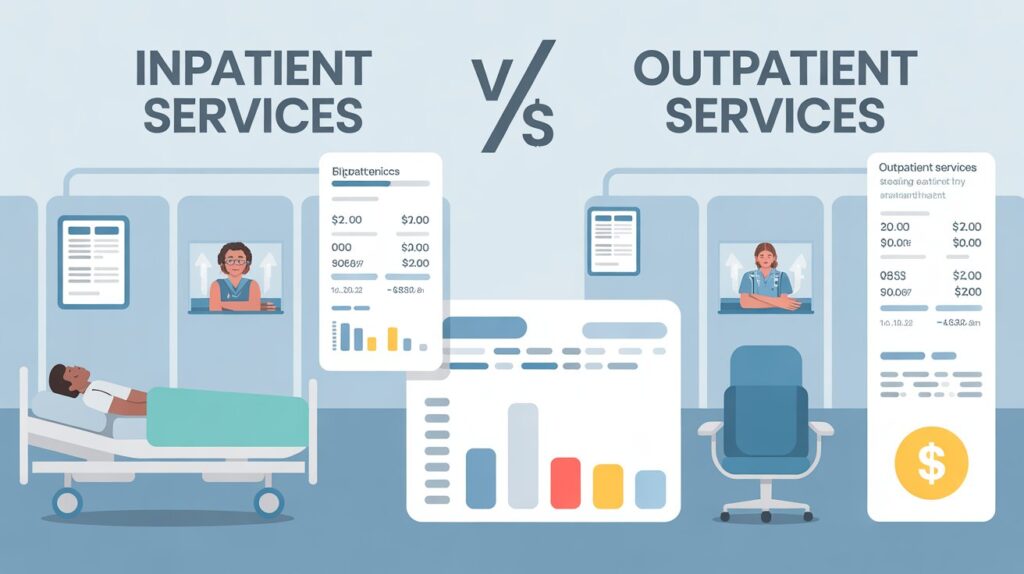
When someone goes to a hospital, they receive either inpatient care or outpatient care. Inpatient means the patient is admitted to the hospital and stays at least one night. Outpatient means the patient receives treatment and goes home the same day without being admitted. This simple difference, staying overnight or not, changes everything about how the hospital bills for the services.
Hospitals need to bill correctly for inpatient and outpatient services because insurance companies pay different amounts and use different rules for each type. Getting it wrong leads to denied claims, delayed payments, and lost money. For patients, the difference affects how much they pay out of pocket. Their insurance deductibles, copayments, and coverage limits work differently for inpatient versus outpatient care.
This guide explains all the important differences between hospital billing for inpatient and outpatient services. It covers how each type works, what codes are used, how much things cost, what insurance pays, and what can go wrong. Whether you work in hospital billing, manage revenue cycle operations, or want to understand healthcare billing better, this information helps you handle both types of services correctly.
What Inpatient Services Mean
Inpatient services happen when a doctor formally admits a patient to the hospital. The patient has a bed assigned to them in the hospital. They stay at least one night, though many inpatients stay several days or even weeks. During their stay, they receive medical care, meals, medications, and monitoring by hospital staff.
A patient becomes an inpatient through a formal admission order. A doctor must write an order that says “admit patient to hospital.” This order makes it official. Without this admission order, the patient is not an inpatient even if they stay overnight. The admission can happen in different ways. Emergency admission occurs when a patient comes to the emergency room with a serious problem and the emergency doctor decides they need hospital admission. Scheduled admission happens when a patient needs surgery or a procedure that requires staying in the hospital, and the doctor schedules the admission in advance.
Sometimes patients start in observation status and after watching them for hours, the doctor decides they need full admission and changes the status from observation to inpatient.
Once admitted, inpatients receive comprehensive care. They have a bed in a regular hospital room or special unit like intensive care. The hospital provides all meals while they are admitted. Nurses check on them regularly, give medications, monitor vital signs, and help with daily needs. Doctors visit daily to examine them, adjust treatments, and plan care. Lab work, x-rays, scans, and other tests happen as needed. All medications are provided by the hospital pharmacy and administered by nurses. Everything needed for care including IV supplies, bandages, and medical equipment is provided by the hospital.
Inpatient stays vary in length. Short stays of one to two nights might involve simple surgeries, uncomplicated childbirth, or brief illness monitoring. Moderate stays of three to seven nights could include more serious surgeries, bad infections, or heart problems that need close watching. Long stays of one to four weeks might happen for major surgeries with complications, serious illnesses, or rehabilitation after stroke or major injury. Extended stays lasting months occur for very serious conditions, patients who need breathing machines, or severe injuries that need long recovery. The length of stay affects the total bill significantly because longer stays mean higher costs.
Inpatient care ends when the doctor writes discharge orders. The patient is medically stable enough to leave the hospital. They go home or transfer to another facility like a nursing home or rehabilitation center. The discharge order officially ends the inpatient status. Everything from admission to discharge is billed together as one inpatient stay.
What Outpatient Services Mean
Outpatient services are medical care provided without admitting the patient to the hospital. The patient comes to the hospital, receives treatment, and goes home the same day. No overnight stay happens. The defining feature of outpatient care is same-day treatment. The patient arrives and leaves on the same calendar day, even if they spend many hours at the hospital.
Hospitals provide many different outpatient services. Outpatient surgery includes procedures that do not require overnight stay like cataract removal, hernia repair, colonoscopy, or minor skin procedures. The patient arrives, has surgery, recovers for a few hours, and goes home. Emergency room visits are mostly outpatient. The patient comes in with an emergency, gets treated, and is released to go home. Only if the emergency doctor admits them do they become inpatient. Diagnostic tests include x-rays, CT scans, MRI scans, ultrasounds, and other imaging as well as lab work and blood tests done in the hospital’s outpatient departments.
Infusion therapy means patients come for IV medications like chemotherapy, antibiotics, or specialty drugs. The infusion takes hours but the patient goes home afterward. Hospital-based specialty clinics provide consultations or follow-up care where patients see doctors. Therapy services like physical therapy, occupational therapy, or speech therapy happen in hospital outpatient departments. Regular kidney dialysis treatments happen three times per week but do not require staying overnight.
Observation services cause a lot of confusion. The hospital keeps the patient for extended observation, usually less than 24 hours but sometimes up to 48 hours, to monitor their condition. If they improve, they go home. If not, they might be admitted as inpatient. Despite staying in hospital beds, receiving nursing care, and being monitored for hours or even days, observation is considered outpatient, not inpatient.
This matters a lot for billing and insurance coverage. Many patients think they are admitted when they are actually in observation status. The difference is the admission order. Without formal admission orders, patients remain outpatient even if they stay in a bed overnight.
Outpatient services can be scheduled or unscheduled. Scheduled outpatient care means the patient makes an appointment in advance and knows when to arrive and what service they will receive.
Examples include scheduled surgery, imaging appointments, and therapy sessions. Unscheduled outpatient care means the patient comes without an appointment, usually for urgent issues. Examples include emergency room visits and urgent care visits. Both are still outpatient as long as no admission happens.
How Inpatient Billing Works
Inpatient billing uses a completely different system than outpatient billing. Most inpatient hospital care gets paid through the DRG system. DRG stands for Diagnosis Related Group. This is a payment method used by Medicare and many other insurance companies. The process starts when the patient is admitted and treated, receiving all necessary care during their hospital stay. When the patient leaves, hospital coders review all the medical records and assign codes for the principal diagnosis which is the main reason for admission, secondary diagnoses which are other medical problems, procedures performed, and any complications or comorbidities that affected care.
These codes go into a computer system that assigns a DRG number. There are over 700 different DRGs, and each one represents a group of similar patients with similar conditions. Once the DRG is assigned, payment gets calculated. Each DRG has a set payment amount. Medicare publishes a fee for each DRG that varies by geographic location. The hospital receives this set amount regardless of exactly what they did during the stay. This is called a prospective payment because the amount is determined in advance based on the DRG, not on actual services provided.
For example, a patient admitted for pneumonia who stays four days and receives antibiotics, oxygen, monitoring, meals, and nursing care might cost the hospital $8,000 in actual expenses. But if the DRG payment from Medicare is $7,500, the hospital gets $7,500 total. The hospital receives the DRG payment amount whether the patient stayed three days or six days, whether costs were $6,000 or $10,000.
| DRG Example | Description | Typical Payment |
| 470 | Major joint replacement without complications | $15,000 |
| 885 | Psychoses | $6,200 |
| 190 | COPD with major complications | $7,800 |
| 291 | Heart failure and shock with complications | $8,500 |
| 469 | Major joint replacement with complications | $18,000 |
| 003 | Head and neck procedures | $12,300 |
| 247 | Digestive disorders with complications | $9,100 |
Inpatient hospital claims are submitted on a form called UB-04, also called CMS-1450. This is different from the CMS-1500 form used for doctor services. The UB-04 form includes patient demographic information, admission and discharge dates, room charges, all services provided in summarized form, ICD diagnosis codes, ICD procedure codes, DRG assignment, total charges, and expected payment amount. One UB-04 claim is submitted for the entire hospital stay, not separate bills for each day or each service.
The UB-04 uses revenue codes to categorize different types of hospital services. Revenue codes are four-digit numbers that describe what kind of service was provided. Room and board revenue codes 0110 through 0179 cover daily room charges, bed, and meals. Intensive care unit codes 0200 through 0219 cover ICU room charges. Pharmacy codes 0250 through 0269 cover all medications. Laboratory codes 0300 through 0319 cover lab tests and blood work. Radiology diagnostic codes 0320 through 0329 cover x-rays, CT scans, and MRI. Operating room codes 0360 through 0369 cover surgery room charges.
Emergency room codes 0450 through 0459 cover ER services if the patient came through the ER. These revenue codes help organize the charges, but under DRG payment, the actual charges do not matter much because the DRG payment is the same regardless.
Inpatient payment is bundled. This means one payment covers everything including room charges, nursing care, medications, tests and procedures, supplies, equipment, meals, and doctor visits for hospital-employed doctors. There is no separate bill for each item. Everything gets bundled into the single DRG payment. This is very different from outpatient billing where each service is billed separately.
Some insurance companies do not use DRGs. Instead, they pay a per diem rate. Per diem means per day. With per diem payment, insurance pays a fixed amount for each day the patient stays. If the rate is
$2,000 per day, a five-day stay generates $10,000 payment while a three-day stay generates $6,000 payment. Per diem is simpler than DRGs but less common. Medicare uses DRGs, not per diem, for most inpatient stays. Another alternative is case rate payments where the insurance company and hospital agree on a fixed payment for specific procedures. The hospital gets the agreed amount regardless of length of stay or complications unless severe complications occur, then additional payments might apply.
How Outpatient Billing Works
Outpatient billing operates on a fee-for-service model. Each service provided gets billed separately. This creates much more detailed bills with many individual charges. Medicare pays for outpatient hospital services using APCs. APC stands for Ambulatory Payment Classification. This is similar to DRGs but for outpatient care.
The process begins when services are provided. The patient receives outpatient treatment which might include surgery, tests, medications, and supplies. Each service gets coded with CPT codes for procedures, HCPCS codes for supplies and drugs, and ICD diagnosis codes explaining why the service was needed. Each CPT or HCPCS code maps to an APC. There are hundreds of different APCs.
Services are grouped into APCs based on clinical similarity and cost. Each APC has a set payment amount. Medicare pays the APC rate for each service provided.
For instance, a patient having outpatient surgery might receive payment for the surgical procedure under APC 5112 worth $1,200, anesthesia under APC 5023 worth $300, recovery room under APC 5011 worth
$150, and medications under APC 5691 worth $100, totaling $1,750 in payments. Unlike inpatient DRGs where one payment covers everything, outpatient APCs pay separately for each service.
Outpatient hospital services also use the UB-04 claim form, just like inpatient claims. But the form is filled out differently. Inpatient UB-04 forms have admission and discharge dates, show total charges for entire stay, list one DRG, and provide one payment for everything. Outpatient UB-04 forms show service date instead of admission and discharge dates, itemize each service separately, list multiple CPT and HCPCS codes, and each service gets its own payment. The same form is used but the data looks very different.
Outpatient billing uses CPT and HCPCS codes instead of just diagnosis codes. CPT codes are five-digit codes describing procedures and services. Emergency department visits use codes 99281 through 99285 for different levels. CT scans of head use codes 70450 through 70470. Routine blood draw uses code 36415. Electrocardiogram uses code 93000. HCPCS codes are alphanumeric codes for supplies, drugs, and equipment. Injection of ketorolac pain medication uses code J1885. Surgical tray uses code A4550. Home blood glucose monitor uses code E0607. Every single thing provided gets its own code and charge.
| Service Type | CPT/HCPCS Code | Typical Charge | APC Payment |
| Level 1 ER Visit | 99281 | $500 | $150 |
| Level 3 ER Visit | 99283 | $1,200 | $550 |
| Level 5 ER Visit | 99285 | $3,000 | $1,800 |
| CT Head without contrast | 70450 | $2,500 | $800 |
| Basic metabolic panel | 80048 | $200 | $45 |
| Chest x-ray | 71046 | $400 | $85 |
| Knee x-ray | 73560 | $350 | $75 |
Outpatient bills are very detailed with many line items. An example outpatient surgery bill might show registration and intake for $150, pre-op nursing assessment for $200, operating room use for two hours at $3,500, anesthesia for $1,200, surgical supplies for $800, medications administered for $300, recovery room for three hours at $600, post-op nursing care for $250, and take-home medications for $75, totaling $7,075 in charges. Each line is a separate charge with its own code. This is completely different from inpatient bundled billing.
Observation services are billed as outpatient even though patients might stay overnight. Observation has its own codes. Code G0378 covers hospital observation services per hour for the first eight hours. Code G0379 covers observation each additional hour beyond eight hours. These codes are billed by the hour. If a patient is in observation for 20 hours, the hospital bills for those 20 hours. This is different from regular outpatient services which are billed per service, and different from inpatient which is billed per stay.
Emergency room visits are outpatient services with specific codes based on how sick the patient is and how much work gets done. Level 1 using code 99281 represents minor problems with minimal resources and typically pays $150 to $250. Level 2 using code 99282 represents low difficulty cases and typically pays $300 to $450. Level 3 using code 99283 represents moderate difficulty and typically pays $500 to
$750. Level 4 using code 99284 represents high difficulty and typically pays $900 to $1,400. Level 5 using code 99285 represents highest difficulty with life-threatening conditions and typically pays $1,500 to
$2,500. The level depends on how sick the patient is and how much work the ER staff does. Sicker patients with more tests and treatments get billed at higher levels. Then all the additional services like x-rays, lab tests, medications, and supplies are billed separately on top of the ER visit code.
Major Billing Differences Between Inpatient and Outpatient
Understanding the key differences helps hospitals bill correctly and helps patients understand their bills. The payment method differs completely between the two types. Inpatient uses bundled payment through DRGs where one payment covers the entire stay and the amount is determined by diagnosis and procedures, not based on actual charges. Outpatient uses fee-for-service payment where each service is billed separately, payment is based on APCs or negotiated rates, and actual services provided determine payment.
The claim form structure differs significantly. Inpatient submits one UB-04 claim per admission showing admission and discharge dates, listing the DRG, and summarizing all services. Outpatient submits one UB-04 per visit or service date showing the service date, listing all individual CPT and HCPCS codes, and detailing every service separately.
Coding requirements are structured differently. Inpatient coding requires ICD diagnosis codes for principal and secondary diagnoses, ICD procedure codes, DRG assignment, and revenue codes for organization rather than payment. Outpatient coding requires ICD diagnosis codes to justify services, CPT codes describing what was done, HCPCS codes for drugs and supplies, modifiers to provide additional information, and APC assignment by Medicare.
What gets billed is organized differently. Inpatient billing includes room and board charges, all medications, all tests and procedures, nursing care, supplies and equipment, and meals, all bundled together. Outpatient billing itemizes each specific service, each medication dose, each test individually, each supply item, room and facility fees, with professional fees sometimes separate.
Physician billing works similarly for both but the hospital portion differs. For inpatient care, the hospital bills for facility services including room, nursing, and supplies while doctors bill separately for their professional services, creating two different bills – one from hospital and one from doctors. For outpatient care, the hospital also bills for facility services while doctors bill separately for professional services, again creating two bills, but the outpatient facility bill is itemized rather than bundled.
Documentation requirements differ substantially. Inpatient documentation requires admission orders, daily progress notes, discharge summary, detailed documentation of all diagnoses and procedures, medical necessity for admission, and appropriate length of stay justification. Outpatient documentation requires service-specific documentation, medical necessity for each service, no admission orders, less detailed documentation than inpatient, and focus on services provided rather than overall stay.
| Billing Aspect | Inpatient | Outpatient |
| Payment Structure | Bundled DRG payment | Individual service payments |
| Number of Charges | One payment for entire stay | Multiple line items per visit |
| Coding System | ICD-10-CM + ICD-10-PCS | CPT/HCPCS + ICD-10-CM |
| Claim Timing | After discharge when complete | Within 24-48 hours of service |
| Status Required | Formal admission order | No admission needed |
| Minimum Stay | At least overnight | Same day only |
| Payment Trigger | Diagnosis and procedures | Each service provided |
Insurance Coverage Differences
How insurance covers inpatient versus outpatient services differs significantly, affecting what patients pay out of pocket. Medicare divides coverage between Part A and Part B. Medicare Part A, called Hospital Insurance, covers inpatient hospital stays including room and board, nursing care, meals, medications during stay, tests and procedures during stay, and supplies and equipment used. Most people do not pay premiums for Part A if they or their spouse paid Medicare taxes while working.
Medicare Part B, called Medical Insurance, covers outpatient hospital services including emergency room visits, observation services, outpatient surgery, diagnostic tests, clinic visits, and most doctor services.
Part B requires monthly premiums, with the standard amount being $174.70 in 2024, though this varies by income. This means the same patient pays for coverage differently depending on whether services are inpatient or outpatient.
Deductibles and copayments work differently for each type. For inpatient care under Medicare Part A, the deductible is $1,632 per benefit period in 2024. Days one through 60 have no copayment after the deductible. Days 61 through 90 have a $408 per day copayment. Days 91 and beyond have a $816 per day copayment when using lifetime reserve days. A benefit period starts when you enter the hospital and ends when you have been out for 60 consecutive days.
For outpatient care under Medicare Part B, the annual deductible is $240 in 2024, then patients pay 20 percent coinsurance on most services. Some services have copayments instead of coinsurance. As an example, an inpatient stay for five days would cost the patient $1,632 in deductible with no additional copayments, totaling $1,632 out of pocket. An outpatient surgery costing $5,000 would require the patient to pay the $240 deductible if not yet met, plus 20 percent coinsurance which equals $1,000, totaling $1,240 out of pocket. Different amounts result for different types of care.
Private insurance companies also treat inpatient and outpatient differently. Inpatient coverage often requires pre-authorization, may have a per-admission deductible, might have a flat copayment amount per admission ranging from $500 to $1,000, or percentage coinsurance ranging from 10 to 30 percent, with out-of-pocket maximums applying. Outpatient coverage may or may not require authorization depending on service, usually has a copayment per visit ranging from $100 to $500 for surgery, or percentage coinsurance ranging from 20 to 40 percent, with emergency room visits often having a separate copay of $200 to $500, and out-of-pocket maximums applying. The exact amounts vary by insurance plan, but almost all plans have different cost-sharing for inpatient versus outpatient care.
The biggest insurance coverage problem is observation status. Patients in observation are technically outpatient even though they stay in hospital beds overnight. Patient expectations often are “I stayed overnight in a hospital bed so I must be admitted as an inpatient.” The reality is “You are in observation status, which is outpatient, and you are not admitted.” The insurance impact means Medicare Part B covers observation instead of Part A. The patient pays Part B deductible and 20 percent coinsurance.
This can be more expensive than an inpatient stay. If the patient transfers to skilled nursing after observation, Medicare might not cover it because Medicare only covers skilled nursing after a three-day inpatient admission. Many patients do not understand observation status until they get their bills, causing complaints and confusion.
Pre-authorization requirements differ between inpatient and outpatient care. Most insurance requires pre-authorization for planned inpatient admissions. Emergency admissions must be reported within 24 to 48 hours. Without authorization, insurance might deny the claim or pay reduced amounts. For outpatient services, some require authorization such as expensive imaging, surgeries, and certain medications, while others do not such as emergency room visits, basic x-rays, and simple lab tests. Hospitals must know which services need authorization and obtain it before providing care.
Coding Differences Between Inpatient and Outpatient
Medical coding works differently for inpatient versus outpatient services. Coders need different training and skills for each type. Both inpatient and outpatient use ICD-10-CM diagnosis codes, but they use them differently. Inpatient diagnosis coding must identify the principal diagnosis which is the main reason for admission. Coders must code all secondary diagnoses meaning other conditions treated or affecting care. They must use present on admission indicators. More detailed coding is required. Coders must review the entire hospital stay.
Outpatient diagnosis coding requires coding to the highest level of certainty. Coders code presenting symptoms if diagnosis is uncertain. They only code diagnoses relevant to that specific visit. No POA indicators are required. The process can be more straightforward than inpatient coding. As an example, an inpatient pneumonia admission would be coded with principal diagnosis J18.9 for pneumonia, secondary diagnosis I10 for hypertension, secondary diagnosis E11.9 for diabetes type 2, and secondary diagnosis Z87.891 for history of tobacco use. All conditions addressed during the stay get coded. An outpatient emergency room visit with chest pain would be coded with diagnosis R07.9 for chest pain unspecified. Only the symptoms get coded since diagnosis was not confirmed.
Procedure coding differs completely between the two types. Inpatient procedure coding uses ICD-10-PCS procedure codes. These are seven-character codes that are very specific and detailed. They describe exact procedures performed. An example would be code 0DBJ8ZZ representing surgical removal of appendix via natural opening endoscopic. Outpatient procedure coding uses CPT and HCPCS codes.
CPT codes are five-digit numeric codes. HCPCS codes are alphanumeric codes. These are more familiar to most coders. An example would be code 44970 representing laparoscopic appendectomy. These are completely different code sets. Inpatient coders must learn ICD-10-PCS while outpatient coders must learn CPT and HCPCS.
Inpatient coding requires POA indicators, which are one-character codes that tell whether each diagnosis was present when the patient was admitted or developed during the hospital stay. The POA indicators include Y meaning yes the diagnosis was present at admission, N meaning no it was not present at admission, U meaning unknown with no documentation, W meaning clinically undetermined, and Exempt meaning not required for this diagnosis. POA matters because Medicare does not pay extra for certain complications that hospitals cause. If a patient develops a hospital-acquired infection, Medicare will not pay additional money for treating it. POA indicators show which conditions the patient arrived with versus which developed in the hospital. Outpatient coding does not use POA indicators at all.
Outpatient coding uses modifiers more often. Modifiers are two-digit codes added to CPT and HCPCS codes to provide additional information. Common outpatient modifiers include 25 for significant separately identifiable evaluation on same day as procedure, 59 for distinct procedural service, LT for left side, RT for right side, 76 for repeat procedure by same physician, and 77 for repeat procedure by different physician. Inpatient coding uses modifiers less frequently because most services are bundled into the DRG payment.
Documentation requirements for coding differ between the types. Inpatient coders need complete documentation including history and physical exam, daily progress notes, consultation reports, operative reports, discharge summary, and all test results. Inpatient coders cannot finalize coding until after discharge when all documentation is complete. Outpatient coders need service-specific documentation including procedure notes, test results, provider orders, and nursing notes for the visit. Outpatient coding can happen immediately after the service is provided.
| Coding Element | Inpatient Coding | Outpatient Coding |
| Diagnosis Codes | ICD-10-CM (all conditions) | ICD-10-CM (focused on visit) |
| Procedure Codes | ICD-10-PCS (7 characters) | CPT/HCPCS (5 digits) |
| POA Indicators | Required for all diagnoses | Not used |
| Modifiers | Rarely needed | Frequently required |
| When Coded | After discharge | Same day as service |
| Principal Diagnosis | Must identify main reason | Not always applicable |
| Coding Detail | Very detailed and complete | Service-specific and targeted |
Common Billing Errors for Inpatient vs Outpatient
Different types of errors happen with inpatient versus outpatient billing. Understanding these helps prevent them. The most expensive inpatient billing error is wrong DRG assignment. This happens when the principal diagnosis is coded incorrectly, important secondary diagnoses are missed, procedures are not coded, or complications are not documented or coded. Wrong DRG means wrong payment, sometimes a difference of thousands of dollars. As an example, correct DRG 470 for joint replacement without complications pays $15,000 while wrong DRG 469 for joint replacement with complications pays $18,000. If the hospital codes complications that did not exist, this is fraud. If the hospital misses real complications, they lose $3,000.
POA indicator errors affect payment. Using wrong POA indicators causes problems. Marking a hospital-acquired condition as present on admission by using Y instead of N might get higher payment but is fraudulent. Marking a condition as not present when it actually was by using N instead of Y might reduce payment inappropriately. Missing secondary diagnoses is another inpatient error. Not coding all relevant diagnoses can lower the DRG payment. If a patient has diabetes, heart disease, and kidney disease along with their principal diagnosis, all should be coded because they might affect the DRG assignment.
Incorrect admission dates cause problems. Using wrong admission or discharge dates affects length of stay calculations and potentially DRG assignment. Upcoding means intentionally coding more severe diagnoses or procedures than what actually occurred to get higher DRG payments. This is fraud and illegal. Downcoding means using less specific codes than warranted, resulting in lower payment than deserved. This costs hospitals money.
Outpatient billing errors include unbundling, which means billing separately for services that should be bundled together. Medicare and other payers have extensive bundling rules. Breaking apart services that should be combined is considered fraud. As an example, the correct approach is to bill one code for complete blood count. The wrong approach, which is unbundling, is to bill separately for red blood cells, white blood cells, and platelets.
Upcoding emergency visits is another outpatient error. Using higher-level ER codes than warranted happens when a patient has a minor issue that should be level 2 using code 99282, but the hospital bills level 4 using code 99284, getting higher payment but being inappropriate. Missing modifiers causes denials. Forgetting required modifiers creates problems. Bilateral procedures need modifier 50 or RT and LT. Multiple procedures the same day might need modifier 59. Without correct modifiers, claims deny.
Wrong place of service creates errors. Using hospital outpatient codes for services actually provided in other locations like clinic or doctor office is wrong. Place of service must match where care actually happened. Observation miscoding means using wrong codes for observation services or billing observation as inpatient. This causes major payment problems. Not meeting medical necessity happens when billing for tests or services that are not medically justified by the diagnosis codes. Insurance denies these for lack of medical necessity.
| Common Error | Inpatient Impact | Outpatient Impact |
| Wrong codes | Wrong DRG equals wrong payment | Each service paid or denied individually |
| Unbundling | Rare since services already bundled | Common error causing denials |
| Missing diagnoses | Might lower DRG payment | Might deny service for lack of necessity |
| Wrong dates | Affects length of stay and DRG | Less impact, affects claim processing |
| Upcoding | Higher DRG equals higher payment but is fraud | Higher level codes equal higher payment but is fraud |
| Poor documentation | Cannot assign accurate DRG | Cannot code specific services |
| Missing modifiers | Rarely affects payment | Frequently causes denials |
How Billing Companies Handle Inpatient vs Outpatient
Outsourced medical billing companies that work with hospitals must handle both inpatient and outpatient billing. Their processes differ for each type. Professional billing companies usually have separate teams. The inpatient billing team includes certified inpatient coders with ICD-10-PCS knowledge, DRG specialists who understand payment rules, staff experienced with UB-04 inpatient claims, knowledge of admission criteria and medical necessity, and understanding of length of stay requirements. The outpatient billing team includes certified outpatient coders with CPT and HCPCS expertise, APC payment specialists, staff who know outpatient UB-04 formatting, understanding of service-specific documentation, and knowledge of modifier requirements. Some coders specialize in one type or the other. Others are trained in both but still work one type at a time.
Different software and systems support each type of billing. Inpatient systems include DRG grouper software that assigns DRGs based on codes, MS-DRG or AP-DRG systems depending on payer, tools for reviewing complete medical records, POA indicator tracking, and length of stay analysis tools. Outpatient systems include encoder software for CPT and HCPCS code lookup, APC grouper for Medicare outpatient, charge description masters with thousands of items, line-item billing capabilities, and modifier assignment tools. Billing companies invest in both types of software to handle each appropriately.
Workflow differs between inpatient and outpatient billing. The inpatient workflow begins when the patient is discharged and medical records are completed. Coders review the entire record and assign all diagnosis and procedure codes. The DRG grouper assigns the DRG. The claim is created with the DRG and submitted to insurance. Payment is received as a lump sum and posted to the patient account.
Claims usually get submitted three to seven days after discharge once all documentation is complete.
The outpatient workflow begins when service is provided. Charges are entered in real-time or same day. Coders review documentation and assign CPT and HCPCS codes with modifiers. Diagnosis codes are added to justify services. The claim is created with all line items and scrubbed for errors. The claim is submitted to insurance. Payment is received for each service and posted line by line to the patient account. Claims can be submitted within 24 to 48 hours of service.
Denial management differs between the types. Common inpatient denial reasons include DRG downgrades where insurance assigns a lower-paying DRG, medical necessity of admission being questioned, length of stay disputes, lack of documentation, and cases that should have been observation not inpatient. Appeals often require complete medical records, physician peer-to-peer calls, citations of medical literature, and documentation of medical necessity. High dollar amounts per denial make these worth intensive effort.
Common outpatient denial reasons include service not covered, bundling edits where services should be combined, missing or wrong modifiers, lack of medical necessity, prior authorization missing, and duplicate services. Appeals require service-specific documentation, explanation of medical necessity, correct coding references, and authorization documentation. Lower dollar amounts per service but higher volume of denials characterize outpatient billing.
Quality assurance programs run differently for each type. Inpatient QA involves reviewing samples of coded charts, verifying DRG accuracy, checking POA indicator accuracy, making sure principal diagnosis selection is correct, and verifying all procedures are coded. Outpatient QA involves reviewing charge capture completeness, verifying CPT and HCPCS code accuracy, checking modifier usage, making sure
charges match documentation, and verifying medical necessity. Each type has different accuracy targets and measures.
Billing companies provide different reports for each type. Inpatient reports show average DRG payment by diagnosis, case mix index measuring how sick patients are, length of stay analysis, denial rates by DRG, coding accuracy rates, and days in accounts receivable. Outpatient reports show payment by service type, top denied services, charge capture audit results, modifier usage accuracy, service volume by department, and days in accounts receivable. These metrics help hospitals understand their revenue cycle performance for each type of care.
Patient Financial Impact
The type of service affects what patients pay out of pocket significantly. Different cost structures apply depending on whether care is inpatient or outpatient. For a hip replacement done as inpatient surgery, total hospital charges might be $60,000 with Medicare DRG payment of $18,000. A patient with Medicare Part A would pay the deductible of $1,632 with no copay for days one through 60, totaling $1,632 in patient cost. The same hip replacement done as outpatient surgery if eligible would have total hospital charges of $25,000 with Medicare paying 80 percent of the allowed amount of $15,000, which equals $12,000. A patient with Medicare Part B would pay the deductible of $240 plus 20 percent coinsurance of $3,000, totaling $3,240 in patient cost. Same procedure, different cost to patient depending on inpatient versus outpatient status.
For chest pain evaluation, if admitted as inpatient for two days, a patient with commercial insurance having a plan with $500 per-admission copay would pay $500 total. If the same patient with the same insurance was kept in observation status for two days, the plan has 20 percent coinsurance for outpatient care. With hospital charges of $8,000, the patient pays 20 percent which equals $1,600. The patient thought they were admitted but were in observation, and the bill is triple what they expected.
For surgery with complications done as inpatient for five days, a Medicare patient pays the deductible of $1,632 with days one through 60 having no copay, totaling $1,632 in patient cost. The same type of surgery done outpatient with no complications for the same Medicare patient results in paying the deductible of $240, plus with surgery cost of $6,000 where Medicare allows $4,000, the patient pays 20 percent coinsurance of $800, totaling $1,040 in patient cost. Different amounts result depending on many factors.
Balance billing concerns exist for both types. For inpatient care, hospitals cannot balance bill Medicare patients beyond the allowed deductibles and copayments. For private insurance, contract terms determine if balance billing is allowed. For outpatient care, the same rules apply, but patients might face higher percentages of costs in outpatient settings for some services.
Financial counseling needs differ before each type of service. Before inpatient admission, hospitals should explain what Part A versus Part B covers, clarify expected out-of-pocket costs, discuss payment plans if needed, and explain how observation differs from admission. Before outpatient services, hospitals should provide cost estimates, explain coinsurance responsibilities, discuss prior authorization requirements, and explain how multiple services add up. Good communication prevents surprise bills and payment problems.
| Service Example | Inpatient Cost to Patient | Outpatient Cost to Patient |
| 3-day hospital stay | $1,632 deductible | $240 deductible + 20% of charges |
| Emergency care | Part A deductible if admitted | Part B deductible + 20% + ER copay |
| Surgery | Per-admission copay ($500) | Per-service copay ($200) + 20% |
| Observation 2 days | N/A – observation is outpatient | $240 deductible + 20% of all charges |
| Skilled nursing after | Covered if 3-day inpatient stay | Not covered after observation |
Observation Status: The Gray Area
Observation status creates the most confusion in hospital billing because it looks like inpatient care but is billed as outpatient. Observation is an outpatient service where the hospital monitors a patient’s condition to determine if they need admission. It typically lasts less than 24 hours but can extend to 48 hours.
Common observation scenarios include chest pain that might be a heart attack where doctors watch to see if symptoms worsen, head injury from a fall where staff monitor for signs of brain bleeding, asthma attack where providers observe response to treatment, dehydration where staff monitor while giving IV fluids, and abdominal pain of unclear cause where doctors watch to see if surgery becomes necessary.
Hospitals use observation instead of admission for several reasons. Medical uncertainty exists when the patient might get better quickly and go home, or might get worse and need admission, so observation lets doctors watch and decide. Insurance requirements create pressure because Medicare and other insurers have strict rules about when inpatient admission is appropriate. If the case does not meet admission criteria, observation is safer for the hospital to avoid denied claims. Avoiding denials is important because if a hospital admits a patient who insurance later determines did not need admission, the entire inpatient claim might be denied and the hospital loses all payment. Observation is safer because it will not be denied for inappropriate admission.
Patients in observation face multiple problems. They think they are admitted because the patient is in a hospital bed, has an IV, receives medications, nurses check on them, and doctors visit. It looks and feels like being admitted. Higher costs result because Medicare Part B covers observation with 20 percent patient coinsurance. This can be more expensive than the Part A inpatient deductible, especially for short stays. No skilled nursing coverage follows observation because Medicare only covers skilled nursing facility care after a three-day inpatient admission. Observation days do not count toward this requirement. Patients who need nursing home care after observation must pay privately. A prescription coverage gap exists because medications given during observation are billed under Part B while medications given during inpatient admission are included in the bundled payment. Patients in observation might pay more for drugs.
Medicare created the Two-Midnight Rule to clarify when admission is appropriate. The rule states that if a doctor expects a patient to need hospital care crossing two midnights, they should be admitted as inpatient. If expected to need less than two midnights, they should be in observation. For example, a patient arriving Monday afternoon where the doctor expects the patient to leave Tuesday morning should be in observation. If the doctor expects the patient to stay until Wednesday or later, they should be
admitted as inpatient. A patient arriving Thursday evening where the doctor expects them to leave Friday should be in observation. If the doctor expects them to stay through Saturday, they should be admitted as inpatient.
The two midnights do not have to be back-to-back. Surgery patients who arrive the day before surgery count the midnight before surgery and the midnight after surgery. Exceptions exist where certain procedures always justify inpatient admission even if less than two midnights, such as major surgeries and transplants. Some situations are never appropriate for inpatient even if longer than two midnights. Observation by definition is outpatient regardless of how long it lasts.
Observation must be billed with specific codes. Code G0378 represents hospital observation services per hour for the first eight hours. Code G0379 represents observation services each additional hour beyond eight hours. These are hourly charges. If a patient is in observation for 23 hours, the hospital bills for 23 hours. Observation cannot be billed using regular inpatient room codes or regular outpatient emergency or clinic codes. It has its own special codes.
Sometimes patients in observation get worse and need admission. The hospital changes the order from observation to inpatient admission. The billing impact means observation hours before admission are billed as outpatient observation. Time after the admission order is included in the inpatient DRG. The hospital cannot bill both observation and inpatient for the same time period. This creates two separate bills, one outpatient and one inpatient. The change must be documented with an admission order. Without the admission order, the entire stay remains outpatient observation.
Technology and Systems for Inpatient vs Outpatient Billing
Different technology supports each type of billing. Hospitals maintain a Charge Description Master, also called chargemaster, which is a huge database of every item and service the hospital provides with prices. The outpatient CDM contains tens of thousands of line items. Every medication with its dose, every supply item, every procedure, and every test each has a code, either CPT, HCPCS, or revenue code, and a price. Outpatient billing pulls from the CDM for every service provided.
The inpatient CDM is also detailed but used differently. Items still have codes and prices. Charges are tracked for internal cost accounting. But payment is DRG-based, not item-based. CDM charges help calculate hospital costs versus revenue. The CDM must be maintained accurately for both types of billing. Hospitals review and update their CDM regularly, often annually, to make sure prices are current and codes are correct.
Encoder software helps coders assign the right codes. Inpatient encoders help coders assign ICD-10-CM diagnosis codes and ICD-10-PCS procedure codes. Features include code lookup by term, coding guidelines built in, DRG grouper integration, POA indicator assignment, and documentation queries.
Outpatient encoders help coders assign CPT, HCPCS, and ICD-10-CM codes. Features include CPT code lookup, modifier assignment help, bundling edit checking, medical necessity checking, and APC grouper integration. Hospitals need both types of encoders to handle their complete billing operations.
Claim scrubbing software checks claims for errors before submission. Inpatient scrubbing validates DRG assignment logic, checks POA indicators are present, verifies principal diagnosis follows coding guidelines, confirms procedure codes match documentation, and checks for valid code combinations.
Outpatient scrubbing validates all CPT and HCPCS codes are current, checks modifier usage is correct, verifies no unbundling errors exist, confirms medical necessity, and validates quantity and units. Both types prevent costly errors before claims go to insurance companies.
Revenue cycle management systems track the entire billing process. Inpatient RCM functions include admission tracking, case management, coding workflow, DRG validation, claim generation, payment posting, denial management, and reporting on case mix index, DRG payments, and length of stay.
Outpatient RCM functions include charge capture, coding and coding edits, claim generation with line items, APC assignment, payment posting by line, denial management, and reporting on service volumes, APC payments, and charge capture rates. One system might handle both but with different modules and workflows for each type of care.
| Technology Component | Inpatient Use | Outpatient Use |
| Charge Description Master | Cost tracking, not payment basis | Direct pricing for each service |
| Encoder Software | ICD-10-PCS procedures | CPT/HCPCS procedures |
| Grouper Software | Assigns DRGs | Assigns APCs |
| Claim Scrubber | Validates DRG logic | Checks unbundling and modifiers |
| RCM System | Tracks admissions and discharges | Tracks individual services |
| Documentation Tools | Discharge summary focused | Service-note focused |
| Denial Management | High-dollar DRG appeals | High-volume service appeals |
Regulatory Requirements for Inpatient vs Outpatient
Different regulations govern inpatient versus outpatient billing. Hospitals must meet Medicare Conditions of Participation to receive Medicare payment. Requirements differ between inpatient and outpatient care. Inpatient CoPs require that a physician must be present for care, 24-hour nursing coverage is required, specific inpatient services must be available, medical staff bylaws govern admissions, and quality improvement programs for inpatient care must exist. Outpatient CoPs specify that physician supervision levels vary by service, nursing requirements are less strict, different safety and quality standards apply, and more flexibility exists in service delivery.
Medicare uses Recovery Audit Contractors to find improper payments. They audit both inpatient and outpatient claims but focus differently. Inpatient RAC audits commonly review whether admission was medically necessary, whether observation would have been appropriate instead, DRG accuracy, whether readmissions were appropriate, and discharge planning adequacy. Hospitals must defend admission decisions and DRG assignments.
Outpatient RAC audits commonly review medical necessity of specific services, proper use of modifiers, bundling compliance, duplicate service billing, and upcoding of service levels. Different documentation is requested for each type of audit. Understanding what auditors look for helps hospitals prepare proper documentation from the start.
Documentation requirements are specific for each type. Inpatient documentation must include admission orders signed by physician, history and physical within 24 hours of admission, daily progress notes, consultant reports if applicable, operative reports for surgeries, discharge summary, and medical necessity for admission clearly documented. Outpatient documentation must include orders for each service provided, medical necessity for each service, procedure notes for procedures, test results, and nursing documentation for medications and care provided. Both require thorough documentation but organized differently to match the type of care provided.
Future of Inpatient vs Outpatient Billing
Healthcare is changing in ways that affect inpatient and outpatient billing. Medical advances allow more procedures to be done outpatient. Improved surgical techniques, better anesthesia methods, advanced pain management, and better recovery protocols mean services that required inpatient admission 10 years ago are now done outpatient. This trend continues and affects the mix of services hospitals provide. More outpatient claims and fewer inpatient claims result. Higher difficulty outpatient services become common. Observation use is increasing. Inpatient stays are becoming shorter and patients are sicker.
Billing staff must adapt to this changing mix. Some payers are moving toward site-neutral payments where they pay the same amount for a service regardless of where it happens, whether hospital outpatient, ambulatory surgery center, or physician office. This reduces the payment advantage hospitals historically had for outpatient services. It affects hospital revenue and might change where services are provided. Hospitals may need to become more efficient to maintain profitability under site-neutral payment systems.
More services are moving to bundled payments beyond traditional inpatient DRGs. Bundled payments for joint replacements covering 90 days after surgery, bundled payments for heart procedures, and bundled payments spanning inpatient and after-hospital care are becoming more common. These bundles blur the lines between inpatient and outpatient billing. Hospitals must track costs and outcomes across the entire episode of care, not just the initial hospital encounter.
Future technology will improve billing processes. Artificial intelligence for automated coding, real-time claim scrubbing, predictive analytics for denial prevention, integrated documentation and coding systems, and automated prior authorization will make both inpatient and outpatient billing more automated and efficient. These technologies reduce manual work, improve accuracy, and speed up payment cycles.
Conclusion: Understanding Both Types of Billing
Inpatient and outpatient hospital billing are fundamentally different processes. Hospitals, billing companies, and patients all need to understand these differences to navigate the healthcare system successfully. For hospitals, success requires training separate staff for inpatient and outpatient coding, using appropriate systems for each type, understanding when admission is appropriate versus observation, documenting thoroughly to support both types of billing, monitoring metrics separately for inpatient and outpatient performance, and staying current on regulatory requirements for both.
For billing companies managing hospital revenue cycles, effectiveness requires developing expertise in both billing types, using specialized software for each, creating separate workflows optimized for each type, providing clear reporting that distinguishes results, training staff on the unique aspects of each type, and keeping up with changing regulations affecting both inpatient and outpatient services.
For patients navigating the healthcare system, understanding helps reduce confusion and unexpected bills. Patients should know that staying overnight does not automatically mean inpatient admission. They should ask their care team whether they are admitted or in observation. Understanding how insurance covers inpatient versus outpatient care helps patients plan financially. Knowing that financial responsibility differs based on status allows patients to ask appropriate questions. Requesting cost estimates before procedures helps avoid surprises. Questioning bills if status seems wrong protects patients from incorrect charges.
The key points to remember are that inpatient billing uses bundled DRG payments covering entire hospital stays. One payment covers everything from room and nursing to medications and tests. Patients must be formally admitted with admission orders. Medicare Part A covers inpatient stays. Coding uses ICD-10-PCS procedure codes. DRG assignment determines payment amount.
Outpatient billing uses fee-for-service with each service billed separately. Multiple line items create detailed bills. Patients are not admitted even if they stay in a hospital bed. Medicare Part B covers outpatient services. Coding uses CPT and HCPCS codes. APC assignment determines payment for each service.
Observation status is outpatient care that looks like inpatient care. This causes the most confusion and patient complaints. Hospitals use observation for medical uncertainty and to avoid inappropriate admission denials. Patients pay more and lose some benefits compared to inpatient admission.
Understanding observation status helps everyone set proper expectations. As healthcare continues changing with more outpatient care and different payment models, this knowledge becomes even more important for managing hospital revenue cycles successfully. Both inpatient and outpatient billing will continue to exist, though the balance between them shifts. Mastering both types of billing helps hospitals receive appropriate payment for the care they provide while patients understand what they owe and why.